
The oil price shock due to the Israel/USA Iran war led to my empirical research of the 1973 oil price shock which is widely considered t the first of many. My forte is to research extreme events and to find cause and then utilize findings to predict next similar event.
Investors were caught off guard by the 1973 shock. The Dow Jones Composite Index was higher on 11/1/73 than it was on 10/6/73, which is when the Israel Arab Yom Kippur war began. The war, which ended on 10/25/73, included OPEC placing an embargo for oil sold to the US on 10/19/73. The embargo was the catalyst that caused the price shock. By the time the embargo was lifted on 03/18/74, the Dow had declined by 13% from its Q4 of 1973 November high.
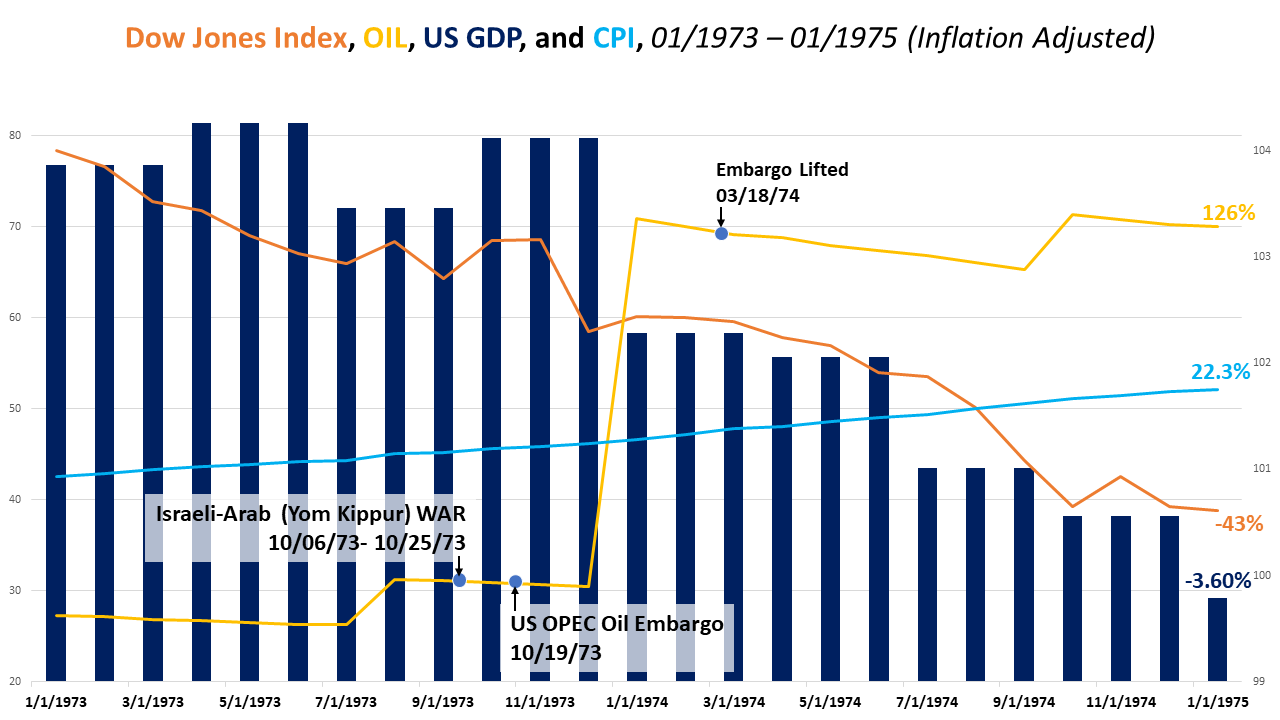
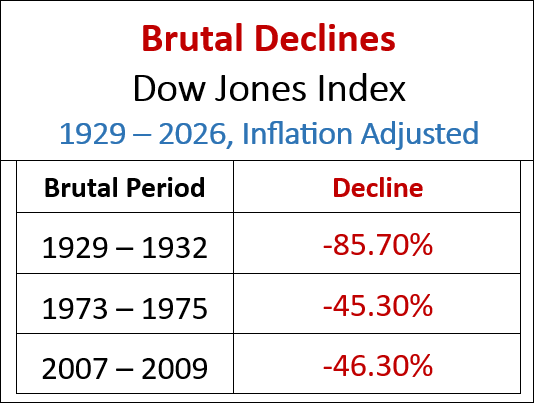
The Dow continued to decline and in January 1975, the venerable index had declined by 45.3% from its 1973 high. The decline was among the three most brutal declines for the Dow Jones Composite from 1929 to 2009.
Most investors did not see the risk and instead bought the dip because:
1. The war had a short duration
2. Embargo also had a short duration
3. Price for oil peaked in January 1974 and had begun a gradual and steady decline.
Based on the Dow reaching a new interim high after the OPEC embargo was initiated and the brutality of the index’s subsequent decline to its January 1975 multiyear bottom, the insidious nature of inflation had not been discounted. Approximately 15% of crude oil consumed on an annual basis is used to manufacture consumer staples and durables. The price declines at the pump was a false signal that had indicated that the coast was clear.
However, the increase in the price of oil by 126% from 1973 to 1974 was the signal that significant increases for the Consumer Price Index were inevitable. From October of 1973 to January of 1974 the increase for CPI was 2.2%. The nominal increase reinforced analysts and pundits to proclaim bullishness. What was not discounted was the fact the oil price shocks instantly impact gasoline and fertilizer. The impact on consumer products and on the price of the food that is nurtured by fertilizer is delayed.
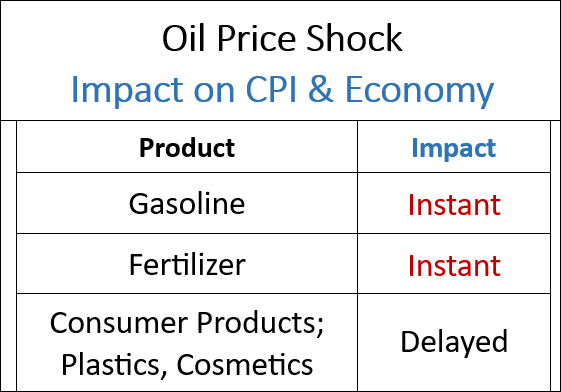
Oil price shocks create insidious inflation. A good example is the drug store. The store does not increase the price of the goods on the shelves which were produced from petroleum until the manufacturer of the products raises their wholesale prices. Thus, prices not increasing at the retail level in the early months after the 1973/74 oil price shock only reinforced that all was well for the consumer and the economy. From when the embargo was lifted to August of 1974, the CPI had increased by another 4.6%. From October of 1973, to August 1974, the increase was 8.8%. The price increases were too much and too fast for the consumer. A reduction in demand by consumers and profit margin destruction for manufacturers resulted in extreme volatility for the US economy.
The US economy’s GDP began a precipitous decline and into a recession that arguably ranks as the most severe since the US Great Depression. For 1974, US GDP declined for four consecutive quarters.
What exacerbated the 1974 Recession and Dow collapse was the price of oil remaining near its high. The result was that prices of consumer goods relatively remained high while the profit margins for the manufacturers remained lower.
My prediction is that 2026/2027 for the global stock markets and economy will be a carbon copy of 1973/1974. Both periods have, or will have, resulted in the price of a barrel of oil permanently plateauing at much higher prices as compared to the prices for when the shocks began.
- US and other countries created strategic oil and petroleum Reserve and storage initiatives in 1975. The policies were implemented to have plenty of supply that could be used to mitigate future oil price shocks.
- Iran/Israel/US 2026 war has resulted in significant damage to the oil producing capacity of the Middle East. It will take years and billions for the capacity to get back 2025 level.
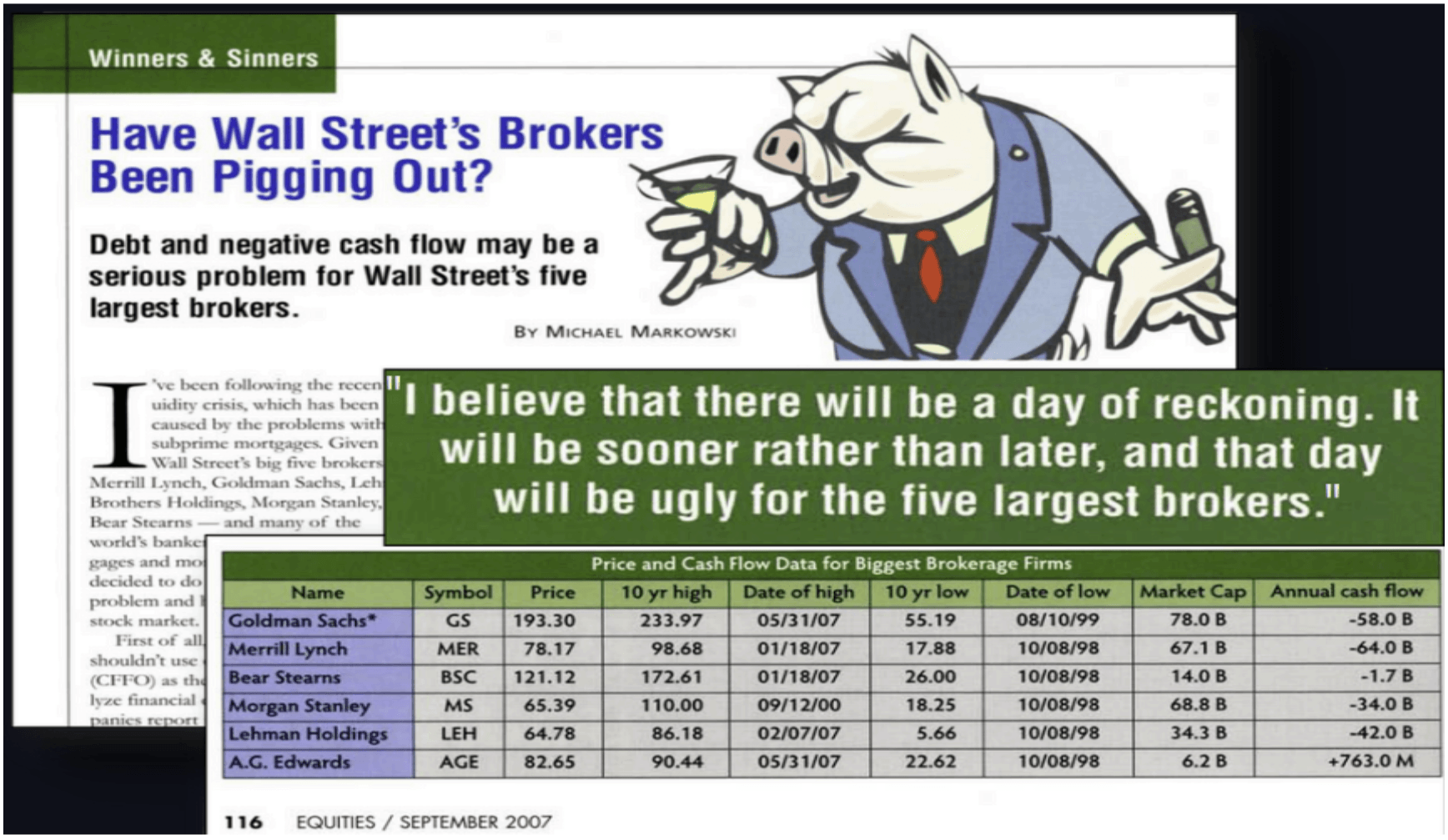
A severe global recession is inevitable and a third Great economic Depression is possible. The serious damage that has been inflicted on the world economy by the 2026 Middle East War will soon take its toll on the global stock markets. My level of conviction for the inevitability of a significant global economic contraction to occur is on par with my prediction for the five brokers including Lehman to collapse. The image below is from my September 2007 Equities Magazine article, that was widely available on newsstands.
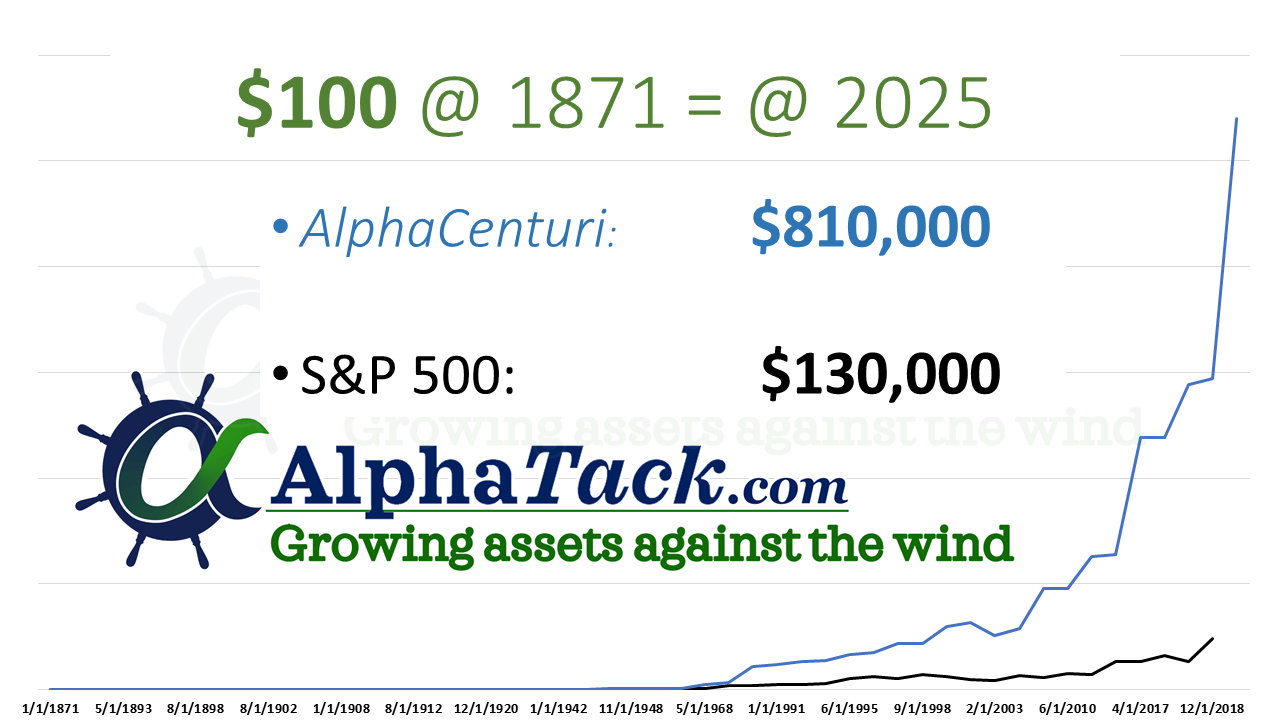
In addition to the significant risk for the markets my Alpha Centuri algorithm which was developed from by empirical research of the CPI’s impact on the S&P 500 since 1871. The algorithm is presently in cash. The chart below depicts the performance of $100 invested in Alpha Centuri versus the S&P 500 from 1871 to 2025.
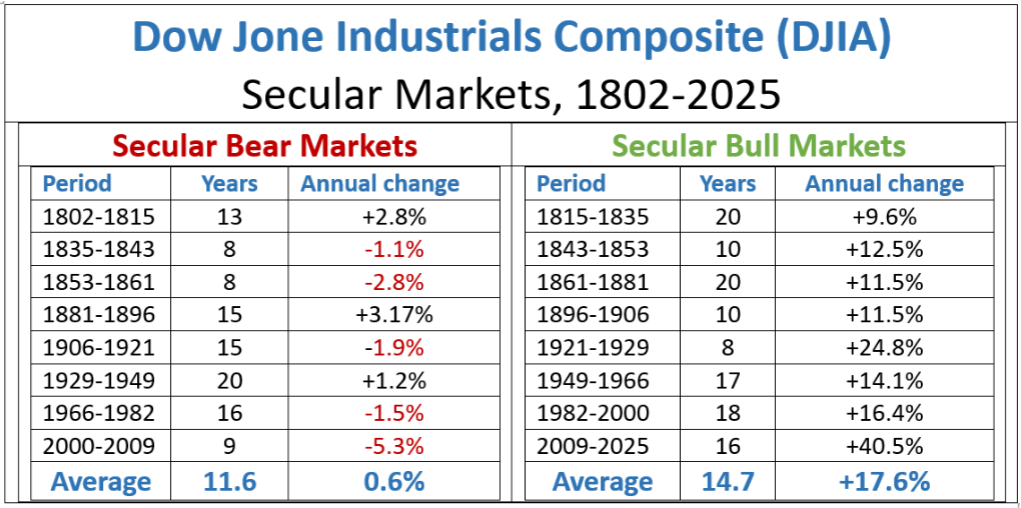
I am also predicting that a secular bear market has already or will soon begin. Based on prior secular bears since 1802, I am predicting that blue chips will produce a negative real return for the next eight to 20 years.
My recommendation is for all US and global investors to sell their blue chip stocks and to deploy a defensive growth strategy. The table below contains the asset classes for which the proceeds for the sales of blue chips be allocated:
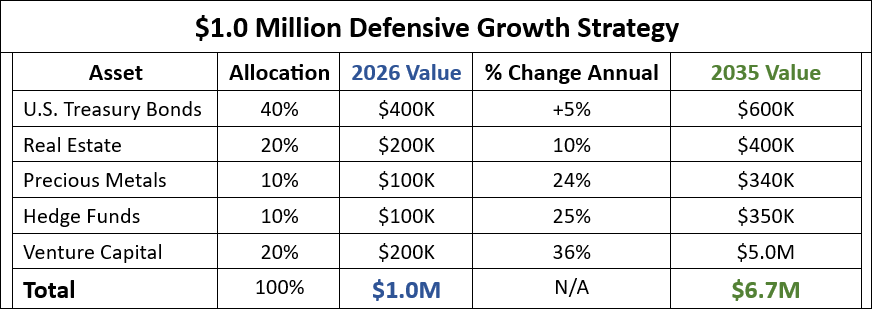
The video below covers my Liquid Hyper Growth Strategy (LHGS) that is highly recommended for the 20% venture capital allocation in the above table. Under the strategy which can be managed by affiliated funds an investor can capture 100% or more of their allocation back within a year. The investor, then has the discretion to either sell or let the balance ride for a possible additional gain that is equivalent to 10 or more times the original amount allocated to venture capital.
LHGS Introduction Video:


Michael Markowski, Director of Research for DynastyWealth.com and SaveChangeWorld.com. Developer of “Defensive Growth Strategy”. Entered markets with Merrill Lynch in 1977. Named “Top 50 Investor” by Fortune Magazine. Formerly, underwriter of venture stage IPOs, including one acquired by United Health Care for 1700% gain. Since 2002 has conducted empirical research to develop algorithms which predict the negative and positive extremes for the market and stocks. Has verifiable track records for predicting (1) bankruptcies of blue chips, (2) market crashes and (3) stocks multiplying by 10X. In a 2007 Equities Magazine article predicted the epic collapses for Lehman, Bear Stearns and Merrill Lynch. Most recent algorithm developed from research of UBER and AirBnB has enabled identification of startups having 100X upside potential within 7 to 10 years. Video (3 minutes, 53 seconds) covers Mr. Markowski's research to develop predictive algorithm methodology.