
Financial Technologies Holding Corporation (“Brixxer”) has emerged and is disrupting the $26 Trillion US real estate industry. Brixxer’s disruptive digital application or model will result in the extinction of many of the industry’s providers. Brixxer will also power a substantial increase in the liquidity for the entire global real estate asset class.
According to Statistia the value of global real estate will go from $624.62 trillion in 2026 to $725.05 trillion by 2031. The value of real estate assets in the world is at a multiple of the aggregate value for all global equities.
Brixxer is very rare. It by far has the most upside when compared to my other recommendations throughout my career in the financial markets which began with Merrill Lynch in 1977. There are two reasons for why:
- Brixxer is a digital disruptor with the same pedigree as UBER and Airbnb. Brixxer’s digital application or model is extremely disruptive to and transformative for real estate.
- The enactment of the U.S. “The 21st Century ROAD to Housing Act” (“Act”) in July 2026 created a moat for Brixxer. The Act effectively eliminated all of Brixxer’s US competitors.
The digital disruptor segment of the equities/venture capital asset class is absolutely the best for producing exponential gains for an investor within a relatively short period of time. The potential for Centuries old brick and mortar industries to be digitally disrupted only became possible because of the following:
- Internet became commercially available in 1986
- Apple launch of first smart phone in 2007
Those, who had the foresight to invest in the best known digital disruptors, UBER and AirBnb, were able to generate immense and dynasty wealth relatively quickly. The table below contains the value of a $100,000 series A round investment into both of the iconic disruptors. At end of 2025, the value of $100,000 ranged from $116 -$268 million. The multiples through the end of 2025 were more than 1,000 times investment.
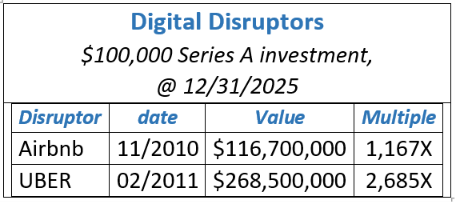
Brixxer’s Series A became available in August 2026. By 2035, the funding round is projected to deliver a higher multiple than UBER’s from 2011 to 2025.
My prediction is that “Brixxer” will eclipse both UBER and Airbnb to become the world’s most valuable digital disruptor. Brixxer enables billions to invest in and to trade real estate assets.
The commercial real estate industry has been ripe for disruption for several centuries. Due to the illiquidity for real estate, and the significant down payments and cash reserves needed to participate, the industry has been untouchable by the masses for investment. Real estate has for the most part outperformed stocks throughout the history of the planet. However, the allocations to real estate investments by institutional investors and pension funds have been paltry.
The enactment of the JOBS Act in 2012, changed the course of history for real estate. The new securities regulations that evolved from the JOBS Act provided the foundation to enable real estate to become as liquid as stocks and bonds. The development of the block chain only added momentum to enable real estate to compete with its paper asset competitors. The two landmark events for the capital markets enabled real assets to be:
- Tokenized
- Fractionalized
At last count there were 79 U.S. entities or platforms in the business of fractionalizing or tokenizing real estate. The existing business models for all of them, other than Brixxer, are almost identical. They acquire a property and split it into fractions. Shares or tokens, reflecting a potential investor’s percentage of ownership, are then marketed in denominations for less than $1,000. The shares or tokens held by the investors become liquid via SEC Regulations which were spawned from the JOBS Act or the Securities Act of 1933.
The competitors, en masse, have done a great job to create the demand for fractionalized or tokenized real estate (FRE) by both individual and institutional investors. YouTube and Social Media are littered with advertisements promoting FRE. The wannabe leaders to transform the real estate asset class include such notables as:
- “Arrived” backed by Amazon founder Jeff Bezos
- “Ember” backed by Facebook seed investor Peter Thiel.
The passage of the 21st Century ROAD to Housing Act (“Act”) tossed a grenade into all but one of the 79 real estate fractionalization startups. The sole survivor, which has a model that is NOT applicable to the Act, is Brixxer.
The new housing Act prohibits any business, entity or institution which holds, owns, or has control of 350 or more, single family homes from purchasing any additional existing properties. The Act effectively erected a gate which prevents institutions and corporations from growing their revenue streams and profits by making acquisitions of existing single family homes. The Act also prohibits mergers and acquisitions for entities that would result in the surviving entity having more than 350 homes.
Despite the Act, the “residential real estate fractionalization genie” is not going back into the bottle. The supply to fulfill the demand for FRE investing will be provided by sole survivor, Brixxer. The company was projected to be the leader of residential, including multi-family dwellings, prior to the Act becoming the law. Brixxer has an organic model, which is much more highly scalable and viral, when compared to the model of any existing FRE competitor.
Brixxer is able to circumvent the Act because of its extremely unique property acquisition model. Under the model Brixxer does not purchase a property. Brixxer instead, provides its proprietary mortgage elimination or reduction service to the existing owner or landlord of the residential rental property. Brixxer enables a property to be fractionalized via those investors who participate or contribute to reduce or eliminate the principal amount of the mortgage. The contribution enables the contributor to hold a pro rata portion of the property. Thus, the landlord, or the owner of a property that Brix fractionalizes remain as majority owner of the property. The end result is that a property that is fractionalized by Brixxer never has to be listed for sale via a real estate agent.
Brixxer provides the secondary market for those investors, whom acquire a minority stake, in each of the properties it fractionalizes. Additionally, Brixxer enters into an evergreen property management contract with each of the properties which it fractionalizes. Brixxer is a First Mover that is ideally positioned to become:
- largest manager of real assets in the US, if not the world
- The exclusive exchange, or the NASDAQ, for the secondary market trading of all fractionalized real estate securities
Residential is the key for Brixxer, or any other competitor, to have the foundation to dominate the fractionalization of all commercial real estate. It’s the prized sector, and the first for commercial real estate, to be targeted for fractionalization, because it’s the largest. The sector is also the easiest for John Q. Public to understand and to invest in. Residential, to the entire commercial real estate asset class, is akin to what books were to Amazon. The books first strategy enabled Amazon to become the online consumer products retailing juggernaut.
The new FRE segment for the commercial real estate asset class has been projected to become among the world’s largest investables by two leading market research firms:
- $3.0 Trillion by 2030, Boston Consulting Group
- $4.0 trillion by 2035, Deloitte
The projections by the two firms are realistic. According to Clarion Partners Global Research, as of June 30, 2025, the investable universe for commercial real estate in US was $26.2 trillion. Therefore, Deloitte’s 2035 fractionalization projection would account for only 15% of all investable commercial real estate. Housing’s portion equates to approximately $11 Trillion.
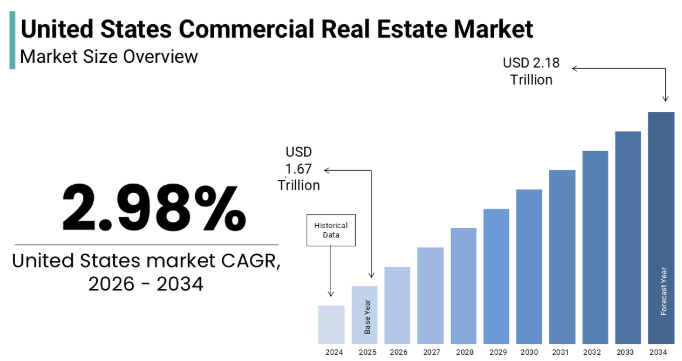
The chart below was produced by Market Data Forecast. It depicts that the US Commercial Real Estate market, consisting of sales and rentals, etc., will grow from $1.67 trillion in 2025 to $2.18 trillion by 2034, a compounded annual growth rate of 2.98%.
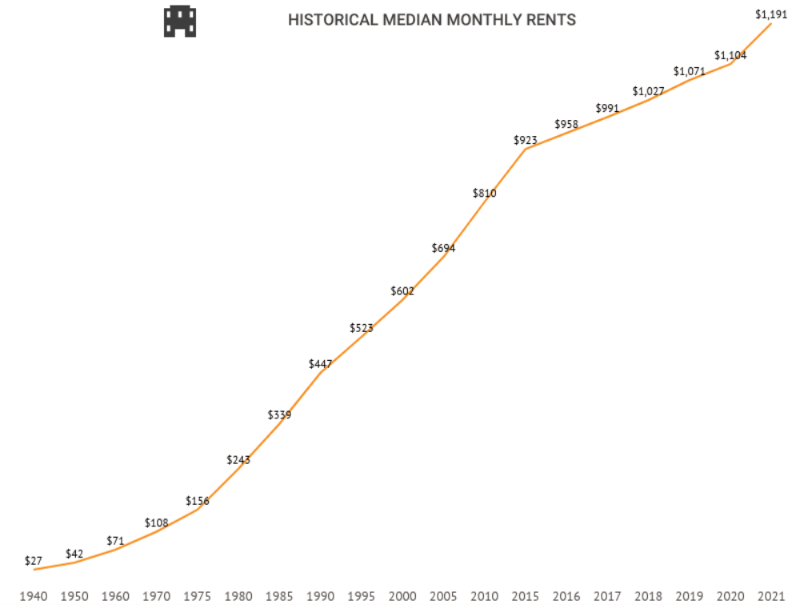
Residential real estate is an ideal sector for investment by both individual and institutional investors. From 1940 to 2026, the median monthly rental income for a single family house in the US increased to $2100 per month as compared to $27.00, a compounded 5.19% annual growth rate. The chart below is a great example. It depicts that rents have steadily increased, and even, during the major 1974, 2008 and 2020 recessions.
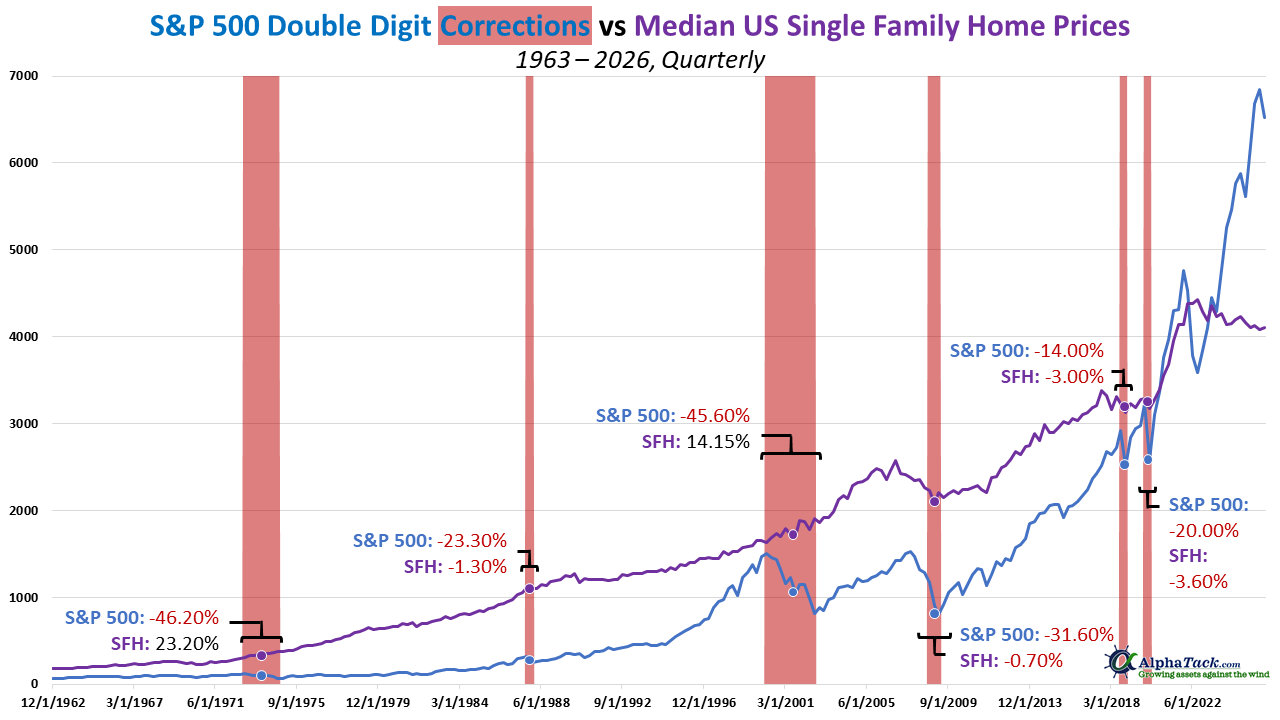
AlphaTack’s chart for the period of 1963 to 2026 below depicts the median performance for the prices of single family houses versus the S&P. Note that during the S&P’s double digit correction periods single family houses were safe havens.
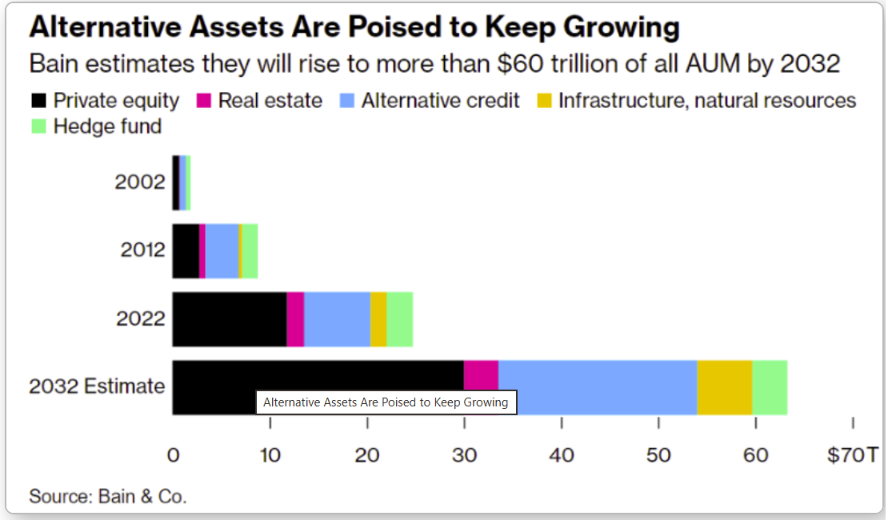
The majority of the trillions to be invested into fractional real estate will be from institutional investors. The demand by professional investors to invest into fractionalized real estate and other investment categories that are not correlated to the S&P 500, has begun and will continue to accelerate. The chart below is from Bain’s August 2024 report. Bain projects that private assets held or managed by institutional investors and wealth managers, which include real estate, will reach $65 Trillion by 2032. For perspective, the value of the S&P 500 as of July 30, 2026 was $67 Trillion.
The paragraph in italics below is an excerpt from the 10/01/2025 report “Fractional Ownership Platforms Compared: A Comprehensive Analysis for Institutional Investors” by REITX. The report, even though it preceded President Trump’s announcing his plan to eliminate the big buyers of single family homes, is highly recommended. It explains the role that fractionalization or tokenization has been, and will continue, playing for institutional investors, including pension funds. Institutional investors are desperate to increase their real estate allocations to real estate. The only way for a liquid market for real estate to be established is via fractionalization.
“For institutional investors, REITs, and property portfolio managers, navigating the expanding ecosystem of fractional ownership platforms requires detailed analysis of their structural differences, performance metrics, and strategic advantages. The tokenization of real estate assets—powered by blockchain technology and innovative financial structures—has created new paradigms for liquidity, transparency, and cross-border investment that were previously unattainable in traditional real estate markets.”
Source: Reitx
Brixxer has the potential to be the most disruptive disruptor ever. The commercial real estate industry is among the world’s oldest. Brixxer’s existing addressable market in the US alone is exponentially larger than UBER’s. The US ride share market is projected to reach $96 billion in 2030.
Banks and mortgages have been in existence since the 12th Century. Brixxer eliminates or reduces the following:
- Available new real estate loans to be made by banks, etc.
- Interest income and revenue generated by banks and other financial institutions from making and servicing real estate loans
- Revenue and profit margins for property managers
- Real estate agents
- Revenue for all ancillary real estate service providers:
– Law firms
– Appraisers
– Title companies
– Escrow agents
Brixxer enables millions of, if not a billion, investors throughout the world to acquire and to trade small portions of commercial real estate. Brixxer’s establishment of a ubiquitous marketplace will result in the percentage of assets that are allocated to commercial real estate by institutional investors, including pension funds, to increase substantially.
The company is well positioned to become the largest provider of fractionalized real asset investment opportunities in the world. Brixxer is the front runner to own and operate the world’s largest real estate exchange. An entirely new publishing industry; “Commercial Real Estate Research & Analyses” will be spawned due to the arrival of Brixxer.
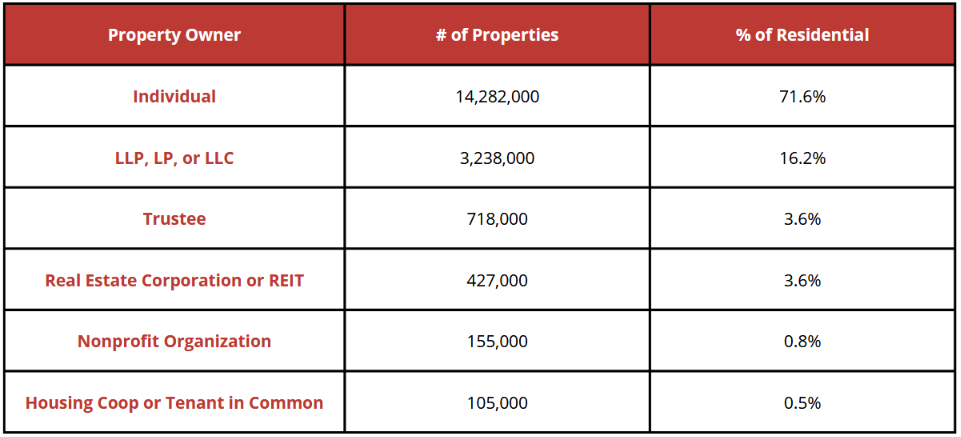
The supply of residential properties that can be fractionalized by Brixxer is massive. The table below is from Brixxer’s Executive Summary. It depicts that in 2024 there were approximately 17.5 million residential properties owned by individuals and limited partnerships. 87% of all residential rental properties in the US are held by individuals or limited partnerships. The vast majority of the property owners will want to utilize Brixxer. A contraction for the US economy would only add fuel to the Brixxer fire.
Brixxer’s roots were planted during the Pandemic. Its founder, Julio Caceres, found himself in a bind when the Governor of Florida issued a moratorium. The edict prohibited landlords from evicting tenants whom were not paying the rent. To save his properties from foreclosure Caceres solicited his friends and family to help pay off the mortgages for his properties.
Brixxer was born out of necessity. The story is similar to UBER, which was founded by Travis Kalanick after he was unable to hail a taxi in Paris on a frigid New Years Eve.
To date, Brixxer has fractionalized 29 properties. The fractionalizations enabled it to gain valuable experience and insight to develop its fully automated systems and intellectual property. The automated and SEC compliant system that has been under development enables:
- Property owner to reduce or eliminate the mortgage without the need for an appraisal
- Investors to legally own a portion of the property
- Liquidity for all owners of each property
Brixxer’s model is highly scalable and profitable, which positions the company for exponential growth. Unlike all of its now fledgling competitors, Brixxer does not have to outlay cash to process or add a property. Brixxer receives a monthly cash fee from each of the properties which it processes.
Brixxer has a growing backlog of properties. The company will begin to process them as soon as the development of its automated SEC compliant system is completed. Viral growth is projected to begin by end of 2026 or early 2027. The architect and Chief Technology Officer (CTO) of Brixxer’s automated system, Anthony Sabatini was the CTO and developer of Telerate, the first alternative investments quotation and trading system, which was acquired by Dow Jones. Mr. Sabatini was also instrumental in the development of the NASD’s automated dealers’ terminals infrastructure. The automated system enabled NASDAQ to overtake the New York Stock Exchange and to become the largest securities exchange in the world.
Note. NASD is an acronym for National Association of Securities Dealers. The NASD is the owner and operator of NASDAQ, which is an acronym for National Association Securities Dealers Automated Quotation system.
Brixxer’s model produces positive cash flow. However, the company has no intention to steadily grow its profits and cash flow. Instead, Brixxer intends to fully leverage it first mover status and to enable exponential growth. Even though, the company is confident that its intellectual property can be protected, Brixxer’s plan is to take no prisoners. Thus, the best defense to protect its first mover advantage is OFFENSE.
The plan is for Brixxer to raise an aggregate of $872 million via six funding rounds at increasingly higher company valuations through November of 2027. The majority of the amount is to be used for marketing and advertising. The spend for sales and marketing can provide the foundation for Brixxer to be valued for a projected $100 billion by 2032 and $1.0 trillion by 2035.
Brixxer has the same genes as Airbnb and UBER. The rideshare leader spent a significant amount of the funds that it raised via its private offerings for sales and marketing activities. The chart below depicts UBER’s multi-billion dollar annual advertising spends from 2016 to 2018. See “Uber blew as much as $3.2 billion on advertising alone in 2018 on its way to one of the biggest US IPOs on record”, Business Insider 05/13/2019.
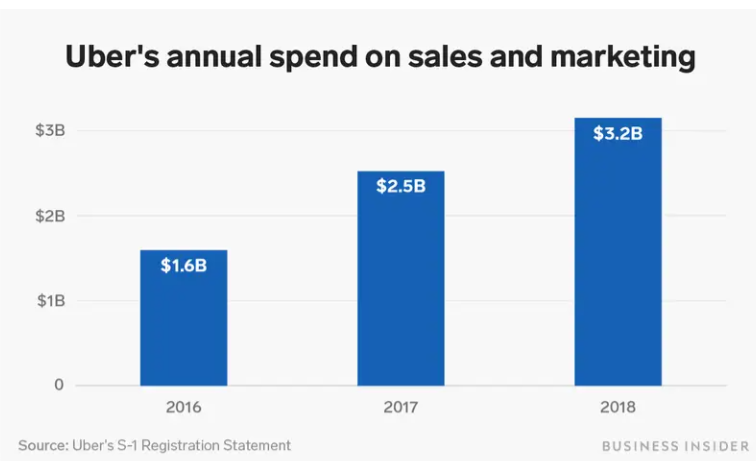
The majority of the cash to finance the ad spends came from UBER’s Series G, the last round prior to its IPO, which netted $5.8 billion. At the IPO’s price, UBER had a valuation of $82.4 billion. At 07/31/2026 UBER was valued for $155 billion.
Please note. My methodology since 1977, after joining Merrill Lynch, and throughout my 50 years in the financial markets, has been to research extreme current and historic events. The purpose of the research is to find possible common denominators that can be used to predict the next or subsequent event. Both extreme positive and negative events are researched.
Upon the cause being found an algorithm is then developed to predict and to profit from the next possible extreme event. My research of Enron’s financials, the 7th largest US company in June 2001, after its infamous collapse into bankruptcy in December 2001, is a great example of my capabilities.
The discovery of Enron’s cause of death enabled my prediction for the collapses of Lehman and the four other brokers to be made. The prediction was published in a magazine, which was on newsstands, throughout the U.S. See “Have Wall Street’s Brokers been Pigging Out?”, Equities Magazine, September 2007.
The companies in the table below were researched because each of them were extreme events. A $10,000 seed round investment in each of them from 2008 to 2012 increased to between $7.4 million for Snapchat and $570 million for UBER by 2025.
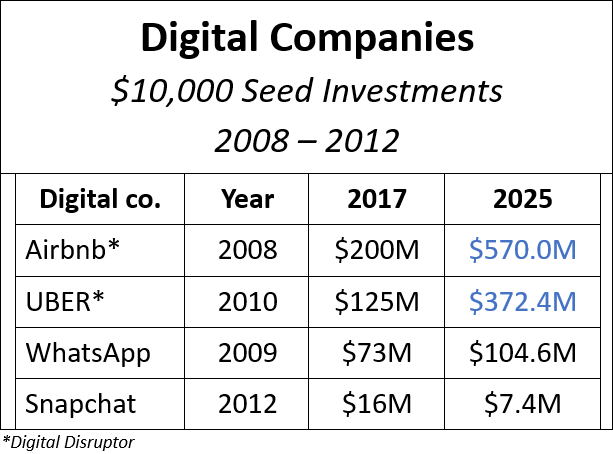
The research of the four digital companies in the table above enabled the discovery of their shared common denominators. The findings enabled Brixxer and three other digital companies that share their common denominators to be identified.
For a summary of the extreme events which have been researched and my track record for subsequent predictions view 4 minute, 57 second video below:

The hundreds of millions that Brixxer intends to raise quickly will be from the utilization of a perpetual financing strategy (PFS). The table below contains the projected valuations and time frames for the raises through November of 2027. In Q4 of 2027, Brixxer is projected to reach a valuation of $10.8 billion. Beyond 2027, Brixxer is projected to steadily increase, and to an eventual valuation of $2.0 Trillion.
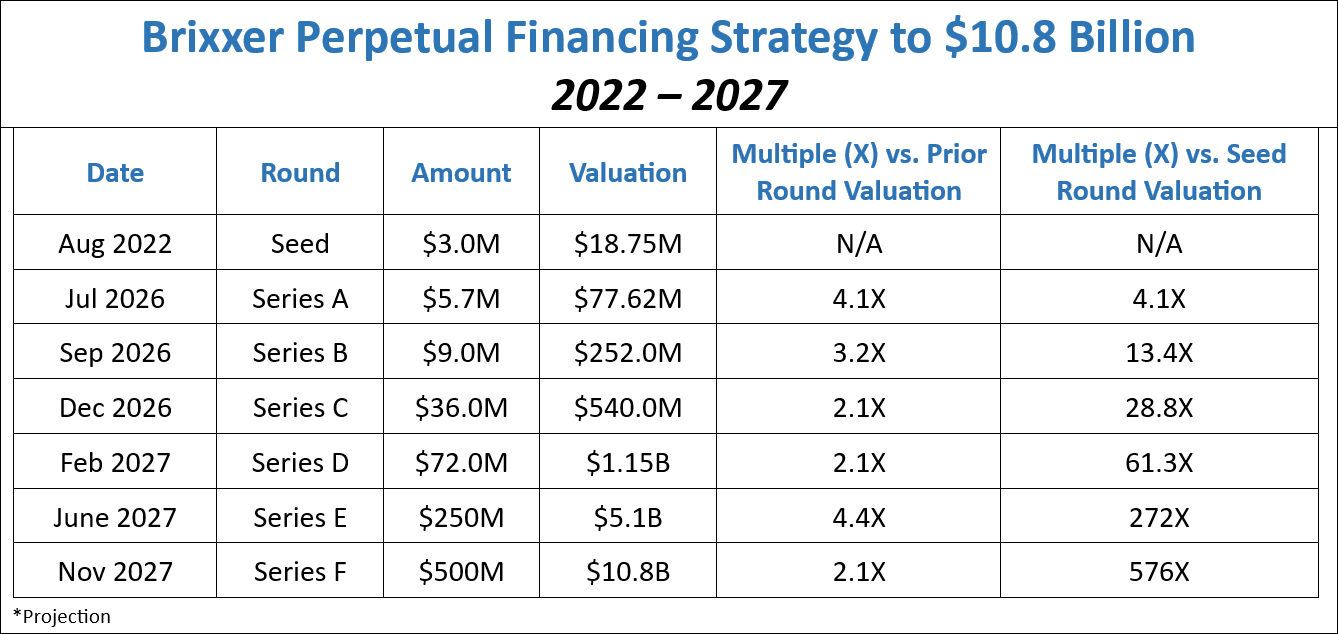
The probability is high for Brixxer to raise almost $900 million over the next 17 months while experiencing minimal dilution. The PFS is the same strategy that was utilized by both Airbnb and UBER to support their viral and exponential growth. The table below depicts that UBER in its early stages raised an aggregate of approximately $400 million from its B and C funding rounds within an 11 month period.
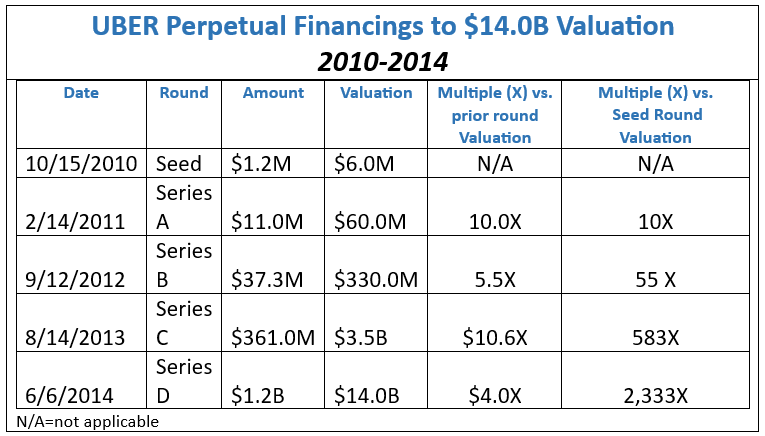
Under the PFS, a venture or early stage company, architects a plan or a road map to automatically sell equity or shares at increasingly higher valuations. Upon a round becoming fully subscribed, the funding activities automatically commence for the subsequent planned round. A perpetually financed company, is always in the process to raise cash, and it and its management never sleeps.
The PFS is ideal for especially companies, which offer digital or downloadable applications, that are very disruptive to large and well established brick and mortar industries. Digital companies are brutal competitors as they have little to no cost of goods or receivables. They also have high gross margins. Their models are the optimum for producing viral and exponential growth.
Uber, the world’s largest transportation company does not own a vehicle. Airbnb, the world’s largest lodging company does not own a bed. Brixxer has a high probability to become the largest manager and owner of US commercial real estate. Yet it will likely never be the sole owner of any one rental property.
The PFS is much more efficient than the traditional venture capital method for financing early stage companies with viral growth potential. The biggest risk for a digital disruptor is not having the capacity to scale upon the application or service having ignited viral demand. The PFS anticipates, and is a preplan for, the capital needed to ensure domination. The cash is provided much faster than even a just-in-time financing strategy.
My experience with the PFS dates back to the 1980s. It was utilized for the venture stage IPOs that were underwritten by me during my seven year stint as an investment banker.
The chart below is for Senior Service. The venture stage company surfaced as an extremely lucrative investment opportunity through my research of prior extreme events. Those investors who purchased its IPO and held the shares until it was acquired by United Healthcare booked a gain of 1700%.
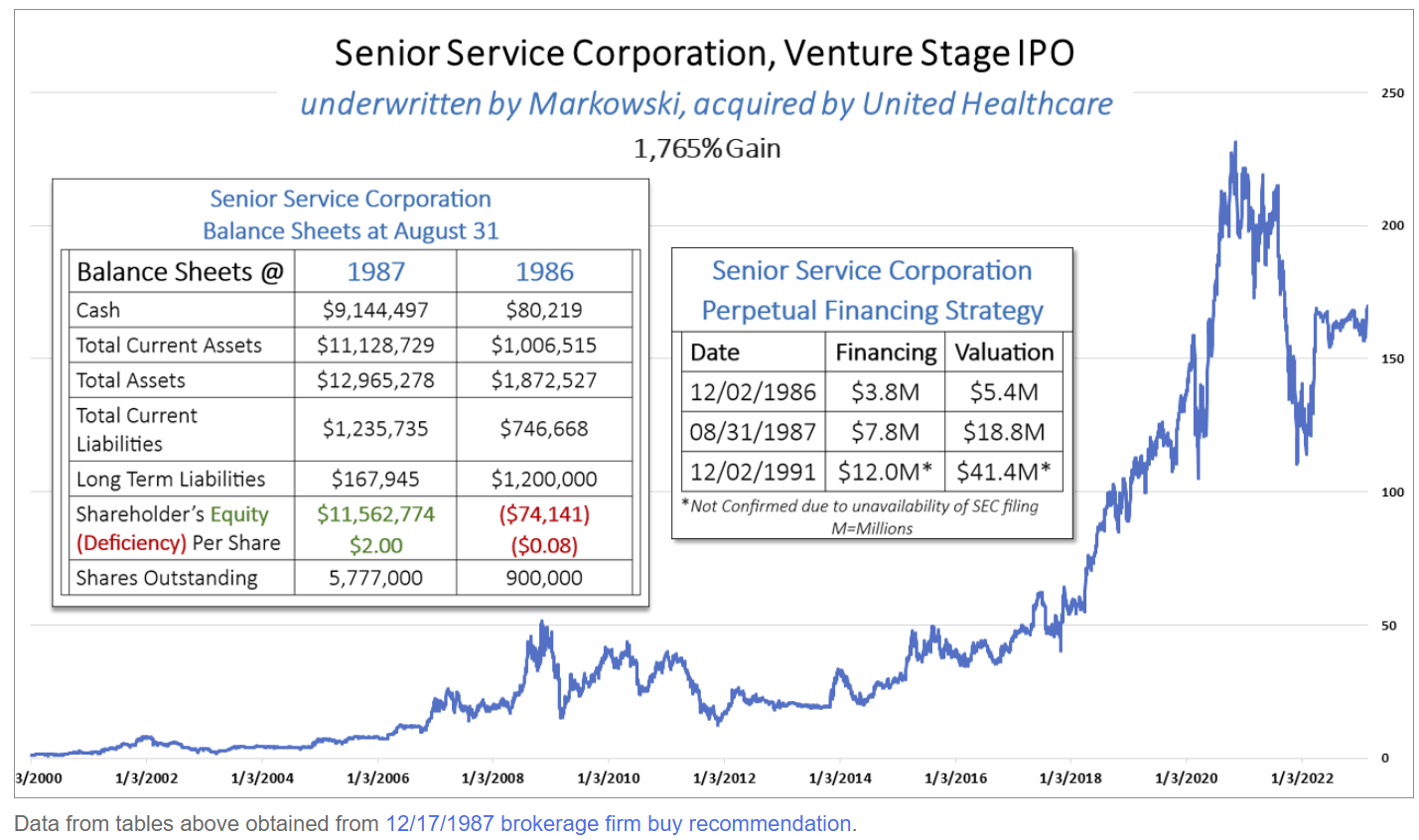
Adult day care provider Senior Service was identified because it possessed the same common denominators as Kindercare. The child day care first mover was among the 250 companies that I had researched which had multiplied by a median 19 times from 1974 to 1983.
The PFS, which was constructed for Senior, enabled the company to raise the aggregate of approximately $24 million at valuations ranging from $5.4 to $41.4 million. The cash laden Balance Sheet enabled Senior’s share price to never decline to below the IPO price throughout its history as a public company.
The table below contains the PFS for EmotionTrac, another digital company, in AlphaTack’s stable, utilizing a PFS. EmotionTrac is not a digital disruptor. However, it was the first digital company that was identified after the common denominators for the researched digital companies were discovered. The PFS has enabled valuation and share price to increase by seven times since seed round.
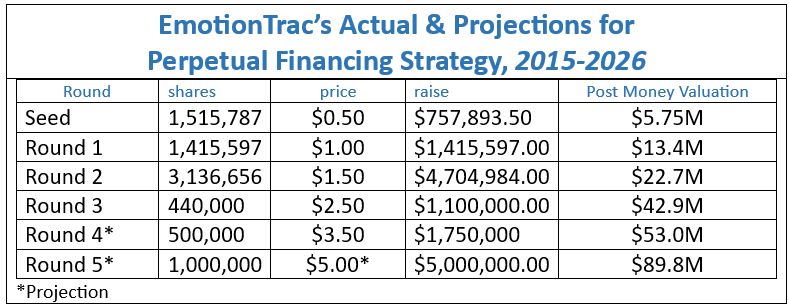
Upon the model for a digital disruptor app being perfected the valuation of the disruptor can almost instantly increase to $10 billion. There are three key reasons:
- The profit margin for a digital disruptor app increases incrementally for each new user installed.
- Apps that disrupt can spread by word of mouth and go viral.
- Utilization of a PFS enables momentum to be maintained
The June 13, 2026 video “Realty Brixxer, Real Estate’s UBER!” below is highly recommended. It explained what was required for UBER to perfect it’s rideshare app. It resulted in UBER reaching a double digit billion valuation within four years after its seed round was launched. Brixxer is projected to exceed the $10 billion threshold within five years of its seed round. The clip also includes an interview of Brixxer CEO and founder, Julio Caceres. Mr. Caceres, during the interview, explained Brixxer’s perfecting its model.
Realty Brixxer, Real Estate’s UBER! – MOTM June 13 2026

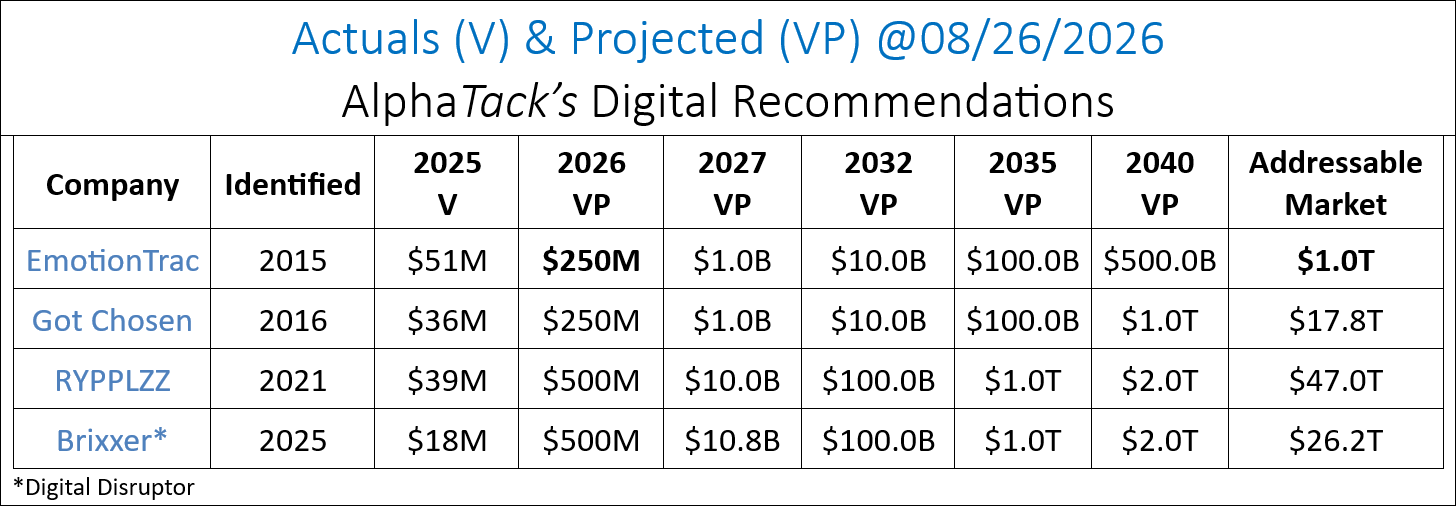
The table below contains the valuation projections and timetables for the four digital early stage companies that have been identified. Each of the companies, including Brixxer and EmotionTrac, have achievable valuations ranging from $500 Billion to $2.0 Trillion. The company that has the potential to become the most valuable in the world is RYPPLZZ. See “Passing of TEST Locks in $10B Valuation for RYPPLZZ”.
Please note.
The achievable valuation projections for the companies in the above table are determined by AlphaTack and not by the management of the respective companies. A video that covers the addressable markets of the companies and most recent interviews of the management of each of the companies is available at https://savechangeworld.com/lhgs-information/
Investment opportunities in Brixxer and the three other companies are available via the following:
- Direct investment
- Fund deploying a Liquid Hyper Growth Strategy (LHGS). LHGS enables investor to receive their original investment back by 2027 and remaining stake can be sold or held. IF held gains could potentially equate to 100 times or more return on original amount invested. View video about LHGS.
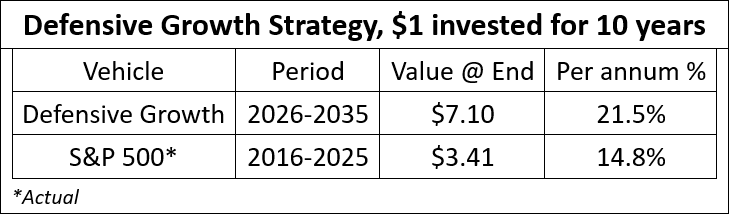
- Fund deploying AlphaTack’s defensive growth strategy. Under strategy, monies are invested into assets that are un correlated with S&P 500. This includes bonds (40%), hedge funds (15%), precious metals (15%), venture capital (20%) and real estate (10%). Table below contains projected nominal values at 2035 per each $1.00 invested in 2026. Table also includes nominal value of 10 year investment in S&P 500 at end of 2025. For more about AlphaTack and defensive growth strategy view video.
The report “HALF MILLION to BILLION by 2033?” is a highly recommended read. It covers the Liquid Hyper Growth Strategy (LHGS).

Michael Markowski, Director of Research for DynastyWealth.com and SaveChangeWorld.com. Developer of “Defensive Growth Strategy”. Entered markets with Merrill Lynch in 1977. Named “Top 50 Investor” by Fortune Magazine. Formerly, underwriter of venture stage IPOs, including one acquired by United Health Care for 1700% gain. Since 2002 has conducted empirical research to develop algorithms which predict the negative and positive extremes for the market and stocks. Has verifiable track records for predicting (1) bankruptcies of blue chips, (2) market crashes and (3) stocks multiplying by 10X. In a 2007 Equities Magazine article predicted the epic collapses for Lehman, Bear Stearns and Merrill Lynch. Most recent algorithm developed from research of UBER and AirBnB has enabled identification of startups having 100X upside potential within 7 to 10 years. Video (3 minutes, 53 seconds) covers Mr. Markowski's research to develop predictive algorithm methodology.