
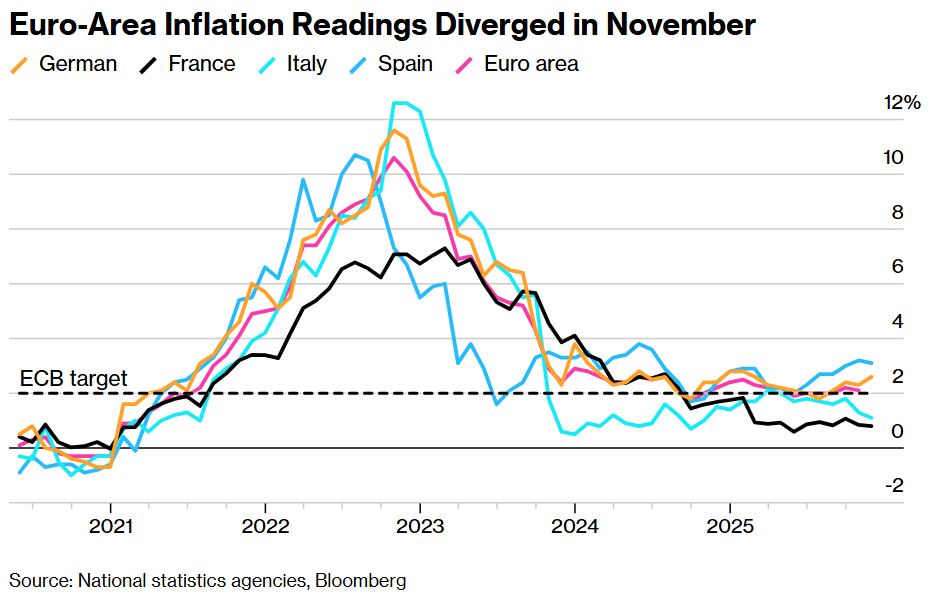
Germany’s inflation rate unexpectedly rose to the highest level in nine months, offering a reminder before the European Central Bank’s final meeting of the year that risks to price stability remain.
The reading came in at 2.6% in November, up from 2.3% last month, according to data published by the statistics office. Economists surveyed by Bloomberg predicted a smaller pickup to 2.4%.
The report concludes inflation updates Friday from the euro zone’s top four economies and will help inform officials as they prepare to set interest rates in three weeks’ time. Price pressures were weaker than expected in France and Italy, and stronger in Spain, with economists anticipating a reading for the 20-nation bloc — due Tuesday — remaining close to 2%.
Policymakers have signaled recently that they’re comfortable with the outlook and aren’t inclined to adjust borrowing costs for the time being. Chief Economist Philip Lane said Wednesday that he and his colleagues are confident a moderation in wage gains will help them deliver sustainably on-target inflation.
What Bloomberg Economics Says…
“We still see Germany’s inflation rate on a firm downward trajectory, despite the stronger-than-expected November spike, which was likely driven by the volatile travel-cost component. We expect price gains to dip below 2% next year. Services inflation might stay elevated, but should also gradually ease in 2026.”
—Martin Ademmer. Click here for full REACT
But concerns remain. Services and food costs are still rising rapidly, and an ECB survey released Friday showed consumers’ price expectations for the next 12 months rose to 2.8% in October from 2.7% the previous month. They remained unchanged, though above the ECB’s target, for three and five years ahead.
The pickup in German inflation this month was likely driven by package holidays and rising fuel costs, according to Martin Ademmer of Bloomberg Economics, who added that food prices may have provided a modest drag.
Even so, he argued ahead of the release that “the broader trend points to a steady disinflation,” predicting Germany’s inflation rate will average 2.3% in 2025 and stay below 2% through 2026.
Written by: Jana Randow — With assistance from Joel Rinneby, Kristian Siedenburg, and Barbara Sladkowska @Bloomberg
The post “German Inflation Jumps to Nine-Month High as ECB Ponders Outlook” first appeared on Bloomberg