
US stocks haven’t been this out of favor relative to their international peers in more than five years, according to Bank of America Corp.’s Michael Hartnett.
American equities have attracted only $26 out of every $100 of inflows to global equity funds so far this year, the strategist wrote. That’s the smallest slice since 2020 and compares with a peak of $92 in 2022.
The figures suggest that the theme of so-called US exceptionalism, or sustained outperformance, was ending with lower relative inflows to the country’s assets, rather than outright outflows, Hartnett said.
The S&P 500 Index is virtually flat in 2026, compared with an almost 8% advance in an MSCI World Index that excludes the US. Investors have a reduced appetite for US equities over concerns about excessive artificial intelligence spending by big tech companies, dollar weakness driven by Trump administration polices and a growing preference for cyclicals that benefit from stronger economic growth.
Stock funds in Europe, Japan and other international developed markets have attracted a combined $125 billion so far this year, against just $35 billion for the US, the BofA strategists said in a note, citing EPFR Global data.
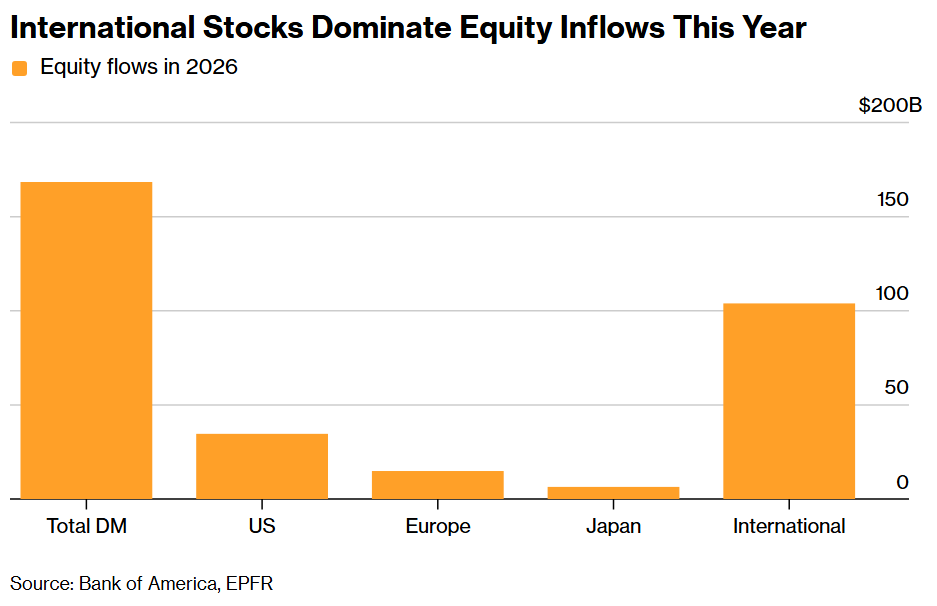
The flow numbers reinforce Hartnett’s comments earlier this month that US trade polices are creating a “new world order.” He has maintained a preference for international equities since late 2024.
Written by: Levin Stamm — With assistance from Michael Msika and Sagarika Jaisinghani @Bloomberg
The post “BofA Says US Stocks Draw Lowest Share of Global Flows Since 2020” first appeared on Bloomberg