
For years, Wall Street banks eagerly helped private credit funds amplify their investing firepower with hundreds of billions of dollars in loans, helping them notch ever-higher returns.
Now, those same banks are tightening their arrangements, adding to the pressure on managers already reeling from an exodus of investors.
Some big banks are raising interest rates for the leverage they provide, and they’re also marking down specific loans posted as collateral. Behind the scenes, that’s prompting private credit fund managers to swap out holdings from the pools as banks including JPMorgan Chase & Co., Goldman Sachs Group Inc. and Barclays Plc exercise their right to write down individual assets, according to people involved in the talks.
The strategies banks are employing to address risks in existing facilities aren’t new, but they’re becoming more prevalent given the turmoil roiling global markets, said the people, asking not to be identified discussing confidential negotiations. Some banks, for example, are scrutinizing loans made to software companies and other industries at risk of being disrupted by artificial intelligence in coming years.
“Every bank does it differently and every bank charges differently,” JPMorgan Chief Executive Officer Jamie Dimon told investors on a conference call Tuesday. “We always had what we call marking rights to look at the underlying collateral. And that’s just a right that protects you.”
The stakes are high enough that top bank executives are getting directly involved in adjusting the interest rates they charge for leverage and tightening collateral terms, some of the people said. Because banks don’t all have the same rights to challenge assets, some may end up better protected than rivals if private credit defaults begin to rise.
The consequences are potentially far-reaching for the asset management firms, too, which have helped fuel $1.8 trillion of private loans to companies across the economy. Funds rely on leverage to keep cash on hand for near-term needs. They also reinvest the bulk of it to juice returns, helping to attract clients and keep them happy.
As banks race to protect themselves, they risk whittling down returns at a time when certain funds run by some of the biggest managers are already contending with a surge in redemption requests amid concerns about loan quality and exposure to borrowers vulnerable to AI disruption.
Spokespeople for JPMorgan, Goldman Sachs and Barclays declined to comment.
Lucrative Business
For years, offering loans to private credit funds against a portfolio of assets — known in the industry as “back leverage” — has been a lucrative growth area for banks. And the franchise remains valuable.
The biggest US banks revealed this week that they’ve amassed roughly $180 billion of exposure to private credit firms. JPMorgan pegged its portfolio at $50 billion, with Dimon telling analysts that he wasn’t “particularly concerned about it.”
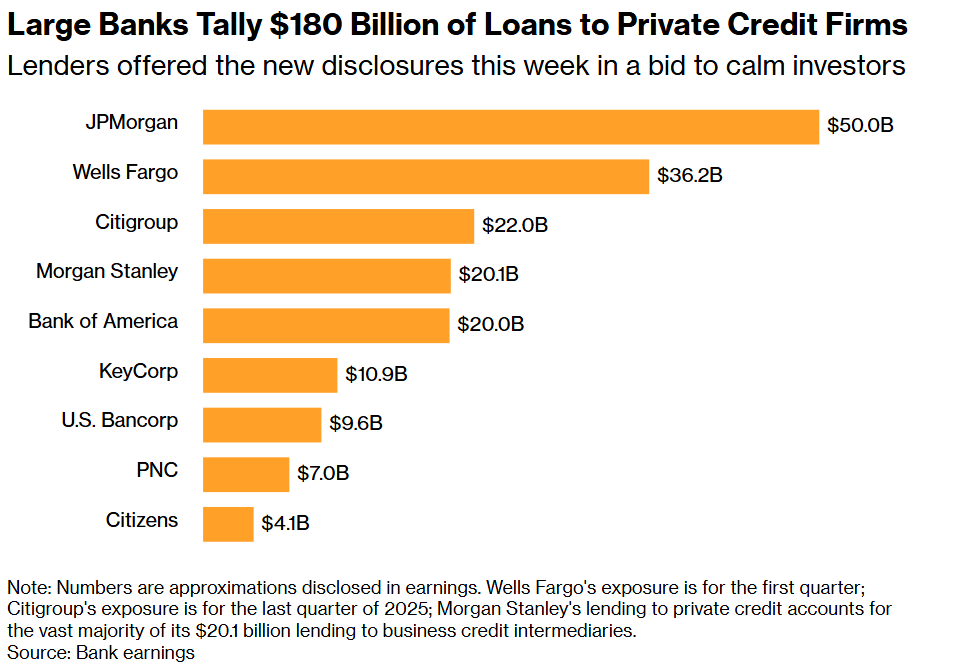
Wells Fargo & Co. said it had about $36.2 billion of loans to private credit funds in the first quarter, while Citigroup Inc. reported $22 billion of such exposure in the fourth quarter, noting that it has had zero losses over the life of the portfolio.
The new details, disclosed with the banks’ latest earnings, were a part of the lenders’ bid to calm investor jitters about the financial industry’s exposure to nonbanks.
While it’s still a growing asset class, private credit is “having a learning moment,” said Morgan Stanley CEO Ted Pick. “We’ll call it an adolescent moment, where both the lenders and the borrowers are being looked at carefully.”
In one of the broadest hits to credit funds’ future performance, banks have been ratcheting up the interest rates they charge for back leverage. Some rates are now topping 3 percentage points over the Secured Overnight Financing Rate benchmark, representing an increase of 50 to 150 basis points, according to people with knowledge of the arrangements.
That makes it harder for fund managers to generate the types of returns they long touted, and it can leave them with a slimmer buffer should investments ever sour. One way managers can blunt that is by demanding higher interest rates on the loans they, in turn, offer to corporate borrowers. Indeed, some managers said that spreads are widening in private credit markets, which would offset such losses.
When it comes to deploying other strategies to protect themselves, one of the most active banks is JPMorgan. The firm caused a stir last month when word emerged that it’s dialing back lending to some funds by marking down the value of certain loans in fund portfolios.
JPMorgan offers lower interest when providing leverage but, in doing so, also demands stronger rights to adjust the marks on collateral, and can move faster in the process, according to market participants. The bank may mark down a piece of debt if the underlying borrower is a company with deteriorating earnings. It can also do so based on the yields such borrowings are commanding.
Not all fund managers are willing to hand over such unilateral authority to their banks.
For example, Blue Owl Capital Inc.’s flagship fund, Blue Owl Credit Income Corp., doesn’t use leverage from JPMorgan. Filings by the vehicle show it has set up facilities led by nine other banks. They may have some degree of discretion in marking down or revaluing assets, but agreements are structured differently to what JPMorgan demands, according to a person with knowledge of the deals.
JPMorgan does provide revolving debt to Blue Owl BDCs, but the bank doesn’t mark assets in that arrangement, the person said.
A spokesperson for Blue Owl declined to comment.
Shifting Loans
This year wasn’t the first time JPMorgan exercised its rights to make broad-based markdowns. It also did so in 2022 and twice in 2020.
“In past cycles JPMorgan has marked earlier than maybe some others,” Jake Pollack, the firm’s global head of credit financing, said on a podcast this month. “And I think our clients have seen us behave quite rationally when things get dislocated.”
While markdowns can trigger margin calls, the bank changed its marks by a couple of percentage points, which is typically within the headroom funds have in their loan-to-value ratio, according to a person with knowledge of its business.
Still, that irked some fund managers, leading a few to reconsider their relationships with the bank and look at shifting their future borrowings elsewhere, according to people familiar with their thinking.
Some banks are using the incident to pitch themselves as more reliable partners.
Markdowns present fund managers with a conundrum. They can borrow less, offer more collateral or equity to maintain their leverage, or — if they have the rights and capacity — swap out assets to avoid the hit, the people said.
That last option can be less expensive.
Asset Swap
Some banks may start by asking a fund to remove an asset, according to a person directly involved in those conversations. When that happens, managers usually oblige, assuming that if they wait, the leverage provider may seek to write down that asset dramatically.
Other banks may simply announce their markdowns and let the fund manager decide how to handle it.
In relatively rare cases, some of the people said, fund managers might swap assets disparaged by one bank into a pool of collateral pledged to another bank.
Indeed, markdown rights vary among banks. Some facilities feature so-called dispute provisions, which allow banks to negotiate marks or rely on third party advisers.
At Citizens Financial Group Inc., for instance, executives get quarterly updates on assets held in the facilities they financed. Citizens has rights to revalue those assets if the leverage offered has breached a specific threshold or if there’s been a material amendment in the underlying company’s credit agreement, said Jeffrey Kung, head of the firm’s financial institutions group and private capital coverage.
While banks are trying to strengthen their protections, people with knowledge of the adjustments note that lenders don’t want to damage a business they still view as a safe, attractive source of steady income. Lending to the funds can also position banks to win other mandates advising asset managers.
“We feel comfortable with this portfolio for many reasons, including we have decades of lending experience, a deep understanding of collateral and experienced underwriters,” Wells Fargo Chief Financial Officer Michael Santomassimo said on a conference call with investors. “We maintain diversification across both clients and asset types and we structured the loans with protections designed to limit downside risk.”
But as bankers take more time underwriting debt deals, fewer new facilities are being opened, some of the people said. If the bank maneuvers to strengthen protections become more ubiquitous and chisel down the returns generated by credit funds, that might drive more redemption requests, spur asset sales and potentially put further pressure on asset prices.
“You have to have very large losses in private credit before at least it looks like banks are going to get hit,” Dimon said. “It doesn’t mean you won’t feel some stress and strain and you might have to do something about it. But I’m not particularly worried about it.”
Deals
- Pacific Investment Management Co. bought all $400 million of bonds issued on Monday by a Blue Owl Capital Inc. private credit fund
Fundraising
- Mexico’s SilverBlue is looking to raise as much as $232 million for a new private credit fund focused on mezzanine debt
- Adams Street Partners LLC has raised $7.5 billion for its third private credit vehicle focused on institutional investors, more than double the size of its previous fund
- Ares Management Corp. is planning a significantly smaller flagship US direct lending fund than its previous record-breaking vehicle of $33.6 billion to speed up the deployment of capital amid broader dislocations in private markets
- Carlyle Group Inc. raised $1.5 billion in its first round of fundraising for a new vehicle investing in asset-backed finance as the private equity giant grows its credit business
- Dawson Partners plans to hit the fundraising trail for its next flagship vehicle after the private credit manager closed a prior iteration in October with about $7.7 billion
Job Moves
- A top Goldman Sachs Group Inc. credit partner is leaving for a merchant bank run by former executives of the Wall Street firm, just as investors in the asset class fret about the explosive growth of private markets and risks posed by artificial intelligence
- Dennis Cornell, the head of client coverage for the Americas at Apollo Global Management, has left the firm
Written by: Laura Benitez, Ellen DiMauro, Hannah Levitt, Olivia Fishlow, and Weihua Li — With assistance from Yizhu Wang, Sridhar Natarajan, Todd Gillespie, Rene Ismail, and Katherine Doherty @Bloomberg
The post “Private Credit Funds Face More Pressure as Banks Swap Collateral” first appeared on Bloomberg