
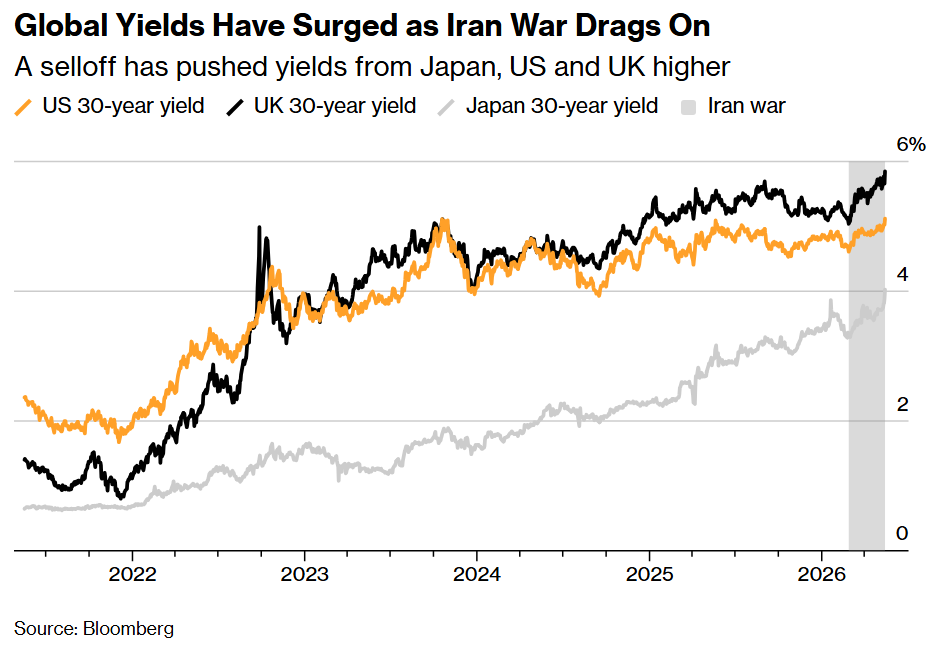
Government bond markets tumbled around the world, sending yields surging from Japan to the US on intensifying fears that the war-driven price shock will force central banks to raise interest rates to contain the impact.
The rout was led by longer-dated bonds that are the most vulnerable to accelerating inflation, sending 30-year US Treasury yields to the cusp of their 2023 peak. US 10-year yields rose 12 basis points to 4.6%, capping the biggest weekly jump since President Donald Trump’s tariffs threw markets into a tailspin in April 2025.
Japan’s 30-year yield hit 4% for the first time since the bonds were issued in 1999. In the UK, where the selling was compounded by a political crisis that’s imperiling Prime Minister Keir Starmer’s leadership, 30-year gilt yields reached a 28-year high. Similar increases raced through markets around the developing world.
The selloff came as crude oil prices climbed and the US-Chinese summit failed deliver any breakthroughs toward ending the war in Iran. That’s compounding worries sparked by back-to-back US reports that revealed a sharp rise in consumer and wholesale prices, fueling speculation that the Federal Reserve and other central banks will need to shift to tightening monetary policy.
“Bond yields definitely feel like they are getting unhinged,” Subadra Rajappa, head of research at Societe Generale Americas, told Bloomberg Television. “The market is not only testing the Fed, it’s putting Congress on notice. The longer that interest rates remain high, financing costs go higher.”
In a sign the concern is spreading from markets to the corridors of power, Japanese Finance Minister Satsuki Katayama said she and her Group-of-Seven peers would discuss the selloff when they meet at the start of next week in Paris.
The rising bond yields are both lifting borrowing costs for governments and exerting a drag on the pace of global economic growth by rippling through to the cost of business and consumer loans.
Investors are beginning to express concern that it could reverse the run-up in equity prices. US stocks dropped Friday, pulling back from what has been a sharp rally since late March.
What Bloomberg’s Strategists Say…
“Any further rise at the long-end of the bond curve threatens to worsen valuation jitters and unsettle a rally increasingly driven by long-duration equities.”
— Edward Harrison, Markets Live strategist. Click here for more.
While yields gradually moved higher in recent days, the selloff gathered pace on Friday, with yields in Germany, Spain, Australia and New Zealand also pushing up.
John Briggs, head of US rates strategy at Natixis North America said, “the restablishment of trades favoring bonds have been placed under pressure again this week,” citing higher-than-expected inflation data globally and the failure of the meeting between Trump and Chinese President Xi Jinping to generate progress on ending the Iran war and re-opening the vital energy-shipping route, the Strait of Hormuz.
“So the Strait is still closed and reflected in Brent’s move higher,” and Briggs.
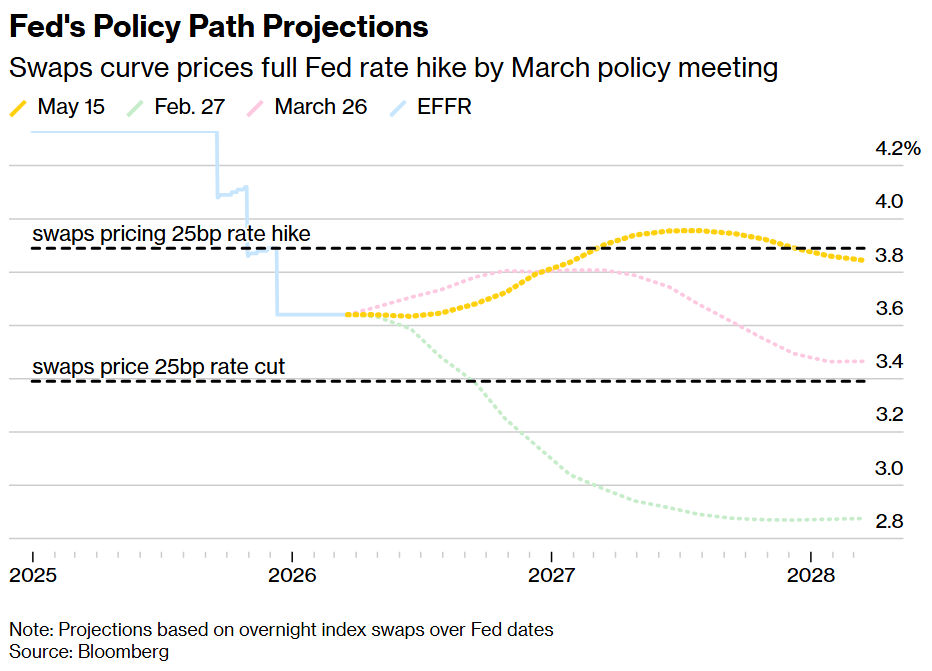
Fed Governor Michael Barr said on Thursday that inflation is the overwhelming risk facing the economy after producer costs accelerated at the fastest pace since 2022. Traders are pricing in an almost two-thirds chance the Fed will hike interest rates in December, even with the central bank under incoming Chair Kevin Warsh, who Trump picked to replace Jerome Powell.
“Markets are starting to price the Fed having to work harder to tamp down inflation,” said Ed Al-Hussainy, portfolio manager at Columbia Threadneedle Investments, noting that the bond market selloff reflects both a worrisome inflation trajectory and the economy heating up. The market likely needs “at least two hikes in the price before we can take a breather,” he said.
Higher yields in Japan also reflect renewed concerns over the nation’s fiscal policy. A report in Kyodo News said the government is weighing an extra budget to fund relief measures for the economy. Finance Minister Katayama later said the situation has not yet reached the point where that’s needed.
“In Japan, where interest rates have been near zero for a long time, the fact that the yield on the 30-year JGB has risen to 4% is historic,” said Rinto Maruyama, senior FX and rates strategist at SMBC Nikko Securities Inc. “This suggests the possibility of sustained inflation in Japan, which has long been plagued by deflation.”
The country’s yields jumped across the curve on Friday. The 20-year rate climbed to the highest since 1996, and the 40-year yield hit its highest since debuting in 2007.
Meanwhile, the UK has been gripped by a brewing leadership contest that could cause a shift away from Prime Minister Starmer’s efforts to restrain the government’s spending. That added to the bond selloff on Friday amid signs that Manchester Mayor Andy Burnham may have a path to challenge Starmer’s leadership.
The yield on 10-year gilts jumped to 5.17%, the highest since 2008. Traders have also flipped from previously expecting the Bank of England to cut interest rate cuts to bracing for hikes, with swaps markets pricing in at least two such increases by year-end.
Written by: Matthew Burgess and Michael MacKenzie — With assistance from Lynn Thomasson @Bloomberg
The post “Global Bond Selloff Worsens as Rising Oil Prices Spook Investors” first appeared on Bloomberg