
Michael Saylor built Strategy Inc. around a straightforward idea: raise money to buy Bitcoin, then never sell it. Over time, that simple bet has turned far more complicated.
After years of raising money to buy more Bitcoin, Strategy now has three investor groups to satisfy: Bitcoin investors, equity traders seeking leveraged exposure to the token, and preferred shareholders collecting cash dividends. That arrangement worked when Bitcoin was rising and investors were eager to finance ever-larger purchases.
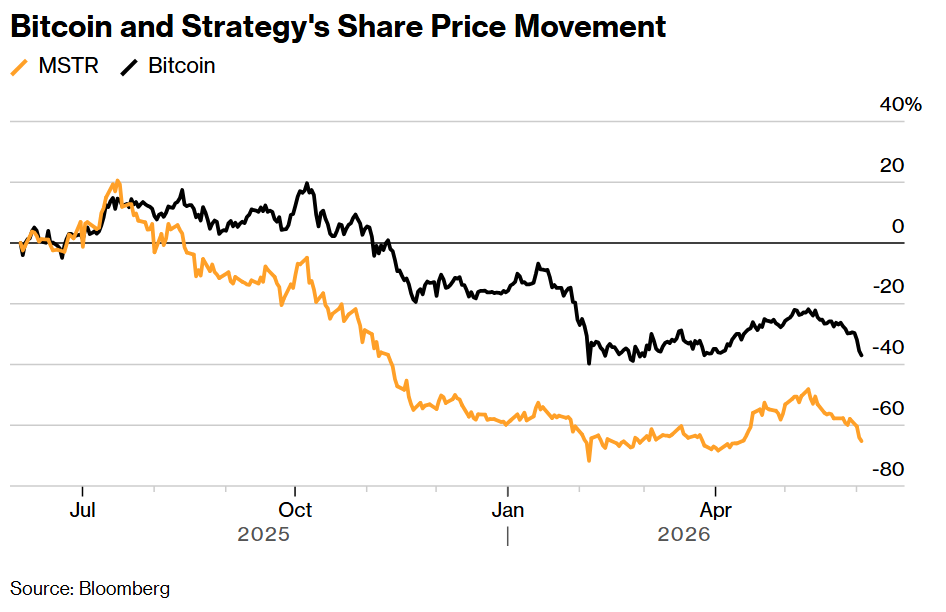
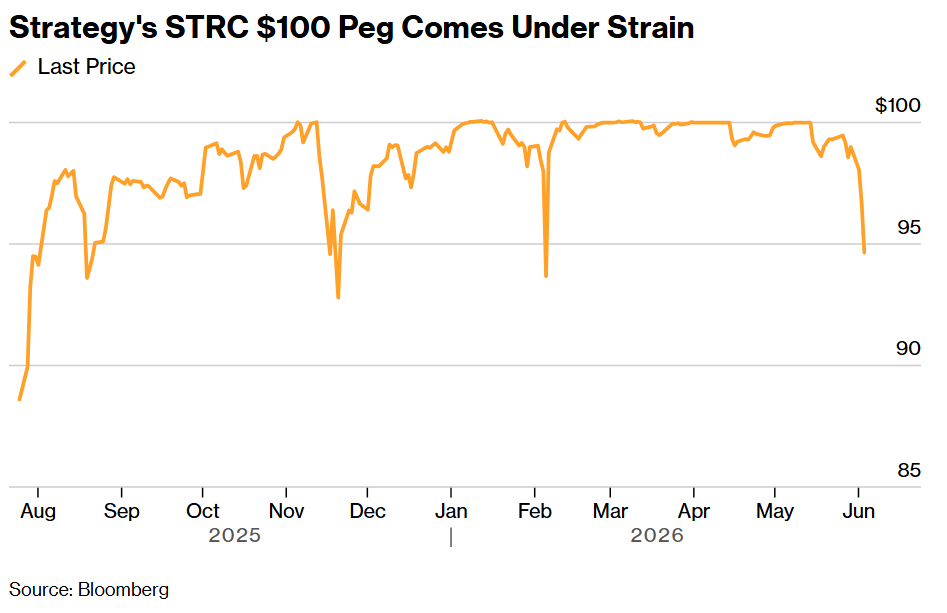
Now all three are under pressure. The token is trading near a four-month low after the latest selloff, while Strategy’s stock has fallen about 70% from last year’s high. And STRC — the preferred share vehicle that has become central to funding new Bitcoin purchases — is trading below par, making it harder to raise fresh capital.
The strain came into focus this week after Strategy disclosed it had sold 32 Bitcoin worth about $2.5 million. The sale was tiny relative to its roughly $54 billion holdings, but symbolically significant. It marked the company’s first Bitcoin sale since late 2022 and challenged a core promise that the cryptocurrency would be held indefinitely.
The question facing Saylor is no longer simply whether Bitcoin rises. It is whether Strategy can simultaneously protect the value of its Bitcoin holdings, support the stock and maintain confidence in its preferred shares.
“I don’t see it as possible for him to protect all three,” said Richard Galvin, founder of Sydney-based digital-asset manager DACM. “One of them will have to take the pain to protect the other two.”
₿ack to Work pic.twitter.com/MmDLwySJpn
— Michael Saylor (@saylor) June 3, 2026
The challenge is that the actions that help one group can undermine another. Selling Bitcoin can raise cash and support preferred shareholders, but it weakens the company’s core Bitcoin accumulation story. Issuing more stock can fund additional Bitcoin purchases, but risks diluting common shareholders. Protecting the balance sheet may reassure creditors and preferred investors, yet limit the aggressive Bitcoin buying that many equity investors expect.
As market conditions tighten, those trade-offs are becoming harder to avoid. Galvin calls this a “three-body problem”: every move that stabilizes Bitcoin, the stock or the preferred shares risks destabilizing one of the others.
Strategy didn’t respond to a request for comment.
STRC was introduced in July 2025 to help Strategy raise cash after short sellers such as Jim Chanos began questioning Saylor’s use of stock sales to fund his Bitcoin buying. The securities pay an annual cash dividend, currently 11.50%, in monthly installments, but aren’t redeemable by investors, giving Strategy more balance sheet flexibility.
The novel financial engineering reduced reliance on stock issuance. But it also introduced a new vulnerability: a growing stream of cash dividend obligations that become harder to support if markets continue to weaken.
Rajiv Sawhney, head of international portfolio management at Wave Digital Assets, sees STRC’s slide below par as a warning sign.
STRC has a rules-based framework designed to keep the shares near their $100 par value. If STRC trades below $95 as it currently does, the framework recommends a dividend increase of at least 50 basis points. At current levels, Sawhney said, it sits in the band where a hike would be expected, though Strategy has declared the rate will stay steady in June.
“Saylor is now caught in a genuine bind, as raising the rate to defend the $100 par increases the $1.7 billion dividend load and signal stress to the market, but holding it flat lets the price keep sliding and damage the strength of the franchise,” Sawhney said.
The pressure does not stop with STRC.
Alexander Blume, chief executive officer at Bitcoin-focused asset manager Two Prime, said Saylor may have “flown too close to the sun.”
For Blume, the problem is that the flywheel that powered Strategy’s rise is starting to work in reverse. The model worked when markets rewarded every Bitcoin purchase and the equity traded strongly enough to fund more buying. It becomes harder when Bitcoin falls, the stock falls and STRC trades below par at the same time.
Bitcoin tumbled as much as 5.5% on Thursday to a four-month low before paring its decline. The preferred shares were trading at around $96, while the common shares halted a three-day slide and closed up up around 2%.
“Despite a band of cult followers trying to still explain the brilliance of Saylor’s ever-shifting plans, the market has started to grow skeptical,” Blume said, adding that the one saving grace is that Saylor is not an immediate forced seller of Bitcoin but he may have to sell soon to fund the STRC dividends.
Jeff Dorman, chief investment officer at Arca, says the issue is ultimately who absorbs the loss. He does not rule out Saylor finding another financing route. Strategy has repeatedly created new capital-raising instruments. But Dorman says protecting all stakeholders looks unlikely unless Bitcoin rallies before the company’s cash buffer runs down, which he estimates could happen in less than six months.
Dorman said that each escape route shifts the pain. The harshest option would be to stop preferred dividends, preserving cash but risking Strategy’s access to capital markets.
Strategy shareholders will vote on Monday to transition to a twice-a-month dividend payment on STRC, a proposal seen helping to keep the price near par.
The bearish case is not the only one. StoneX, one of the firms that sells securities for Strategy, takes a more constructive view. In a report, it said the Bitcoin sale showed Strategy can meet obligations without materially reducing its holdings. It expects the company to remain a major net buyer of Bitcoin, funded mainly through STRC and occasional stock sales.
The sale of 32 Bitcoin did not change Strategy’s position as the largest corporate holder of the token. It did change the market’s reading of the story. A company that said it would not sell has sold. A preferred share designed to hold par is below par. A stock built on Bitcoin leverage is falling faster than Bitcoin.
None of that means Strategy is in immediate danger. It does mean the financing machine that helped fuel its Bitcoin accumulation is under increasing strain.
“The cheap funding lever is jammed,” Sawhney said. “If STRC cannot be sold easily, Strategy must rely on common equity sales or small Bitcoin sales. One dilutes shareholders. The other dents the hold-forever narrative.”
Written by: Sidhartha Shukla @Bloomberg
The post “Saylor’s Bitcoin Machine Is Misfiring on Every Cylinder” first appeared on Bloomberg