
Michael Saylor’s Bitcoin buying machine Strategy Inc. should stop purchasing the cryptocurrency if it wants to restore market confidence in its shares.
That’s according to Julio Moreno, head of research at CryptoQuant, who argues Strategy’s priority should be to restore its dollar cash buffer rather than keep buying Bitcoin whenever capital is available. The company needs a more systematic, fundamentals-driven approach to timing Bitcoin purchases, he said in a research report.
“Buying at cycle tops and accumulating during bear markets has resulted in rapid unrealized loss growth and deteriorating STRC fundamentals,” Moreno said, referring to the company’s perpetual preferred shares.
Strategy is under pressure after a months-long Bitcoin selloff that has raised concerns about the company’s ability to meet its financial obligations. The company has said it doesn’t foresee problems with making any payments. Strategy didn’t respond immediately to a request for comment.
Of course, Moreno’s prescription carries its own risk. Strategy’s appeal rests in part on the expectation that every new dollar it raises will eventually be deployed into Bitcoin, creating a self-reinforcing financing loop. A decision to stop buying, even temporarily, could interrupt that flywheel by making investors question whether the company is still maximizing Bitcoin exposure or instead shifting toward balance-sheet preservation. The stronger the pause, the greater the risk that investors demand a higher premium before providing fresh capital.
The Stretch, or STRC, preferred shares dropped to $82.50 last week, a record 17.5% discount to their $100 par value, and were trading at an almost 13% discount at Tuesday’s close. The common stock fell to its lowest level since May 2024, underscoring investor concerns over the company’s funding model. The stock is down more than 70% in the past year.
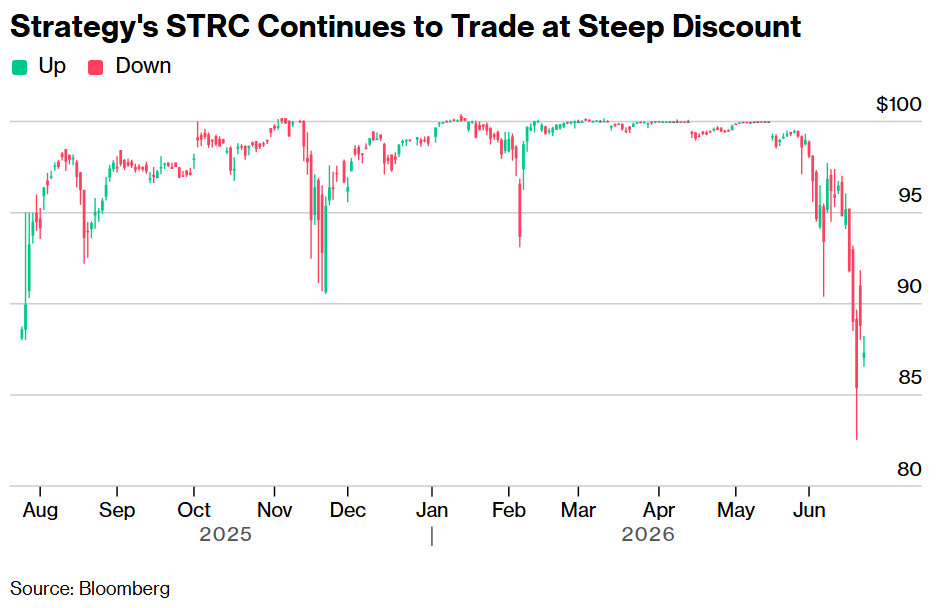
For Strategy’s model to remain viable, Bitcoin needs to appreciate faster than the company’s obligations compound. At the moment the firm sits at a notional loss of $11 billion on its total holdings.
Strategy is paying an 11.5% annual yield on STRC, reset monthly and raised several times since launch, to attract capital that can be used to buy Bitcoin. Based on STRC’s current discounted price, the effective yield stands at 13.17%, according to its website.
Strategy is not required to sell Bitcoin to support STRC’s price. It can raise the dividend yield or issue more common stock to signal its ability to keep paying dividends, tools that are already being deployed. But those measures do not resolve the underlying problem of weaker cash coverage and rising obligations.
Bitcoin’s bear-market correction has coincided with the “simultaneous depletion” of Strategy’s cash reserve, Moreno said. The pressure intensified after Strategy repurchased $1.5 billion of convertible senior notes due 2029 in May, “severely reducing the cash buffer” available to support STRC dividends, he added.
The route back to par “is not straightforward,” according to Moreno. Strategy’s dollar cash reserve has fallen 36% since the start of 2026 to $1.4 billion, he said. The reserve was established in December to help ease investor concern.
Rebuilding the cash reserve to about $2.8 billion, equal to 24 months of dividend coverage, is a “necessary condition” for STRC to recover, Moreno said.
Strategy, formerly known as MicroStrategy, is the world’s largest corporate holder of Bitcoin. As demand from other big Bitcoin buyers including US exchange-traded funds falters, the market has grown increasingly dependent on Strategy’s purchasing power.
At the start of June, however, the company disclosed that it had sold 32 Bitcoin, its first sale since 2022. While negligible compared with a stockpile valued at about $57 billion, the sale carried symbolic weight because it undermined Saylor’s narrative that he would never sell.
Since then the firm has continued to add Bitcoin.
Strategy bought $34.9 million of the cryptocurrency between June 15 and June 21, according to a Monday filing. The purchase was funded entirely through sales of the Class A common stock, marking a third consecutive week in which the company leaned on common equity despite earlier pledges to shift toward perpetual preferred shares as a financing tool. Strategy also used the proceeds to increase the reserve by $300 million.
Written by: Sidhartha Shukla @Bloomberg
The post “Michael Saylor Faces a Bitcoin Dilemma With No Easy Way Out” first appeared on Bloomberg