
Hello and welcome to the newsletter, a grab bag of daily content from the Odd Lots universe. Sometimes it’s us, Joe Weisenthal and Tracy Alloway, bringing you our thoughts on the most recent developments in markets, finance and the economy. And sometimes it’s contributions from our network of expert guests and sources. Whatever it is, we promise it will always be interesting.
If you like chatting with us, check out the Odd Lots Discord, where you can hang out and talk with us and with other listeners 24/7.
Here’s what Tracy’s thinking about…
This morning we released an episode with Alexander ‘Alty’ Altmann, global head of equities tactical strategies at Barclays. We mostly focused on the explosion of single-stock levered ETFs, particularly out of Korea, and their overall impact on the market. That’s a story I’ve writing about before, and one that’s increasingly hard to ignore.
But I also wanted to highlight a related nugget from the conversation, something which Alty describes as “a phenomena of our lifetimes.”
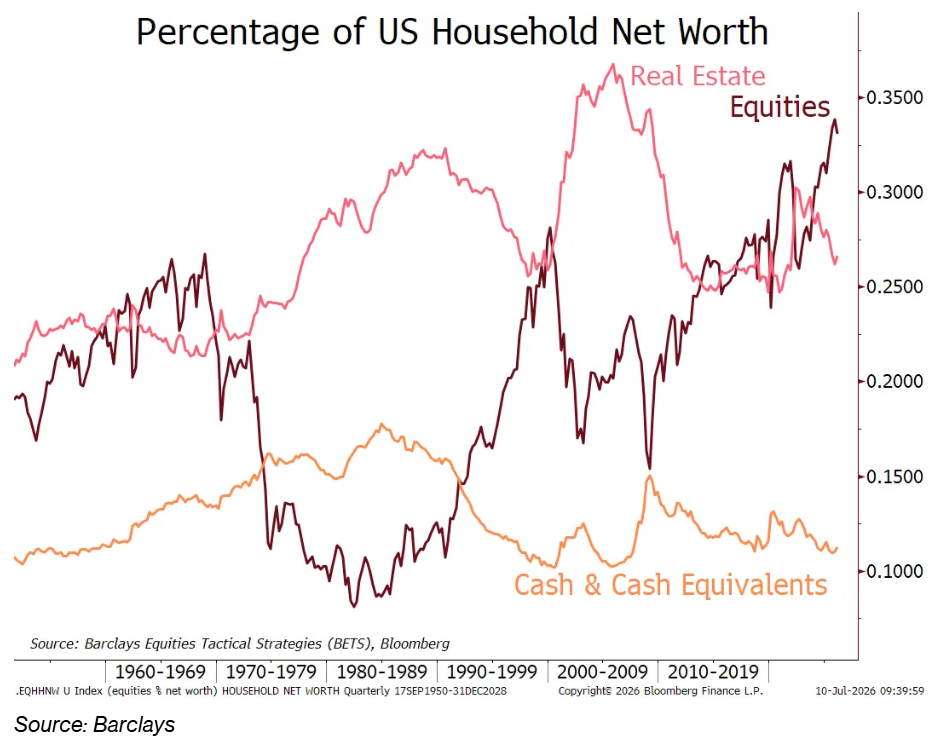
Some 34% of US household wealth is now in stocks — the highest proportion on record.
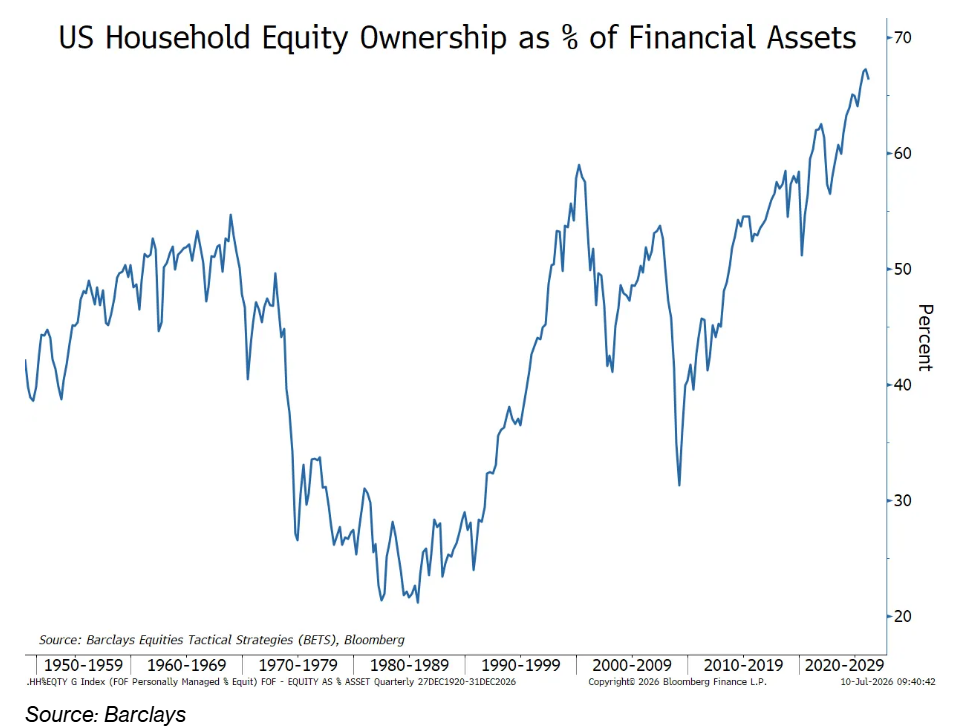
These are obviously aggregate figures, and equity ownership is skewed towards higher-income households. Nevertheless, this is a sea change in the composition of America’s total wealth, which was dominated for years (even after the bursting of the housing bubble in 2008) by real estate.
Now real estate accounts for about 26% of total wealth. That leaves an 8 percentage point difference between equities and housing — the widest on record.
“We as a society have never been this overindexed or overexposed to equities,” says Alex. “And so, I think that what you’ve seen within, say, the levered ETF space is really just another small part of that broader ecosystem that has contributed to this enormous wealth creation.”
There are probably a few ways you could interpret this.
On the one hand, you could think that with with stock ownership — a much more important component of American wealth — US policymakers should be more sensitive to a big drawdown and incentivized to avoid a big disruption. (This, by the way, has always been one of the tensions with homes serving as America’s de facto piggybank — they need to be affordable so people can live in them, but they also need to keep appreciating to keep wealth growing.)
On the other hand, you could also worry about how much this raises the stakes of any equity market downturn that does happen. The broader US economy is effectively tied to stock market valuations (which are now also tied to the future profitability of AI and so on).
“It’s not levered ETFs that keep you awake at night,” says Alex. “What keeps you awake at night is that you [might] have a structural impairment to
equities that effectively no economist on the planet has a cell in their
econometric model that says 20% impairment to the S&P, that basically destroys, let’s just call it, around about $16 trillion of wealth. So let’s just say that’s half of US GDP, right? And that is an instant impairment to US consumption. It’s your recession straight out the gate.”
The explosion in levered ETFs may be one of the more extreme results of increased retail participation in the stock market recently. But when 34% of US wealth is in stocks, the market isn’t just reflecting economic reality, it’s shaping it.
On the podcast
As mentioned above, today we have a conversation with Alexander Altmann, global head of equities tactical strategies at Barclays, about the growth in single-stock levered ETFs and how they’re impacting the broader market. We also talk about the recent sell-off in momentum stocks and the evolution of equity derivatives strategy.
Written by: Joe Weisenthal and Tracy Alloway @Bloomberg
The post “The Stock Market and a “Phenomena of our Lifetimes”” first appeared on Bloomberg