
South Korea’s AI-fueled stock boom is turning into a cautionary tale of what happens when leverage becomes a more powerful market force than the fundamentals.
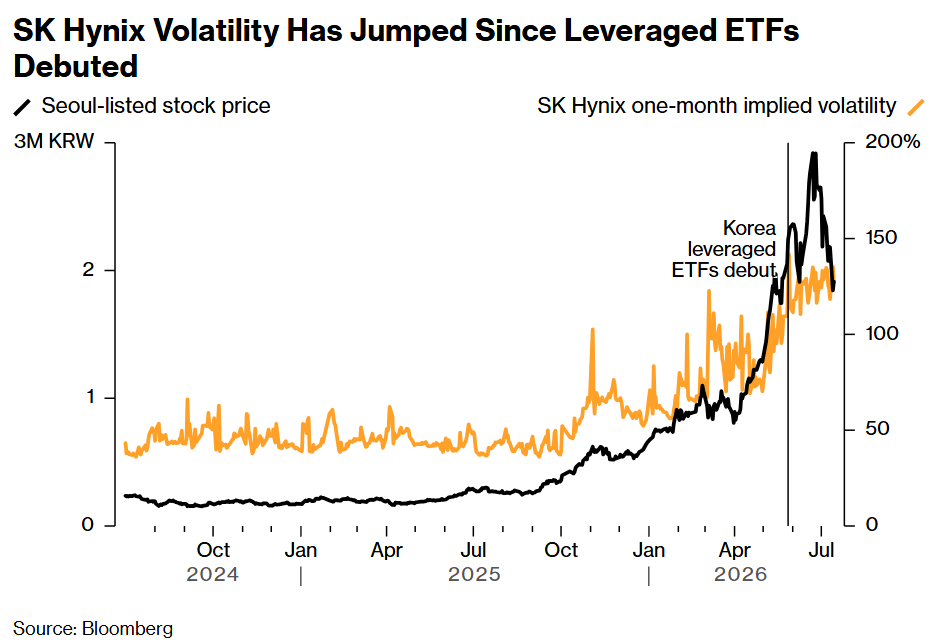
SK Hynix Inc.’s record 15% plunge Monday compelled managers of leveraged products tied to the country’s chipmakers to sell billions of dollars of stock, transforming what began as a global reassessment of AI valuations into a market rout. The selling helped deepen a 25% slide in the Kospi in just three weeks, exposing how margin loans, single-stock leveraged exchange-traded funds and concentrated index weightings can feed on one another, amplifying swings in both directions.
The dynamics are increasingly being watched well beyond Seoul. Korea sits at the center of the AI hardware supply chain, with SK Hynix and Samsung Electronics Co. making up over half the Kospi index. Now that SK Hynix also trades in US time via American depositary receipts, investors say sentiment can bounce between Wall Street and Asia around the clock, raising the risk Korea’s leverage-fueled volatility becomes global.
That feedback loop played out on Wednesday as the Kospi index jumped 6.2%, buoyed by a rebound in SK Hynix shares following a 27% rally in its ADRs. Foreigners added 2.3 trillion won ($1.5 billion) worth of the benchmark’s members, the most in more than two months.
“South Korea is becoming a live experiment in what happens when leverage stops reflecting the market and starts driving it,” said Arun Singhal, chief executive officer at Indicus Capital. “Rising prices attract leverage, leverage amplifies rising prices, and then the same machinery works in reverse.”
President Lee Jae Myung, who has championed higher stock prices as a key policy goal, said Wednesday that the market has become “unstable” after an unprecedented rally. Lee acknowledged recent controversy surrounding leveraged ETFs and urged the heads of the Financial Supervisory Service and the Korea Exchange to prepare follow-up measures.
Amplifying Impact
Single stock leveraged ETFs are relatively new to Asia. The CSOP SK Hynix Daily 2x Leveraged Product, listed in Hong Kong in October, quickly swelled to the largest globally for a product of its kind. In Seoul, more than a dozen such single-stock leveraged products tracking SK Hynix and Samsung debuted in late May, typically offering two times returns on their underlying shares. Together, they account for more than $14 billion of assets under management.
The amplifying impact of leveraged ETFs was on full display this week. SK Hynix’s double-digit slump on Monday meant that the funds may have had to offload about $5 billion of their shares in the company to rebalance their exposure in line with their mandates, according to a Goldman Sachs Group Inc. sales and trading desk note for institutional clients.
That amount accounted for around 18% of the combined total traded value of SK Hynix shares and stock futures on the day, the note said.
This flow-driven trading, without any fundamental catalysts, may be leading to heavy losses for local retail investors who tend to retain their holdings for longer periods than the products are designed for. The prices of more than a dozen leveraged ETFs tracking the two memory chipmakers have slumped about 40% since they were listed in Seoul in May, data compiled by Bloomberg show.
Korean regulators are now faced with the task of seeking to rein in this volatility without overly disrupting the nation’s financial markets. Major brokerages discussed rolling out investor protection measures including raising the minimum deposit for such products and spreading out rebalancing trades, according to the Korea Financial Investment Association.
“There isn’t a huge amount they can do without disrupting market structure but there are expectations that there will be additional investor education, limits on leverage and potentially a lowering of the leverage limit from 2 to 1.5 times,” said Jon Withaar, a portfolio manager at Pictet Asset Management in Singapore. “It’s important to note though, there are leveraged ETFs both in Hong Kong and the US that they do not have jurisdiction over.”
There’s a risk that the increased volatility caused by leveraged ETFs will set off margin calls, leading to a runaway selloff. The total amount of margin loans in Korea — or money borrowed to trade stocks — peaked at above 38 trillion won ($25.4 billion) in June, and was 34.8 trillion won as of Monday.
There’s also a risk that a selloff in New York sets the tone for Seoul, where leveraged ETFs and margin calls amplify the move before feeding it back into the US session, creating a near 24-hour feedback loop.
“Whenever you have these kind of speculative products, it always ends in tears at some point when things turn,” said Aadil Ebrahim, group head of equities at Klay Group in Singapore.
“We’re having that tearing moment now with these leverage ETFs being forced to sell lower because the underlying is weaker,” he said. “Nothing has changed on the fundamentals of the company.”
Written by: Charlotte Yang and Abhishek Vishnoi — With assistance from Sangmi Cha @Bloomberg
The post “Korea’s AI Stock Rout Is Becoming a Lesson in Leveraged Excess” first appeared on Bloomberg