
A surprise breakthrough from Chinese startup Moonshot rippled through global markets Friday, sending AI and semiconductor stocks sharply lower and reviving memories of last year’s so-called DeepSeek moment. It was the latest reminder that markets are being reshaped at extraordinary speed and that assumptions about tomorrow’s winners can change almost overnight.
It capped a bruising week for some of the market’s highest-conviction trades. International Business Machines Corp. tumbled as investors weighed how AI is disrupting software business models. SpaceX slipped below its initial public offering price only weeks after one of the year’s biggest listings. South Korea’s retail boom lurched into reverse. A US leveraged fund cratered before being marked for closure.
Different headlines. The same market problem.
Artificial intelligence is making it harder to identify resilient business models just as Wall Street has built an expanding ecosystem of products — from leveraged ETFs and options to single-stock funds and crypto-linked bets — that allow investors to express their views with amped-up precision. When expectations change, those bets can unwind simultaneously.
“This reminds me a lot, and, not surprisingly, of the DeepSeek moment,” Sarah Hunt, chief market strategist at Alpine Saxon Woods, said on Bloomberg Television. “I do think there was some vulnerability just on how much these stocks have run and what people have been pricing in.”
Few products illustrate that dynamic better than leveraged exchange-traded funds. Once a niche trading tool, they’ve become a fixture of modern retail investing, using derivatives to package amplified long and short bets into products that trade like ordinary stocks. Their rise reflects a broader shift since the meme-stock boom, as increasingly sophisticated trading strategies once associated with professional desks have become part of the everyday retail toolkit.
For all their popularity, they remain relatively modest in size. Bloomberg Intelligence estimates leveraged ETFs account for roughly 13% of ETF trading in the US but make up only about 1.2% of industry assets. Even after accounting for their embedded leverage, they represent less than 1% of the broader US equity market.
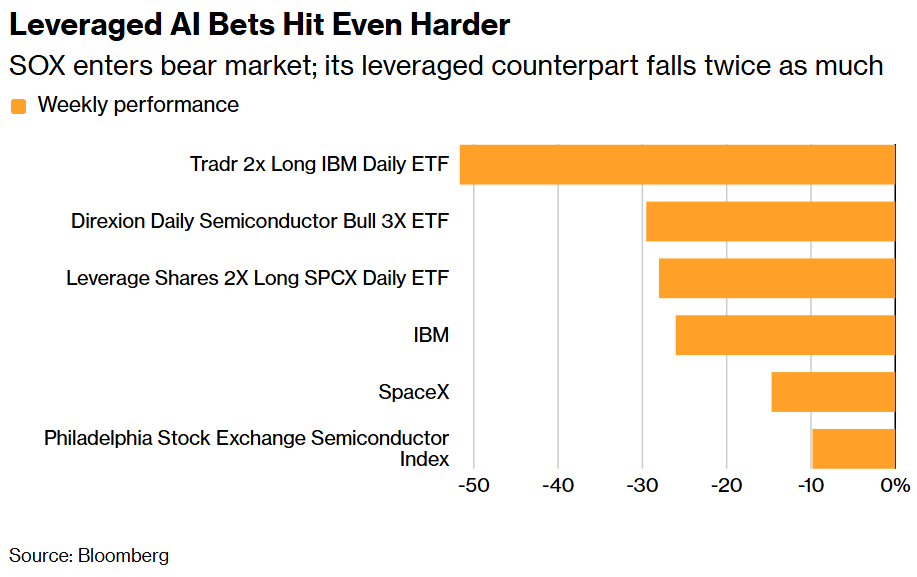
This week’s AI selloff quickly exposed how those products can magnify shifts in sentiment. As Moonshot’s breakthrough rekindled fears about competition and AI spending, a semiconductor benchmark slid into bear-market territory, extending its decline to about 20% from its June high. SOXL, the triple-leveraged ETF tracking the sector, has lost more than half its value over the same period.
The S&P 500 fell around 1.5% for the week while the Nasdaq 100 lost 4.13%, against the backdrop of renewed Middle East tensions.
This week underscored how rapidly Wall Street’s growing menu of AI-linked products can transmit changing expectations across the market. Their influence depends less on how much they hold than on where they hold it. They cluster around the same companies and themes already drawing the market’s greatest enthusiasm: AI chipmakers, volatile stocks and newly public companies. Most days, they simply mirror the underlying stocks. But when concentration, leverage and volatility converge, their daily rebalancing can make them meaningful buyers and sellers in their own right, reinforcing moves already underway.
South Korea, which is now clamping down on the products, offered perhaps the clearest recent example. Retail traders there became some of the world’s biggest buyers of products offering multiples of the daily returns of AI chipmakers, just as Samsung Electronics Co and SK Hynix Inc came to dominate both the benchmark and investor imagination. When sentiment turned, leveraged funds were forced to sell an estimated billions of SK Hynix positions along the way.
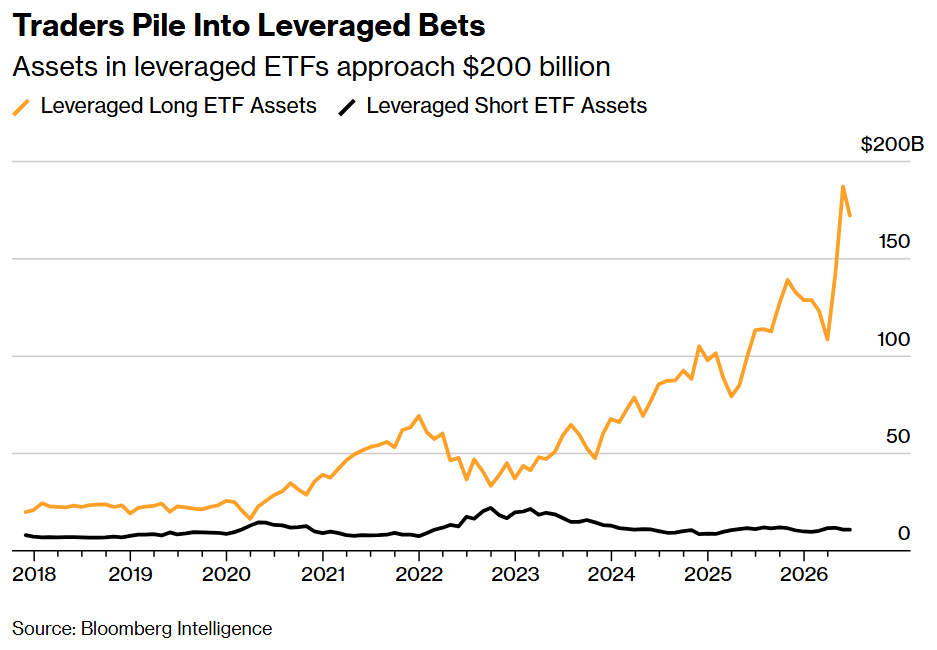
The episode revived long-standing warnings that leveraged ETFs have become destabilizing forces. The broader evidence in the US is less clear-cut. Bloomberg Intelligence estimates the funds have generated roughly $70 billion in cumulative gains, based on current assets minus lifetime net flows, with a greater number of them classified as winners than losers. The measure cannot capture individual investors’ entry points, exits or actual returns, and the gains are heavily concentrated: TQQQ, a triple-leveraged tech play, accounts for a big chunk of the figure.
“Some Americans love to gamble and speculate and they’re basically using these in a way they think is a fair deal,” said BI’s Eric Balchunas.
That concentration cuts both ways. Just as the risks tend to gather around a handful of volatile stocks, much of the industry’s wealth creation has come from a small number of funds tied to long-running bull-market winners. The largest products also appear to function mainly as tactical vehicles, with traders regularly taking profits rather than holding through multiple market cycles.
In many respects, the funds are doing exactly what they were built to do. They track their promised daily returns closely and let investors express short-term views with precision. “If they make up 13% of volume but 1% of assets, it tells you that people are trading the heck out of them — which is exactly what you’re supposed to do,” Balchunas added.
Whether Moonshot proves to be another DeepSeek-style scare or something more consequential is almost beside the point. The AI boom has entered a phase where technological breakthroughs can quickly reshape investors’ assumptions about who wins and who loses. That makes concentrated bets, particularly those expressed through leverage, far more difficult than earlier in the market cycle, when simply owning anything tied to artificial intelligence was often enough.
“What does concern me is how volatile and quick people are to pull the trigger,” said Rebecca Walser, president of Walser Wealth Management. “What this tells me is they don’t have true confidence that this is a long term play.”
Written by: Isabelle Lee and Vildana Hajric — With assistance from Scarlet Fu and Vonnie Quinn @Bloomberg
The post “AI Upheaval Crushes Retail Traders Crowding Into Leveraged Funds” first appeared on Bloomberg