
Highly-indebted companies are increasingly ditching private credit loans for cheaper capital in the bank loan market, a shift underscoring the stark realities of higher-for-longer interest rates.
Corporate America’s effort to limit its interest burden is showing up in refinancing data from JPMorgan Chase & Co. and KBRA DLD. Companies with private debt are refinancing in the syndicated market about three times more often than firms with syndicated loans are tapping private credit, the data show.
The shift comes as the two worlds constantly jockey for business, with the competitive edge routinely swinging between them. Companies tend to pay more to borrow privately, but can also usually close loans faster and with more certainty in that market, making the debt attractive in times of turmoil.
On Wednesday, pharmaceutical company Catalent Inc. refinanced private loans from Ares Management Corp. and Blue Owl Capital Inc. into $4.1 billion of term loans in dollars and euros. In doing so, it cut its borrowing costs by about 225 basis points.
Insurance underwriter Fidelis Partnership is working with Morgan Stanley to refinance about $2 billion in direct loans, and KKR & Co.-backed software business Accuris is slated to price a $700 million leveraged loan next week that’s taking out direct lenders.
Syndicated loans are growing more popular because borrowing costs are climbing and show little sign of falling soon. But even though credit is getting more costly, companies are still able to borrow, showing markets remain orderly.
“To the extent companies can lower the overall cost of capital, I think that’s leapfrogged the other variables and become the most important component,” said Sinjin Bowron, portfolio manager and head of liquid credit strategies at Beach Point Capital Management.
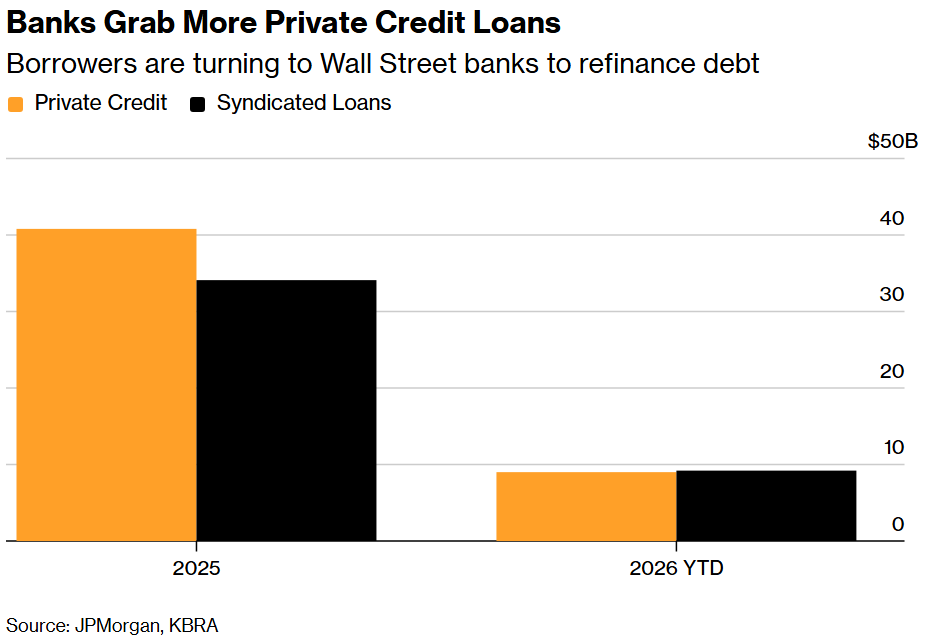
Wall Street banks refinanced nine deals worth $4.5 billion from the private loan market in the second quarter, compared with three deals worth $1.3 billion being taken from the syndicated loan market to direct lenders, the data show.
That’s helped give banks an edge on the year so far. Through mid-July, bank-led deals lured away from private credit had climbed to $9.2 billion, while roughly $9 billion in syndicated loans had been refinanced with direct lenders.
In the whole of 2025, banks took $34.1 billion of deals from private markets, compared to $40.8 billion of deals that went the other way.
Firms may also be concerned about private credit lenders’ shrinking levels of capital. Investors for much of the year have been looking to pull money out of funds known as business development companies, and their asset levels broadly declined in the first quarter.
Many of the firms are marking down their portfolios, with the Blackstone Secured Lending Fund having reduced its net asset value by the most in six years in the second quarter. There are some signs of the sector having stabilized, but the pain isn’t necessarily over.
C&I Loans
Banks may be taking advantage of that weakness. Commercial and industrial loans on their books grew at an annualized rate of 14.2% in the second quarter, according to seasonally adjusted data from the US Federal Reserve. In last year’s second quarter, that growth was just 4.4%.
The head of the Office of the Comptroller of the Currency said explicitly in January that its efforts to relax post-crisis rules for leveraged loans would help banks better compete with private credit.
The net outflows at perpetual BDCs have “allowed some banks to compete more aggressively in commercial lending given less deployable capital at BDCs,” Barclays Plc analysts Peter Troisi and Ishika Goyal wrote in a Tuesday note.
Despite banks clawing back some market share, not all their deals are passing muster. Baker Tilly tapped Deutsche Bank AG to refinance north of $2 billion in private credit in the syndicated-loan market, but the accounting and consulting firm dropped those plans earlier this week after discussions with investors failed to garner a palatable price for the company and prospective buyers of the loan.
Collateralized loan obligations, the largest buyers of loans, have become more selective in their investments, at the same time that direct lenders have tightened their terms, according to a report from KKR.
In some instances, speculative-grade borrowers are shifting more borrowing into the junk bond market. Ancestry.com Inc.’s $2 billion deal last month saw the genealogy business increase a bond sale to $950 million from $450 million, while reducing the loan portion to $1.05 billion from $1.75 billion.
High-yield bonds may become pivotal for private equity-backed borrowers as investors across private and public markets become less tolerant of risk. Junk bonds can offer fixed yields to companies concerned about short-term rates rising.
“Sponsors will use the high-yield market to a much greater degree to refinance the 2028 maturity wall they have to deal with,” Jeremiah Lane, KKR’s co-head of global leveraged credit, said in an interview.
| What to Watch |
|---|
|
Week In Review
- Jane Street is negotiating with a group of investors including Pacific Investment Management Co. in a private-credit deal that would rework the firm’s $11 billion debt load and limit its financial disclosures to market participants.
- Alphabet sold $25 billion of investment-grade bonds after generous yield payouts helped secure one of the year’s largest order books for AI-related debt.
- SoftBank Group secured a $10 billion margin loan backed by its stake in US tech giant OpenAI, marking another fundraising milestone in its bet on AI.
- Blackstone has held early discussions with investors to gauge interest in a second mega debt package to finance Anthropic’s use of chips from Alphabet’s Google.
- One initial proposal is for at least $36 billion of debt. That would exceed the $35 billion lined up by Apollo and Blackstone to fund Anthropic’s lease of Google’s custom chips — one of the biggest private credit deals ever.
- Oracle and Stellantis are among a group of high-grade companies with debt that has recently traded close to junk levels, putting the bond market on watch for a new era of fallen angels.
- In the US high-grade bond market, investors flocked to drugmaker AbbVie’s $10 billion sale, which is funding an acquisition and commanded about $63 billion of peak demand. Meanwhile, Charter Communications sold $4.75 billion of bonds to help fund its pending acquisition of Cox Communications and refinance debt.
- Gainwell Technologies kicked off a $5.8 billion debt overhaul that would be the US software sector’s biggest of 2026, doing so as the sector has underperformed the broader leveraged-loan market by the most in years.
- In the junk bond market, Arrow International wrapped a $1 billion debt deal to refinance existing obligations and fund a payout to private equity firm Platinum Equity.
- BC Partners’ credit arm is leading a group of investors looking at lending money to LIV Golf.
- Investors are becoming more wary of direct lenders who routinely grant “bad” payment-in-kind loans so that struggling portfolio companies can sidestep defaults, according to Anant Kumar, global investment strategist at Benefit Street Partners.
- Authentic Brands Group, the Reebok owner seeking to acquire some of Aston Martin Lagonda Global Holdings Plc’s intellectual property, was among lenders that the luxury carmaker recently tapped for new funding.
- A judge allowed Hughes Satellite Systems to use noteholders’ cash to keep operating for the next four weeks, after a two-day court fight over how the company will pay its bills while in bankruptcy.
- The collapse of solar-power developer GoldenPeaks followed a number of seemingly “fraudulent” transactions between some entities, according to a court-appointed administrator overseeing the group’s key Polish subsidiary.
- Accell Group Holding BV, the bike maker whose €1.6 billion ($1.9 billion) buyout by KKR epitomized pandemic lockdown bets, has sought court protection in the Netherlands after running out of cash to pay its debts.
- Moody’s Ratings downgraded Braskem SA, saying it considered June’s court-ordered standstill from creditors amid talks over a restructuring “as a default.”
On the Move
- David Miller, co-CEO of Goldman Sachs’ business development company, said he plans to resign, according to a filing. The resignation was “not the result of any disagreement with the company,” according to the disclosure. Miller will serve in his role through the end of the year, at which point Vivek Bantwal will become sole CEO of Goldman Sachs Private Credit Corp.
- Toronto-Dominion Bank’s US credit trading unit is ramping up in leveraged finance with the hiring of Eric Tiedeken, who most recently spent more than 16 years at Bank of America Corp. The firm also hired Lisa Chow as vice president in leveraged finance sales and trading. Chow previously worked for Deutsche Bank and reports to Stephen DeLetto, head of US high yield trading at TD Securities. She started July 20 and is based in New York.
- Blue Owl Capital hired former Barclays Plc executive Takeo Ikemori to jointly lead its Japan business, as the alternative asset manager seeks to deepen ties with institutional investors in the country.
Written by: Aaron Weinman and Rachel Graf @Bloomberg
The post “Private Credit Squeezed By Bank Refinancings: Credit Weekly” first appeared on Bloomberg