
Treasury Secretary Scott Bessent’s suggestion of a no-limits approach toward helping Japan rescue the yen risks getting called out by market participants flagging his limited firepower to do the job.
Japan’s currency slid as much as 1% Monday to past 159 per dollar, wiping out half the rally triggered by the July 31 US-Japan intervention. The exercise, the first coordinated effort since 1998, had lifted the currency near 155 before the retreat resumed.
In the wake of that unusual operation, Bessent said “we will do whatever it takes to support them in a way that helps the American economy, the American taxpayer, stabilizes the global economy.”
Trouble is, as far as currency-intervention ammunition goes, the Treasury chief is seen limited by his main dedicated instrument — the Exchange Stabilization Fund, with holdings of less than $220 billion. As a gauge of comparison, Japan on its own is estimated to have spent $53 billion on yen operations on July 30, the day before the coordinated move.
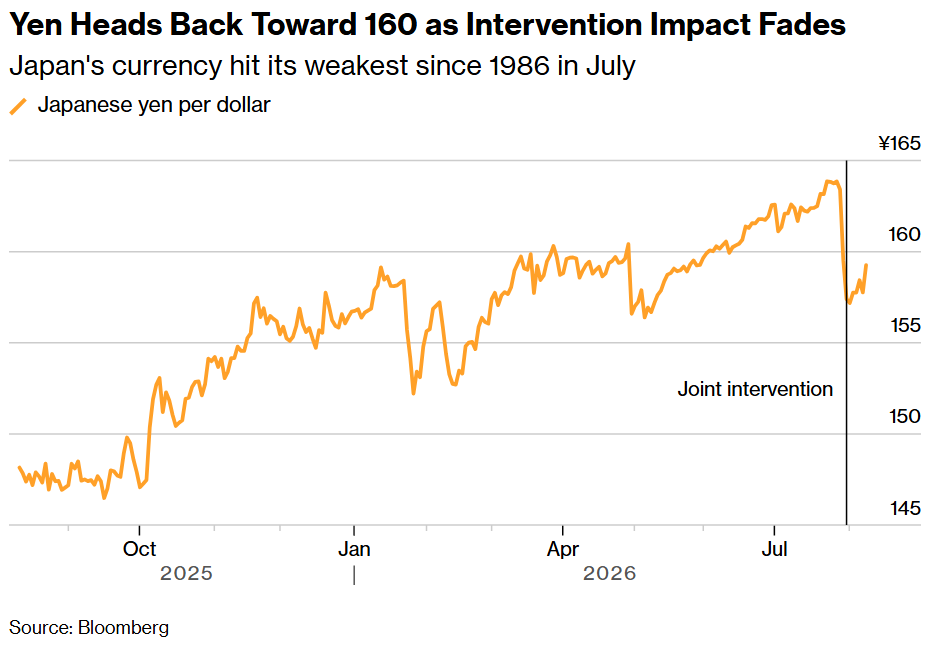
“The US can influence the narrative by coordinating with Japan on intervention, but can’t rewrite the fundamentals,” said Nathan Thooft, a senior portfolio manager at Manulife Investment Management. With regard to American authorities’ capacity, “the pockets are deep but not limitless,” he said.
In the US, the Federal Reserve is the agency with — in principle — unlimited firepower for foreign-exchange intervention to drive down the dollar, as it’s effectively able to manufacture greenbacks. In the case of last month’s operation, however, its role was limited to the actual conduct of the yen purchases, done on behalf of the Treasury.
Historically, the Fed has sometimes joined in with the Treasury with its own funds to show its support for interventions. Back in 1998, the yen intervention at that time was done 50-50 with Fed and Treasury funds. A 2011 joint intervention to sell yen and a 2000 one to buy euros similarly involved even splits.
This time, media reporting on the intervention suggests the Fed “did not stump up” for the US intervention, Derek Tang, an economist at Monetary Policy Analytics wrote in a note Monday. Official data are unlikely to be available to confirm that until later this year.
Fed Capacity
“Its intervention capacity is theoretically limited only by its willingness,” Tang noted of the US central bank.
The Fed on Monday declined to comment about the US intervention. The Treasury didn’t immediately respond to a request for comment.
Bessent has put a spotlight on a separate way the Fed could prove helpful: via its Foreign and International Monetary Authorities Repo Facility. That program would allow Japan to swap a portion of its $1 trillion-plus stockpile of Treasuries for dollar cash. Two days after the intervention, Bessent recommended the program be “upsized.”
Fed data published Thursday suggested Japan hasn’t used the tool, however. Earlier this month, Japanese Finance Minister Satsuki Katayama signaled it could be used at some point.
160 Threshold
Pressure for either Japan or the two allies together to step in again could rise should the yen sink past 160 per dollar, a level seen earlier this year as a key psychological threshold. Authorities intervened to support the currency when it crossed that level in the summer of 2024.
“If the US and Japan let the yen go back to trading durably above 160, markets could interpret the absence of FX intervention” as a sign of US reluctance toward selling dollars, Marco Casiraghi and Gang Lyu at Evercore ISI wrote in a note Monday. “The result could invite additional market pressure that would test the commitment to a stronger yen.”
Bessent’s key likely motivation for propping up the yen, according to economists and market participants, has been to halt any contagion into Treasuries. Japanese government bond selloffs have occasionally spilled over to US securities, and if Tokyo offloads its dollars, that could send American yields higher. Benchmark 10-year Treasury yields recently hit their highest since Bessent took office.
“If Bessent is concerned about the impact of yen trading exerting possible upward pressure on US Treasury and longer-term US yields, the best way to tackle the problem is to counter US fiscal profligacy,” said Mark Sobel, who served at the Treasury for over three decades. “FX intervention and FIMA usage is a Band-Aid.”
What Bloomberg Strategists say…
“Renewed yen weakness alongside higher Treasury yields could draw Washington back in. If the US eventually sells dollars, rather than euros as it did in July, that would be a much stronger deterrent to still short yen positioning.”
—Skylar Montgomery Koning, macro strategist. For the full analysis, click here.
With Japan observing a holiday on Tuesday, traders are wary that thinner liquidity could create conditions for another bout of intervention — as officials could get bigger bang for the buck. Still, Monday’s currency moves highlight the limits of that mechanism in changing the yen’s broader trajectory when the forces behind its decline remain largely intact.
Those forces include wide interest-rate differentials between Japan and the US, concerns over Japan’s fiscal outlook and geopolitical uncertainty. The yen’s retreat on Monday came alongside a rise in the price of oil amid continuing tensions over Iran. Japan imports most of its energy, leaving it vulnerable to higher prices.
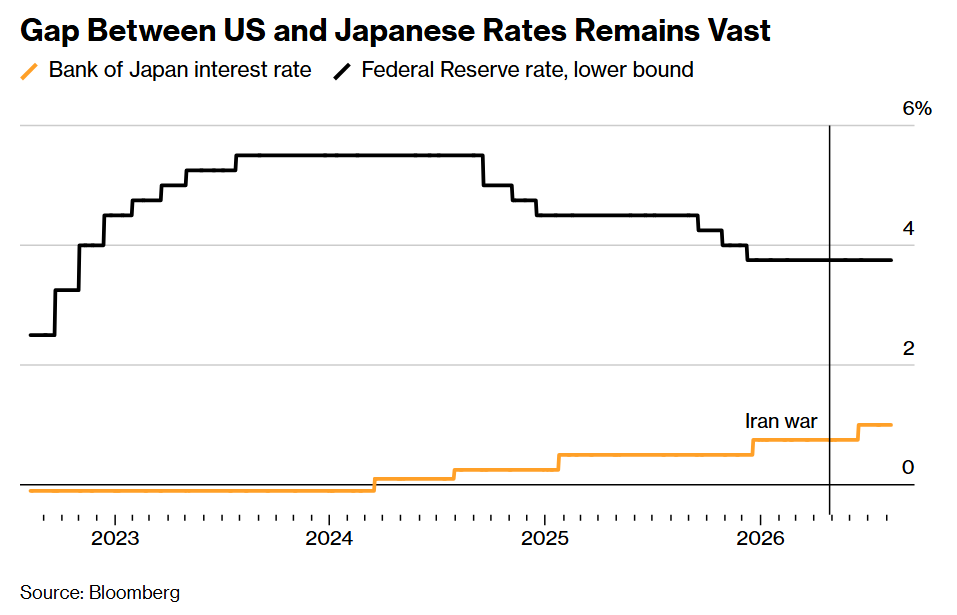
As for policy rates, the Bank of Japan’s benchmark is currently 1%, versus the Fed’s 3.5% to 3.75% target range for its own key rate.
A summary of the BOJ’s most recent policy meeting flagged rising risks of inflation heating up, with one board member pointing to the possibility of an acceleration in the pace of rate hikes. Swaps show traders pricing about a 63% chance of an increase by September, with an October move almost fully priced.
“We think the relatively muted response to the intervention reflects the fundamental reasons for the currency’s weakness,” Goldman Sachs Group Inc. strategists including Kamakshya Trivedi wrote in a note. The team expects “depreciation pressures to reemerge over time absent a shift in global conditions or a policy surprise.”
Written by: Daniel Flatley and Anya Andrianova — With assistance from John Cheng, Enda Curran, and Neha D’Silva @Bloomberg
The post “Bessent’s Whatever-It-Takes Yen Vow Masks Limited Firepower” first appeared on Bloomberg