
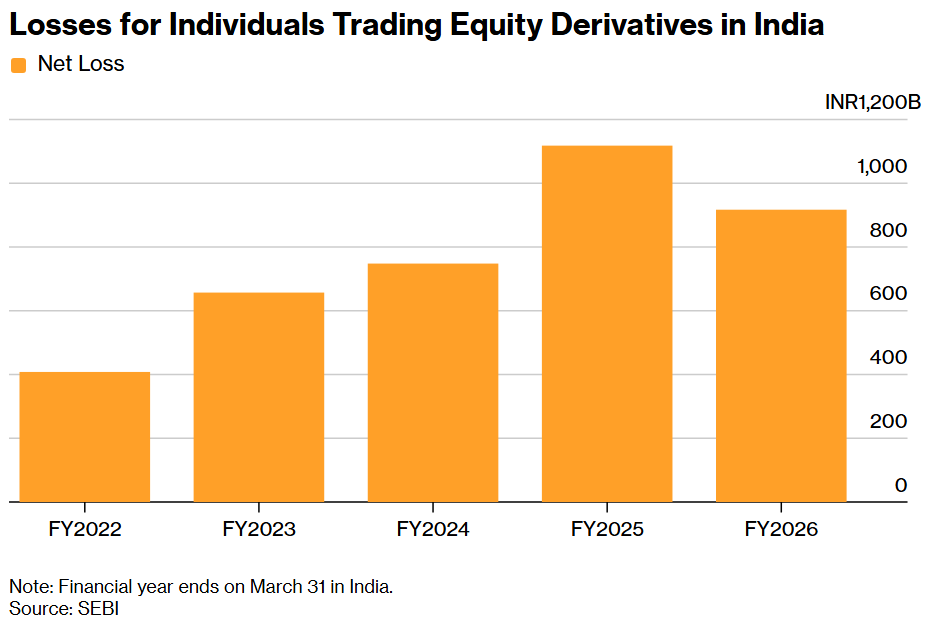
Individuals in India lost 916.85 billion rupees ($9.6 billion) buying and selling equity futures and options in the year ended March, down from 1.1 trillion rupees a year earlier, the government told lawmakers on Tuesday.
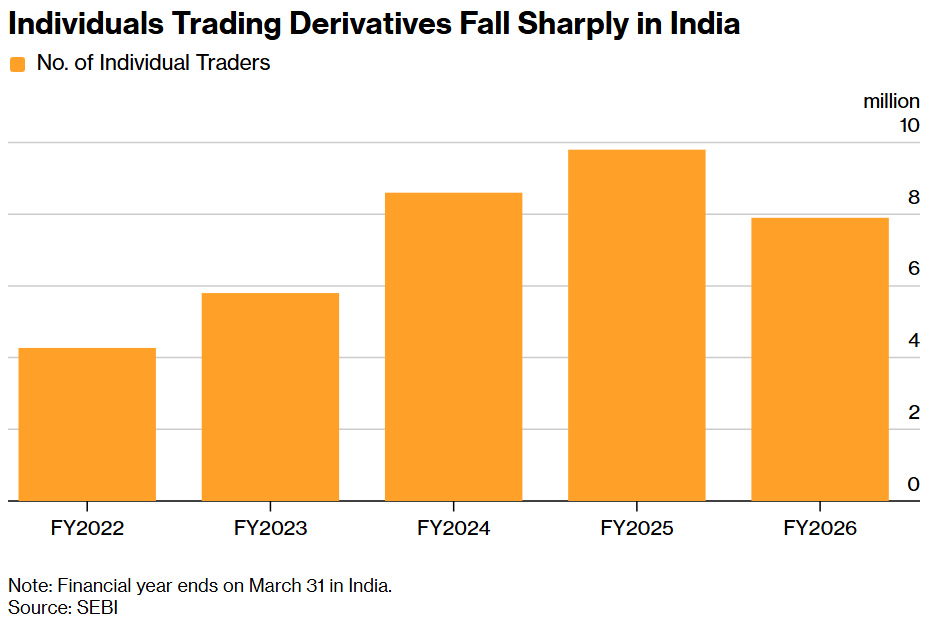
The number of traders in equity derivatives fell to fewer than 8 million from 9.8 million a year earlier, according to a written reply by Minister of State for Finance Pankaj Chaudhary.
The reduced participation follows a regulatory clampdown after the Securities and Exchange Board of India found that nine out of every 10 retail traders lost money trading derivatives — despite repeated warnings about the risks of competing against better-funded, more experienced players. Yet a fifth straight year of losses underscores the limits of those efforts and the challenge of dissuading individual investors from trading them.
“Regulator and government needs to think why year after year we see these losses,” said Abhay Agarwal, founder at Piper Serica Advisors Pvt. “At some point, more needs to be done to plug this hole and to protect retail investors.”
SEBI has increased contract sizes, tightened position limits and put in other safeguards to curb participation in options. The central bank last month introduced tighter funding rules for proprietary traders and stock brokers.
The stricter rules are hurting the stock exchanges — among the biggest winners of India’s retail trading boom. The average daily notional turnover for futures and options listed on the National Stock Exchange of India Ltd. declined 23% to 214 trillion rupees ($2.2 trillion) in July from June, a 17-month low.
The trading-loss data are significant for India’s $5.2 trillion stock market. In March, SEBI Chairman Tuhin Kanta Pandey told local media that the regulator would take a data-driven, balanced approach to curb excessive speculation in equity derivatives, focusing only on short-tenor index options.
Despite the curbs, retail traders’ influence in equity derivatives trading has grown. Individuals account for nearly 31% of trading in these contracts, which offer a relatively cheap way to speculate on stock-price moves, up from 26% last year, according to NSE data.
But the clampdown has also reshaped activity among the market’s biggest players. As trading futures and options has become more expensive, proprietary traders, including high-frequency trading firms, have seen their share of notional derivatives turnover at the NSE fall to 58.1% in June from more than 60% last year.
Written by: Chiranjivi Chakraborty @Bloomberg
The post “India’s Small Traders Lose $9.6 Billion in Options Despite Curbs” first appeared on Bloomberg