
Drone makers and suppliers, including two companies with ties to the Trump family, rallied Friday after the White House said it’s applying a tariff on imports of unmanned aircraft systems and their components.
The stock of drone-parts maker Unusual Machines Inc., which is backed by Donald Trump Jr., rose 24% to a record high while shares of the entity taking Powerus public in a deal involving Trump Jr. and Eric Trump gained 4.9%. Drone technology firm Red Cat Holdings Inc. climbed 8.8%, AeroVironment Inc. shares closed up 1.8% and defense contractor Kratos Defense & Security Solutions Inc. jumped 2.9%. Military drone manufacturer Aevex Corp. climbed 3.1%.
The tariffs — which vary widely — are intended to rapidly expand domestic production and reduce reliance on foreign suppliers for critical components, according to a White House fact sheet. The levies will take effect in 21 days, or 180 days for less sensitive drone components.
“There are still a number of important questions to be answered, however, we believe one conclusion is already clear that the biggest winner is the US drone industrial base,” Needham & Co.’s Austin Bohlig wrote in a note to clients on Friday.
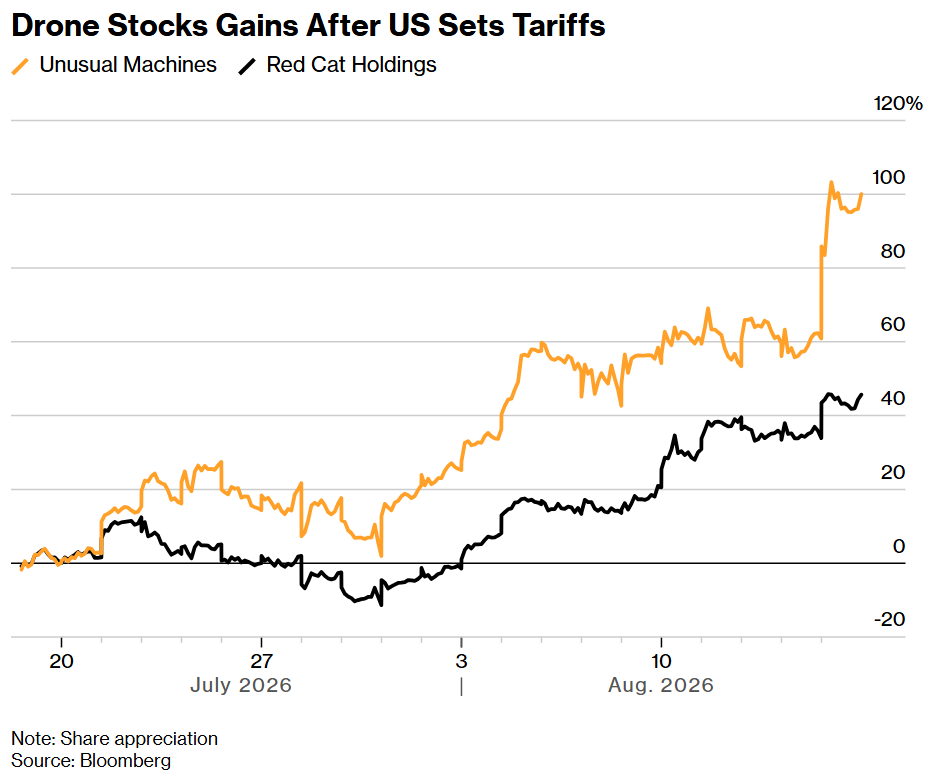
The largest beneficiaries of the move will be the domestic component suppliers, notably Unusual Machines, Lantronix Inc. and potentially Amprius Technologies Inc., the Needham analyst said. While many companies continue to source key components internationally, “the new tariff structure should significantly accelerate the shift toward domestically manufactured alternatives,” he wrote.
Meanwhile, at Jefferies, Sheila Kahyaoglu said Next Vision Stabilized Systems Ltd. appeared most exposed to the levies given its Israeli production. The stock dropped more than 5% in Tel Aviv trading.
“We view the announcement as another step toward reshoring the US drone industrial base and increasing the competitive advantage of domestically manufactured systems,” Kahyaoglu wrote.
The ongoing conflicts in the Middle East and Ukraine have highlighted a broader shift in warfare and in military spending patterns. The focus on the production and deployment of lower-cost, often autonomous unmanned aircraft systems that rely heavily on software has grown at a rapid clip over the past couple of years.
In the US, the Pentagon’s proposed defense budget included a request for $75 billion to spend on drones and counter-drone measures.
“The most compelling narrative is broader than tariffs,” said Ivan Feinseth, chief investment officer and director of research at Tigress Financial. “Drones are evolving from specialized hardware into a critical defense, public-safety and industrial platform, while the federal government is actively creating a domestic supply chain through procurement, regulatory protection and manufacturing incentives.”
Written by: Arvelisse Bonilla Ramos @Bloomberg
The post “Trump Family-Tied Drone Stocks Rise After New US Tariffs” first appeared on Bloomberg