
JPMorgan Chase & Co. strategists warned that markets may view the US Treasury’s surprise effort to curb long-term borrowing costs as lacking credibility, potentially pushing up the term premium and yields over time.
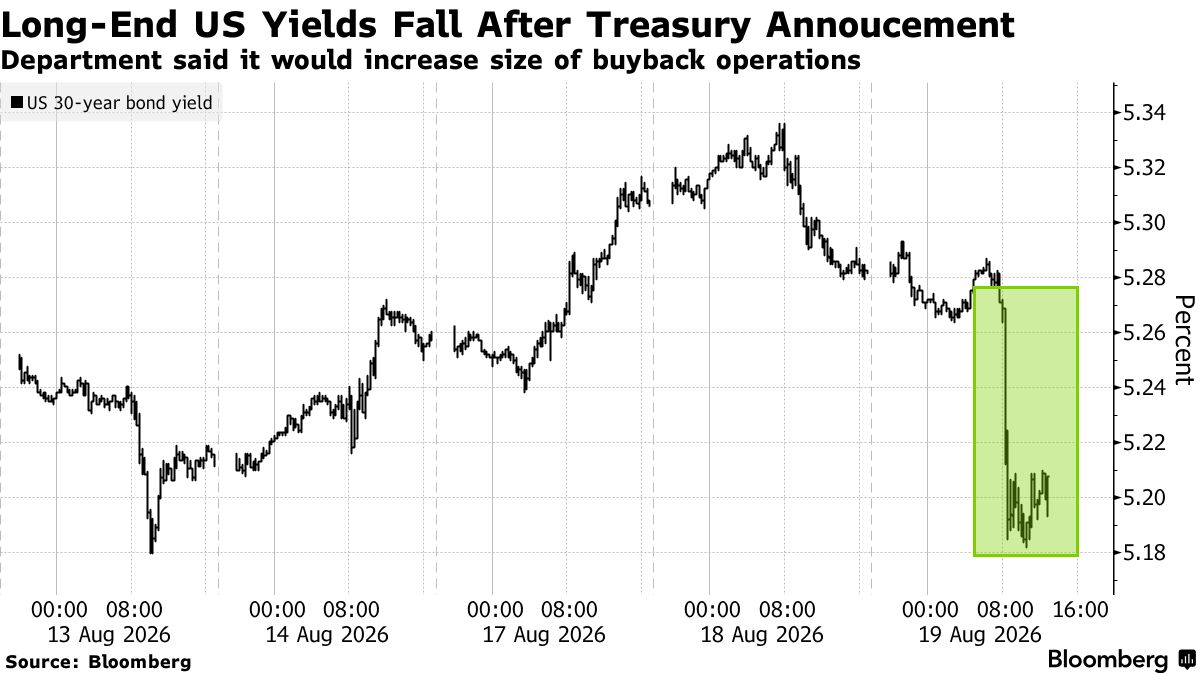
The Treasury said on Wednesday it would at least double the size of its bond buybacks as a way to provide “greater liquidity support,” sending long-term US yields lower. But JPMorgan said the move only addressed the symptoms and not the root cause: the US runs a 6% deficit in an economy near full employment.
“Absent real fiscal consolidation, we fear the markets will view this action as lacking credibility,” strategists including Jay Barry wrote in a note. “This could contribute to higher term premium and yields over time should Treasury become more opportunistic in its approach to debt management and move further away from its ‘regular and predictable’ tenet.”
US national debt has topped $40 trillion, raising the stakes for policymakers trying to keep borrowing costs in check even as Washington continues to sell ever more securities. About 60% of respondents in a Markets Pulse survey said the US debt situation will continue to worsen until it triggers a major crisis.
The implications extend far beyond the federal budget because Treasury yields serve as a benchmark for borrowing costs globally. Higher yields can feed through to US mortgages and corporate debt, as well as currencies and sovereign bonds around the world.
The latest action follows a series of Treasury decisions in recent weeks that have signaled growing concern about rising long-term yields, which by one measure recently hit their highest since 2001. The announcement sent the 30-year yield down nine basis points to 5.19%, while an index of long-dated Treasuries jumped 1.7%, its best day since February 2025.
Citigroup Inc. recommended clients buy 20-year Treasuries, arguing the move looked aimed at keeping long-end yields in check. Together with cooling inflation, Citi sees scope for a strong bond rally in the months ahead.
‘Regular and Predictable’
What makes Treasury’s latest move especially sensitive is that it has long hewed to the principle of being “regular and predictable” and not surprising investors. Treasury Secretary Scott Bessent himself endorsed that approach in a keynote speech at a conference in November.
The department reintroduced its buyback program in 2023, an initiative conceived more than two decades ago when the government was running budget surpluses and repurchasing and retiring higher-cost debt. This time, a key goal was to boost market liquidity, as traders typically prefer to hold the current benchmark of given tenors, leaving older ones less easy — and more expensive — to trade.
Still, JPMorgan said the timing of Treasury’s announcement was “highly unusual,” coming just two weeks after Treasury released its schedule for buying back older securities. The move raises the chances Treasury could cut long-end auction sizes if yields keep climbing.
But Washington still needs to borrow a lot of money. JPMorgan sees a funding gap of more than $3.5 trillion in coming fiscal years, which is likely to require more supply of long-dated bonds, not less.
“While cutting auction sizes has become more likely in our minds, we do not think this would have a lasting impact to lower long-term yields,” the strategists wrote. “We believe today’s actions are likely to have a fleeting impact on long-end yields unless action is taken to reduce the deficit.”
Written by: Ruth Carson @Bloomberg
The post “JPMorgan Team Sees Credibility Risk in Treasury’s Buybacks” first appeared on Bloomberg