
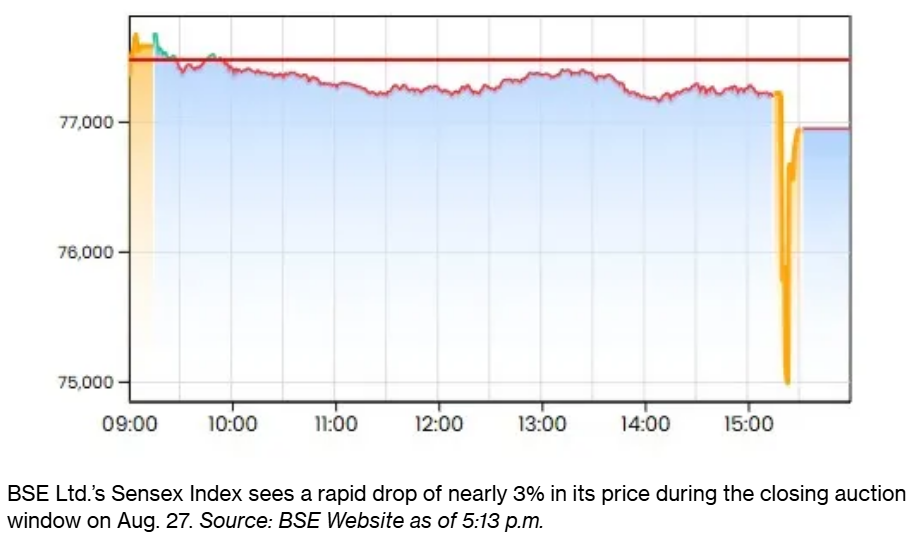
India’s popular stock benchmark, the BSE Sensex, briefly plunged about 3% during a 20-minute closing auction Thursday, exacerbating concerns over thin liquidity and manipulation during the window.
At one point, the 30-stock index slumped to 74,983.19 points, 2.9% lower than the level of 77,182.91 at the end of continuous trading at 3:15 p.m., according to the bourse’s data. The gauge recovered nearly all of the losses to eventually close 0.7% lower for the day.
The “closing auction was expected to have teething troubles but it’s increasingly becoming troublesome for investors to gauge swings,” Suniil D. Pachisia, vice president at Pratibhuti Viniyog Ltd., said. “The sharp move in Sensex today is another example of this.”
The development heightens the scrutiny of India’s newly introduced auction-based mechanism for determining closing prices for over 200 stocks. Since its rollout earlier this month, the system has faced pushback from traders following unexplained swings in benchmarks during closing sessions, and triggered an investigation by the market regulator over alleged manipulation. India transitioned to the new system to align markets with global standards and curb rigging.
The BSE did not immediately respond to queries emailed outside of regular business hours.
The Securities and Exchange Board of India is not considering a rethink or changes for now, Chairman Tuhin Kanta Pandey said at an event after close of trading Thursday. The system is working, and brokers and other stakeholders will help increase participation, he said.
The main trigger for Thursday’s “flash crash-like” move in the Sensex was an index-heavyweight stock, where orders were punched at the 3% lower limit during the auction, said Tejas Shah, head of equity derivatives at Equirus Securities Pvt.
The mechanism allows prices of stocks to move only in a 3% range from the level determined at the beginning of the auction.
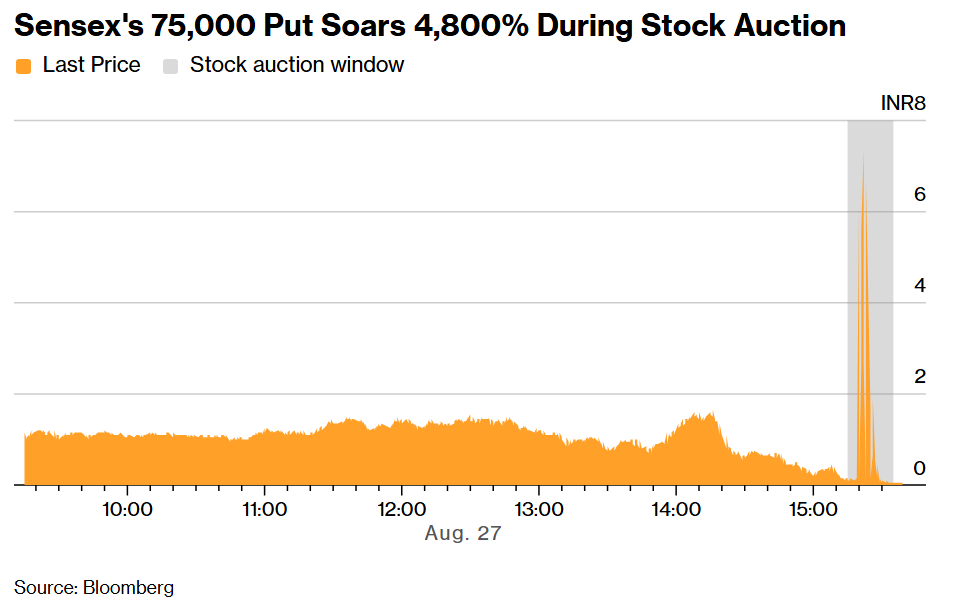
Derivatives linked to the stock benchmark bore out the wild fluctuations in the index during the auction window. The price of far out-of-money 75,000 strike price put option of the Sensex expiring on Aug. 27 soared 4,800% during the auction before giving back all of those gains by close of trading. Similar spikes were visible in put options with strike prices of 76,000 and 75,500.
Earlier this month, SEBI named JPMorgan Chase & Co.’s unit Copthall Mauritius Investment Ltd. and local brokerage Mansi Share and Stock Broking Pvt. in its initial order for allegedly manipulating the auction window on Aug. 13. The regulator said that both entities influenced the closing price of the Sensex during the auction to benefit their positions in the gauge’s derivatives.
Thursday’s unexplained swing in the BSE gauge triggered similar concerns over manipulation on social media.
The focus now shifts to what could be an even bigger test: MSCI Inc.’s month-end index rebalance on Monday. Changes from the index provider’s August review will be implemented at that day’s close, when passive and exchange-traded funds that track MSCI benchmarks will need to adjust their portfolios to match the new composition and weights.
“At this rate, it is better to not carry naked positions in derivatives into the auction window,” Shah said, adding that thin liquidity remains a key concern.
Written by: Chiranjivi Chakraborty and Ashutosh Joshi — With assistance from Samie Modak @Bloomberg
The post “‘Flash Crash’ Hits Sensex Index During Unpopular Closing Auction” first appeared on Bloomberg