
India’s market regulator will allow a $463 billion segment of its portfolio management industry catering to wealthy individuals to invest in overseas securities and short equity options for the first time, as part of a sweeping overhaul of the rules.
The Securities and Exchange Board of India will also allow the funds to invest in unlisted debt securities and take exchange-traded derivatives exposure of up to 1.25 times clients’ assets, it said after a board meeting Thursday. Portfolio managers can also take unhedged short positions up to a prescribed limit, which the regulator didn’t specify.
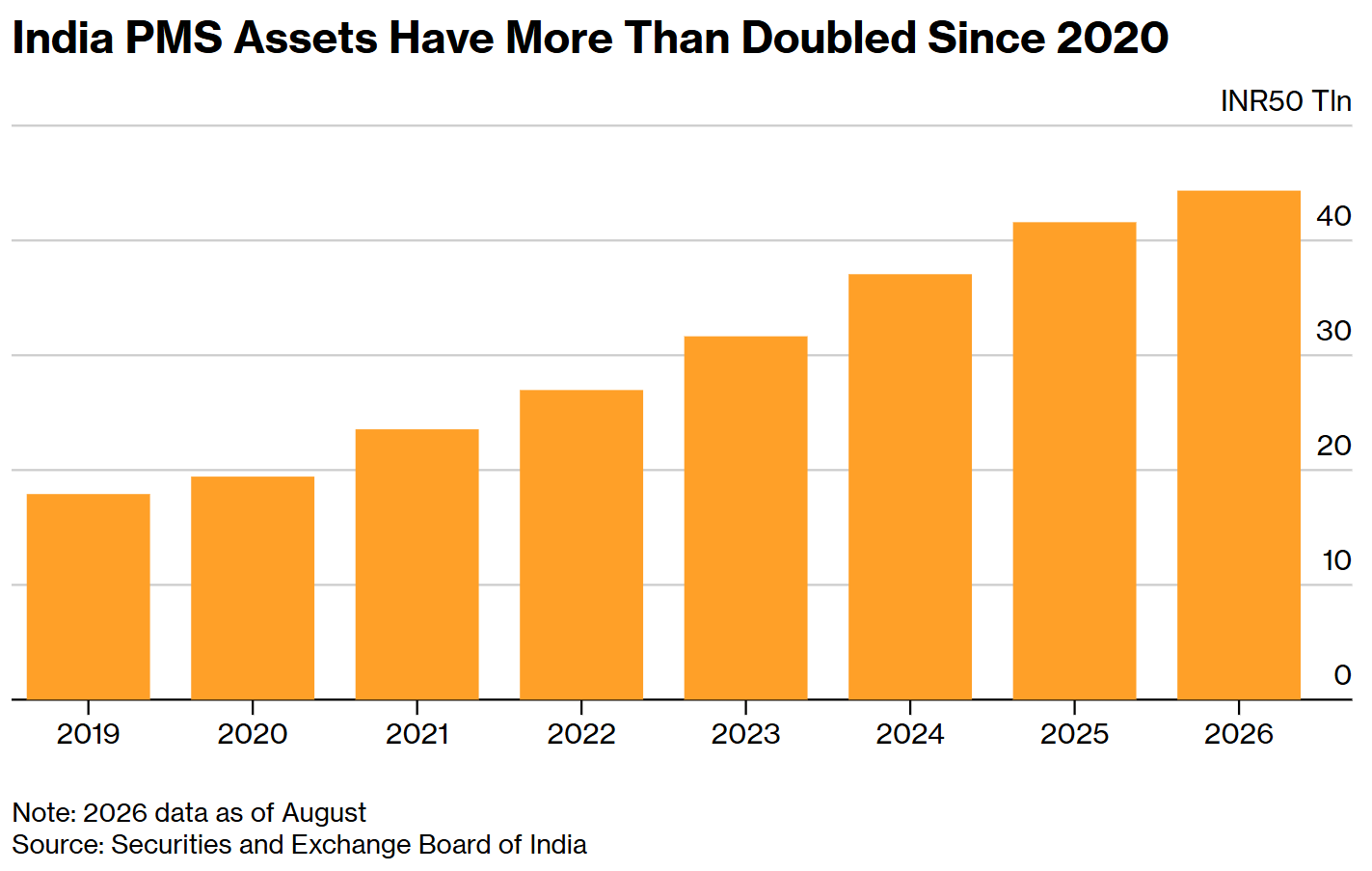
The changes significantly expand investment options for an industry that has grown rapidly in recent years as wealthy Indians seek professionally managed, customized products. Known as portfolio management services, or PMS, the industry oversaw about 44.4 trillion rupees ($463 billion) as of August, up from 40 trillion rupees a year earlier, SEBI data show.
The move also gives wealthy Indians another route to global markets, where demand for artificial-intelligence stocks has surged. The country already allows individuals to invest in foreign securities directly, while mutual fund can invest abroad subject to a regulatory limit. The new rules come as persistent foreign outflows have pressured the rupee against the dollar.
The changes “expand the opportunity across global investments, unlisted investment-grade debt, and the use of derivatives to manage risk,” said Dharmendra Jain, co-founder of Ionic Wealth, an arm of stock broker Angel One Ltd.
Foreign investments in equity and debt will be allowed through the Liberalized Remittance Scheme, which allow resident Indians to send up to $250,000 each financial year, SEBI said. Mutual funds, by contrast, remain constrained by a $7 billion limit exhausted several years ago.
Indians remitted $457 million via the LRS route in June, data published by the Reserve Bank of India last month show.
The overhaul follows a consultation paper floated by SEBI in July.
Meanwhile, allowing portfolio managers to express a bearish view on a stock through unhedged options wagers could also support volumes at Indian bourses, where growth has slowed following years of curbs by the regulator to dim speculative trading.
SEBI also approved a new ‘mutual fund-only’ PMS product with a minimum investment of 2.5 million rupees, half the 5-million-rupee ticket size for a regular PMS products.
Separately, the regulator allowed foreign portfolio investors to trade non-cash-settled, non-agricultural commodity derivatives, a move aimed at broadening market participation. Such instruments have recently enjoyed increased activity from retail investors.
Participation will depend on ensuring that FPIs exit the trade before the delivery obligation arises, the regulator said.
Written by: Samie Modak — With assistance from Chiranjivi Chakraborty @Bloomberg
The post “India Lets Wealth-Focused Funds With $463 Billion Invest Abroad” first appeared on Bloomberg