
Global banks are cooling on financing Australian private credit funds, threatening to squeeze an industry that’s already grappling with a property downturn, higher borrowing costs and regulatory scrutiny.
Goldman Sachs Group Inc. and UBS Group AG are among lenders that are becoming more selective about extending specialized financing to private credit managers, according to people familiar with the matter. Banks are instead focusing any new lending on the largest and top-tier private market managers, while steering away from smaller firms and those heavily exposed to Australia’s struggling real estate market, the people said, asking not to be identified as they aren’t authorized to speak publicly. Existing commitments are largely still being maintained, they added.
Some of Wall Street’s largest players rapidly grew this business in recent years, offering funds the capital to deploy into deals or help meet investor redemptions. Stepping back from the market threatens to seep liquidity from a sector already under stress.
About half of Australia’s A$200 billion ($140 billion) private debt market is linked to real estate, making it vulnerable to the deepening property slump. Bathla Group, a Sydney developer, went into insolvency in August owing A$3.4 billion largely to private debt managers. Regulators have meanwhile intensified a crackdown on improper fund offerings.
“The froth is coming out of the market,” said Belinda Bible, chief operating officer of real estate fund manager Corval Avenue Ltd. “Banks are being more selective in lending to private credit funds and that reduction in liquidity could be troublesome given signs investors are also pulling back.”
The banks have been making this shift in recent months, which includes tightening lending terms as well as blocking deals in instances where they have a say in how the money is used, the people said.
Representatives for Goldman Sachs and UBS declined to comment.
It’s not just the big banks. At Judo Bank, the Melbourne-based specialist lender to small and medium sized businesses has also become more selective in the lending deals it pursues with private credit funds, according to people familiar with the bank’s work. Judo said in August its warehouse lending was around A$445 million across nine facilities, and it has a strong pipeline of new opportunities. The bank declined to comment on its approach.
One executive at a private credit fund manager in Australia said he hasn’t received a single call in the past month from banks wanting to offer debt warehouse facilities. This compares with the usual two or three calls a week he had typically gotten over the past few years.
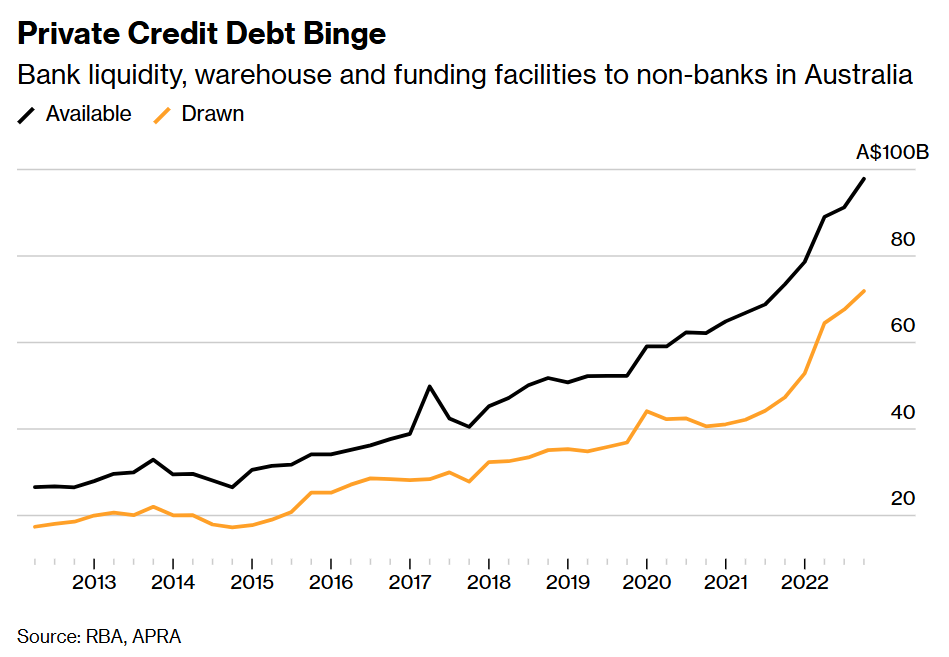
An accurate size of current lending to private debt funds is hard to gauge, though it’s clear the market has ballooned.
Data compiled by the Reserve Bank of Australia and Australian Prudential Regulation Authority show warehouse and funding facilities provided to non-banks reached A$98 billion at the end of 2022, having steadily risen over a decade. There aren’t updated figures that capture some of the market’s busiest growth years after that.
Private debt assets under management in Australia have risen sharply to hit A$234 billion in 2025, according to data compiled by EY-Parthenon. The expansion reflects tighter regulations on domestic banks lending to the higher-risk space as well as an influx of investor capital chasing high-yielding fixed income opportunities.
For the global banks, their lending spans debt warehouse facilities that let funds access bank capital to deploy for deals, net asset value lending — also known as back leverage — where funds borrow against a portfolio of loans, to specialist credit lines and A/B note lending, where banks split a loan in two and leave the riskier portion for the private credit fund.
Deals are not typically publicized. However, some announced transactions in the past five years compiled by Bloomberg News show they exceed A$2.9 billion. Notable ones include two separate A$500 million warehouse offerings led by Goldman Sachs and Morgan Stanley to Pallas Capital, a A$513.5 million Standard Chartered Plc. revolving credit facility for Metrics Credit Partners, and a A$200 million UBS warehouse facility commitment for Centuria Bass Credit.
“Banks like these facilities because they provide attractive income at a relatively low risk,” Bible said. “Private credit funds can use these facilities to increase their capital base, which can boost their overall returns.”
The structure of the financing means banks are unlikely to lose money on the deals unless the assets that secure the underlying loans fall sharply. The banks sit atop the capital structure, meaning the fund’s investors incur losses before them.
Such arrangements can deliver an attractive return on capital. Interest charged on the debt is usually between 100 and 650 basis points above the cash rate, although around 350 basis points above the cash rate is a typical level, depending on the type of lending, according to multiple people briefed on the offerings. The lucrative terms mean banks often encouraged private credit funds to sign up for the warehouse facilities and were keen for them to be drawn down, the people familiar said.
The shift in tone among banks lending to private credit funds is a further sign of caution for a market facing several challenges.
Interest rates are at a 15-year high and the central bank has warned further hikes may come. This increases the amount borrowers must pay to private credit funds given deals are typically executed on a floating rate basis. Meanwhile, a housing downturn has weakened home sales for property developers that borrowed heavily from non-bank lenders, as shown in the case of the collapsed Bathla Group.
Banks pulling back from the private credit sector now could add liquidity stress to the market should investor redemptions materialize, according to Dugald Higgins, head of income research at funds ratings agency Zenith Investment Partners. “We are talking fundamentally about borrowing short and investing long in private markets,” he said. “The pervasiveness of the linkages are always a little bit further than you thought.”
Written by: Richard Henderson @Bloomberg
The post “Banks Pull Back From Financing Australian Private Credit Funds” first appeared on Bloomberg