
Bank of America Corp.’s biggest regulatory fine in the past decade is driving one of its worst earnings days in recent years.
Issues with its money-laundering and sanctions controls culminated this week with $1.21 billion of fines — the biggest penalty ever levied by the Office of the Comptroller of the Currency and the third-biggest from the Treasury Department. The news landed less than 15 hours before the bank reported earnings, which were crimped by the charge.
The hits kept coming from there. The bank’s traders — who had been on a tear this year as markets swung wildly — missed estimates. A bond portfolio that’s been a source of investor frustration before just surpassed $100 billion in paper losses again.
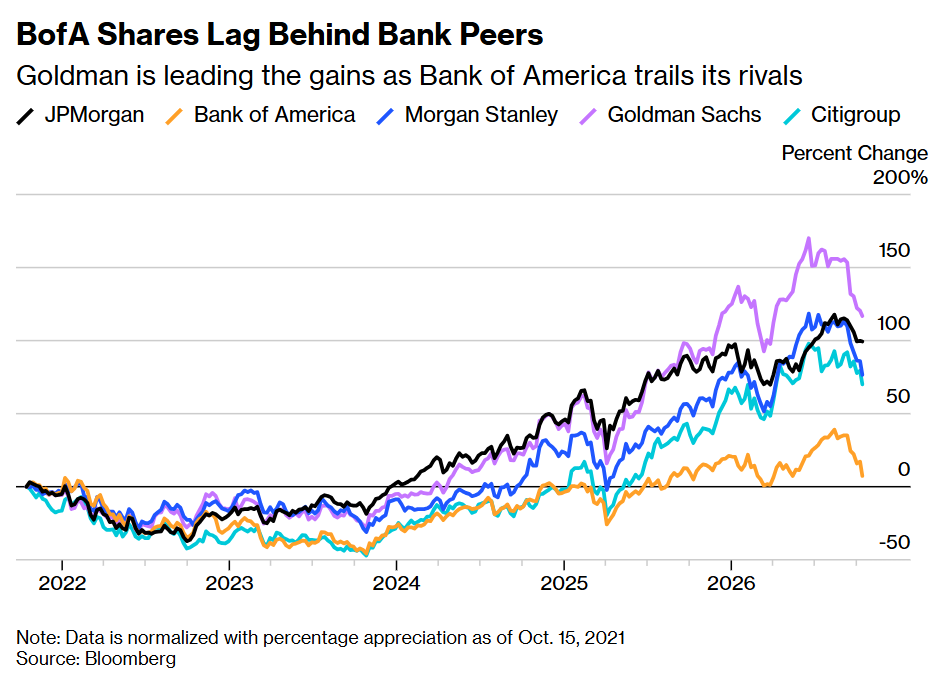
Now, the turmoil is wiping off about $22 billion from Bank of America’s stock Wednesday, piling on the pain for a bank that’s already been the worst performer among the six biggest US banks in the past five years. It’s also a major black eye for Chief Executive Officer Brian Moynihan, the lawyer-turned-executive who has led the bank for nearly two decades.
Moynihan used a conference call with analysts to try to brush off the concern.
“We have agreed to call this a settlement and move forward,” Moynihan said on a call with investors Wednesday. “So I think at the end of the day, we understand what they need us to do. We’re deep in the process of remediating.”
Bank’s System
Years earlier, regulators had pushed Bank of America to tweak a key compliance system to flag more suspicious transactions, which caused the bank to notice that it had missed a staggering amount: thousands of payments totaling $4 billion of activity.
The bank had also failed to report potential money laundering involving companies that auction salvaged cars. Its team of investigators responsible for digging into suspicious activity was so overwhelmed that a backlog of cases had peaked at nearly 200,000. But even two years after regulators first dinged the lender for lapses in its systems, officials still weren’t seeing sufficient progress in fixing the problems.
At the heart of regulators’ issues was Event Processor — a system Bank of America designed in 2010 to monitor the transactions that take place across its vast network and flag potentially suspicious activity. EP was designed to help solve one of Bank of America’s chronic problems: It didn’t have enough investigators to properly explore all of the alerts generated by its other detection channels.
Over the years, the system was dogged by issues. The threshold the bank had designated for flagging suspicious activity was deemed to be too high. When regulators pushed the bank to use new, lower thresholds to look back at past activity, staffers found that it would have filed almost 8,900 additional suspicious activity reports.
Over at the OCC, examiners uncovered other problems, including that the bank lacked the proper amount of staff to properly review suspicious activity. By 2024, the backlog of cases requiring investigator review had peaked at nearly 200,000 cases.
And for years, Bank of America had allowed customers to transmit wire transfers that included the wrong name for senders. In the nearly three years leading up to October 2024, the OCC said, BofA had processed 33,000 wires with inaccurate information, “potentially harming the ability of law enforcement to know who sent the wires.”
For the Treasury’s Financial Crimes Enforcement Network, the concerns centered on three customers, which it identified as A, B and C.
Customer A, according to FinCEN, operates an online marketplace connecting sellers of salvaged vehicles from the US with both domestic and international buyers. Customer B was a publicly traded company offering a similar business. Customer C is a vehicle-export business with commercial relationships with both Customers A and B.
For years, compliance personnel flagged concerns regarding all three customers. One staffer said Customer A was the subject of “an insane amount of cases/investigations,” while another noted the account had drawn scrutiny from at least five different federal agencies, according to a filing from FinCen.
At one point, compliance staffers prepared a presentation to convince executives to terminate the relationship, arguing at the time that Customer A had triggered more than 125 anti-money-laundering investigations, about 90% of which were fraud-related. But the relationship manager overseeing Customer A’s accounts argued it was a “large and valued” client that was generating $6 million a year in revenue.
As of 2025, the client was still processing third-party payments with Bank of America.
“As these issues arose, Bank of America prioritized its revenues and minimized the impact on its required compliance resources,” Treasury said in its statement.
Bank of America said on Tuesday that it has invested billions of dollars in technology and dedicated thousands of employees to combat financial crime.
Rare Rebuke
The issues have overwhelmed the bank’s staff at times. The OCC said the company didn’t have enough investigators to handle the load of reports. As the lender sought to fix its system, it needed to “onboard thousands of new investigators to handle the vast increase in transactions requiring investigation,” the OCC said.
The lapses drew a rare rebuke from Treasury Secretary Scott Bessent himself, who said the “actions send a clear message that even the biggest financial institutions are not above the law.”
The troubles extended to sanctions as well. The bank reached a settlement agreement with the Office of Foreign Assets Control about apparent violations of sanction programs on countries including Iran and Russia.
“Bank of America had a disappointing quarter and this comes on the heels of a billion-dollar regulatory settlement, so it’s just not a good day for those who own Bank of America stock,” Wells Fargo & Co. analyst Mike Mayo said in an interview.
Bank of America isn’t alone with its money-laundering issues. Last week, federal regulators fined American Express Co. $350 million for failing to catch and report money laundering in its system.
“It is the focus of management to get it cleaned up,” Bank of America’s Moynihan said. “Beyond that, there’s not a lot to talk about.”
Written by: Denitsa Tsekova — With assistance from Paige Smith and Georgie McKay @Bloomberg
The post “BofA Sheds $22 Billion in Value as Lapses Come to Light” first appeared on Bloomberg