
Digital divide
The political landscape for crypto was already looking bleak heading into Tuesday’s election, with Democrats — the party the industry blames for “regulation by prosecution” during the Biden years — appearing poised to gain power in the nation’s capital.
Then the Binance hack happened.
The biggest crypto theft on record, with $6.3 billion allegedly stolen by a North Korean group, is sure to cast a pall over the industry in Washington even as the Trump administration continues to champion it and Wall Street firms adopt blockchain technology at an accelerating pace. While details around the cause of the hack — for which Pyongyang has denied any involvement — are emerging, the lesson for many is a reinforcement of long-held doubts about the resilience and reliability of the technology going all the way back to the 2014 hack of Mt. Gox, at the time the largest crypto exchange.
“It’s hard to keep crypto safe,” said Larry Tabb, global head of financial sector research at Bloomberg Intelligence. The hack shows that the technology “doesn’t seem ready for prime time,” he said.
Democrats are already pointing to the hack as an example of crypto’s vulnerabilities. “If you want to understand the crypto ecosystem just ask yourself how big the run would be if this happened to a real bank with real money on deposit,” Rep. Sean Casten of Illinois wrote on X. “An ecosystem designed to move money quickly, dodge money laundering protections and guarantee anonymity is a great way to crime. And a terrible place to park your wealth,” he added.
Polarization over crypto hit new highs in September after legislation embraced by digital-asset industry failed in the Senate amid a unanimous vote by Democrats against it. Ripple Chief Executive Officer Brad Garlinghouse called the Democrats “the anti-crypto army.” Tyler Winklevoss, co-founder of exchange operator Gemini, noted: “Not a single Democrat voted for Clarity. There’s a lesson in that.”
Democrats braced for a wave of cash from crypto’s well-funded lobbying groups. In short order, Fairshake, a crypto campaign group, announced plans to spend millions against Democratic Senate candidate Sherrod Brown in Ohio, who is facing Republican Senator Jon Husted.
But as temperatures cooled, a number of crypto supporters grew concerned that an all-out assault on Democrats could mean trouble as polls showed rising odds that the party could take over not only the House of Representatives but also the Senate. That has put the industry in a tight spot. Should it wage all-out war against Democrats it sees as a mortal enemy? Or should it lay low for the time being in hopes that it can convince some in the party to support a pro-crypto agenda?
“The status of crypto is in a state of immense flux,” said Justin Slaughter, a senior advisor at crypto and financial technology investment firm Paradigm. “What happens in these elections will in some ways define whether the choices of the last two years were worth it or not.”
“The industry can read the tea leaves here,” said Kristin Smith, president of Solana Policy Institute, a crypto advocacy group.
There is another risk if Democrats gain control of either chamber: congressional investigations. A legislative majority would give Democrats greater investigative powers, though inquiries would face legal and practical limits.
Democrats plan to look into a range of crypto-related issues, such as the investments of President Donald Trump’s family as well as oversight of the industry by financial regulators, Casten, who holds a senior position on the House Financial Services Committee, said in an interview. Trump representatives have consistently denied that his family’s crypto ventures conflict with his presidential duties.
Another wrinkle is whether the Clarity Act stands a chance of passing before the start of the new congressional term, when political agendas might not factor into lawmakers’ calculations. Many Democrats voted against Clarity because they said it didn’t do enough to rein in Trump’s crypto investments. If the industry launches an all-out assault on Democrats, that could create enough ill will to doom any attempt to revive it.
“Clarity could be a lame-duck play,” said Ron Hammond, head of policy at Wintermute, a crypto trading firm.
However, as the blast radius around the Binance hack expands, odds of a last act for Clarity this year, if they existed at all, are fading fast.
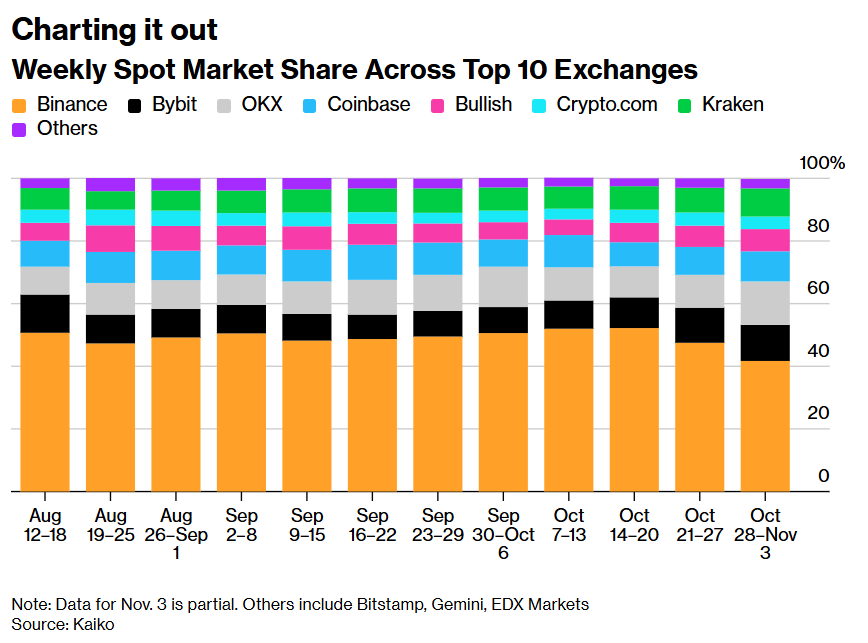
Binance may have digested the largest ever crypto hack with relative ease, but not without ceding some of its dominance in digital-asset trading to rivals. The exchange’s share of crypto trading fell to its lowest level in at least 12 weeks as platforms including OKX gained ground in the aftermath of last week’s $6.3 billion hack, according to data from Kaiko, an analytics firm.
Counting it out
$1 billion
Investors pulled over $1 billion from US-listed Bitcoin funds over two trading sessions, as the record Binance hack and uncertainty around the US midterm elections remain an overhang on sentiment.
Hearing them out
“There’s an understanding that some of the benefits that crypto companies have seen from regulatory changes made by the SEC and CFTC are not necessarily permanent and will depend on the outcome of elections.”
Mark Palmer
Senior equity research analyst StoneX Financial
Written by: Scott Patterson @Bloomberg
The post “Restarting the Pro-Crypto Agenda After a Record-Breaking Hack” first appeared on Bloomberg