
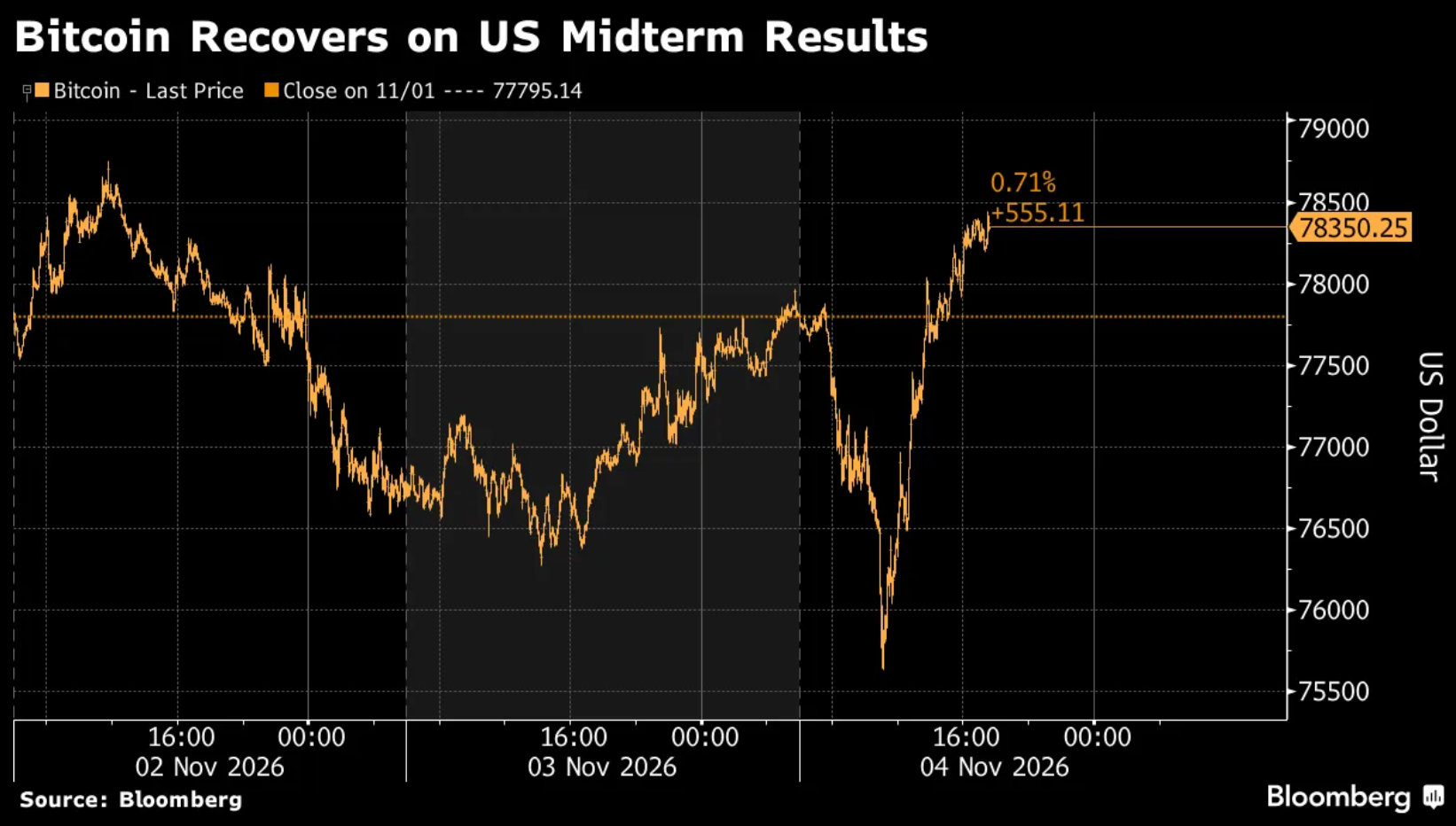
Bitcoin joined a broad rebound across financial markets Wednesday, recovering from a multi-week low even as a Democratic sweep of Congress threatened to deal a fresh setback to the cryptocurrency industry’s political ambitions.
The original cryptocurrency rose as much as 1% to around $78,600 in pre-market trading in New York, erasing an earlier drop as stocks also reversed losses sparked by the election results. The recovery offered some relief to a market already battered by a major exchange hack and withdrawals from Bitcoin funds.
For crypto, the election poses a political setback but a more complicated economic picture. Democratic control of Congress threatens to stall industry-backed legislation and bring tougher scrutiny of digital-asset firms. Yet political gridlock could curb government borrowing and pull Treasury yields lower, potentially supporting riskier investments. The picture is further muddied by the AI boom, which has drawn speculative capital away from crypto but whose weakening could also drag down stocks and broader risk appetite.
Hopes for an easing of the conflict with Iran offer another potential source of support.
“Bitcoin is rallying back as Trump has indicated that he will respect the election results and, as US voters have voted against the war, there is now hope that peace negotiations will resume,” said Markus Thielen, head of 10x Research, referring to the war with Iran that started in February. “Bitcoin is now oversold and should rally.”
With Democrats retaking Congress on the back of voter angst, the legislative branch will be at odds next year with President Donald Trump’s Republican White House. Trump told the New York Times that he would work with the opposing party. The dollar weakened against its major peers, reflecting expectations of gridlock in Washington.
Crypto companies also saw some strength in premarket trading. Bitcoin treasury firm Strategy Inc. rose 2.3%. Coinbase Global Inc., the largest US crypto exchange, was up 1.5%, while stablecoin issuer Circle Internet Group Inc. rose 1.2%. Circle is scheduled to report quarterly earnings before the market opens.
The digital-asset industry has poured money into shaping the political landscape since Trump ran for a second presidential term in 2024. Crypto companies contributed $189 million to political action committees in the 2026 midterm cycle through the first quarter — more than a third of corporate election spending, according to the consumer rights advocacy group Public Citizen.
Much of that corporate spending went to the PAC Fairshake, which poured tens of millions of dollars into races involving candidates seen as friendly to the crypto industry. That included Ohio Senator Jon Husted, who benefited from heavy spending by a Fairshake-affiliated PAC before being defeated by former Senator Sherrod Brown on Tuesday.
For investors, the immediate concern is that a Democratic takeover could stall industry-backed legislation and bring tougher scrutiny of digital-asset firms. The broader macroeconomic implications are less clear. Political stalemate could limit fiscal stimulus and weigh on speculative assets, though lower Treasury yields could eventually provide support by easing financial conditions.
Market Malaise
For now, Bitcoin trading offers limited utility as a gauge of broader market sentiment. Crypto has been grappling with the fallout from a $6.3 billion hack of largest exchange Binance last week and diminished retail enthusiasm amid the artificial intelligence boom. Those pressures make it harder to separate the macro-driven market moves from industry-specific issues already weighing on digital assets.
Meanwhile, the Trump family’s financial gains from its crypto ventures became a contentious issue this year, helping derail a regulatory bill seen as critical to the industry.
“With the Clarity Act already stalled in the Senate, a change in committee control would most likely mean renegotiation rather than a quick revival, and markets had largely priced that in,” said Rachael Lucas, an analyst at BTC Markets.
Bitcoin is down roughly 4% from the high last Thursday, before the Binance hack. Nearly $1.2 billion flowed out of US-listed spot Bitcoin exchange-traded funds from Friday to Tuesday. Options markets continued to show demand for downside protection across maturities, even as open interest remains tilted toward calls, or the right to buy Bitcoin, in several of the largest expiries.
“As a Democratic sweep became more likely, clients shifted from buying upside calls to downside puts,” said Sean McNulty, a derivatives trader at market maker AQC Tech.
Written by: Suvashree Ghosh — With assistance from Emma Haidar @Bloomberg
The post “Bitcoin Rebounds With Stocks Despite Threat to Crypto Agenda” first appeared on Bloomberg