
French unions and student groups were engaged in another day of strikes and protests on Tuesday, testing the momentum of a movement that has brought repeated disruption in recent weeks.
Protesters are seeking to keep up pressure on the government after it offered concessions including a boost to the minimum wage and pledges to invest in education infrastructure.
“Our numbers and determination have forced the government to open its checkbook. Although their announcements are far short of our demands, we have made them react,” the student organization Coordination Nationale Lycéenne said in a statement calling for protests to continue.
A protest march in eastern Paris got underway around 2 p.m. on Thursday.
The high-school protests that began in September broadened into a backlash over rising living costs, with unions joining to demand higher wages in the public and private sectors. The grassroots Yellow Vest movement, which emerged in 2018, has also participated.
Cost of living and inequality were front and center at a presidential debate Monday night, when four candidates – Jean-Luc Mélenchon, Raphael Glucksmann, Bruno Retailleau and Gabriel Attal – sought to challenge the frontrunner Marine Le Pen.
Polls show Le Pen, who leads the far-right National Rally party, will likely make it to the second-round runoff on May 2 with her far-left rival, Mélenchon. Le Pen is the favorite to succeed President Emmanuel Macron, polls show.
The candidates took aim at Le Pen in the debate, with Retailleau of the Republicans party, calling her multiyear budget proposal, which would cut €140 billion cut in public spending, a joke. Mélenchon has called for raising the minimum wage and instituting an inheritance tax.
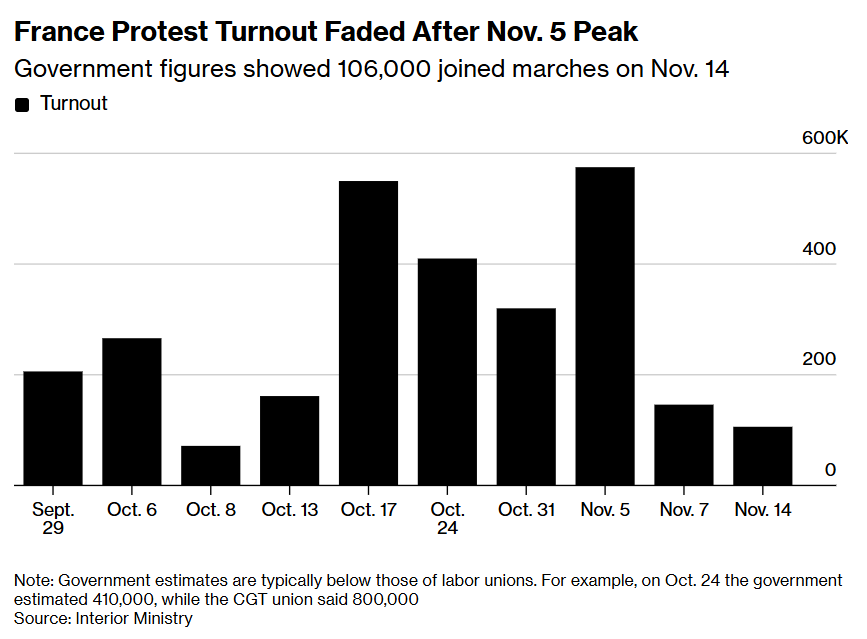
A bolstered police presence at marches has largely avoided a repeat of October 17, when protests degenerated into rioting and looting across the country. Turnout has also faded at the most recent demonstrations.
The minority government is running out of margin to react to demands by protesters as it also faces a parliamentary showdown over the budget. Its capacity to respond is also restricted by a surge in borrowing costs, as the combination of political, social and fiscal difficulties sparked bond market selloffs.
The government has focused much of its response on proposals that have no direct impact on public finances, including raising a cap on regulated savings accounts and overhauling the procedure for university admissions. Still, the increase in the minimum wage announced last week will cost the state around an extra €1 billion ($1.1 billion) as it also raises the lowest civil servant salaries.
“The problem is that with this government, it’s too little, too late,” Sophie Binet, the secretary general of the CGT union, said on Tuesday on RMC radio. “The only response we’ve gotten is a €5 monthly increase to the minimum wage. Frankly, that’s not nearly enough.”
Written by: William Horobin — With assistance from Phil Serafino @Bloomberg
The post “France Faces More Strikes and Protests Over Cost of Living” first appeared on Bloomberg