
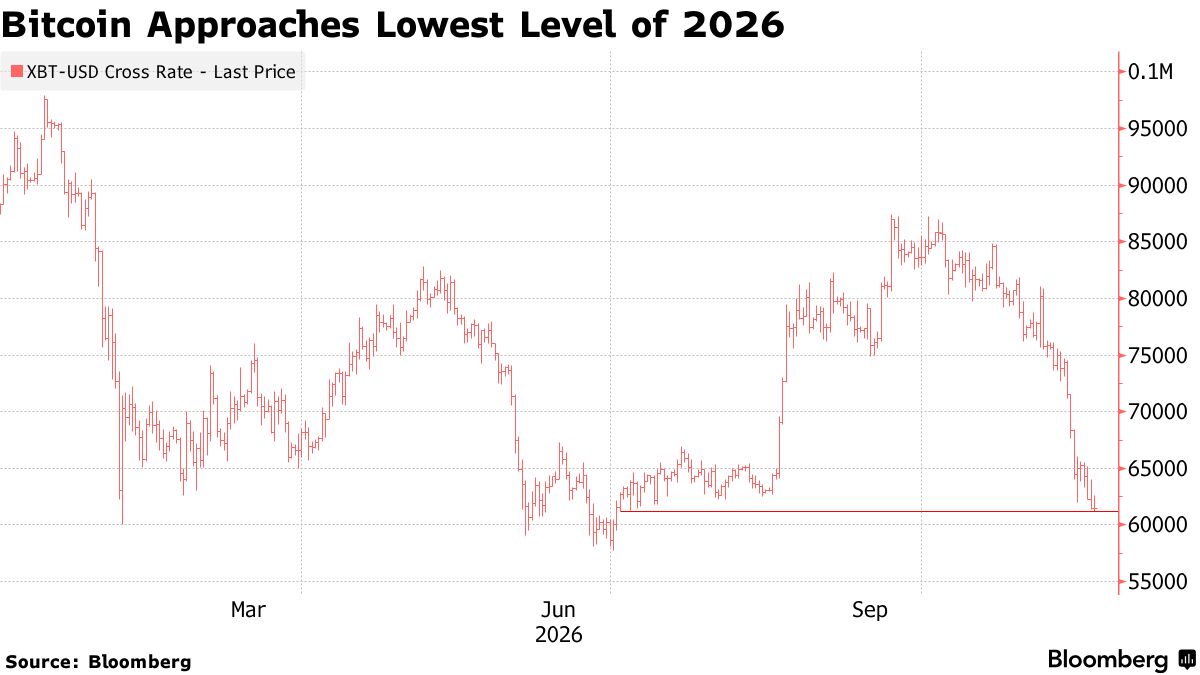
Bitcoin dropped below $58,000 for the first time since July on Friday, as concerns about an unraveling of the artificial-intelligence trade spurred a rush from riskier assets.
The original cryptocurrency — down as much as 5.7% to $57,979 — is on pace for a seventh straight weekly decline, its longest losing streak since 2022. Smaller tokens fell more, with Zcash tumbling around 13% and Ether off 9%.
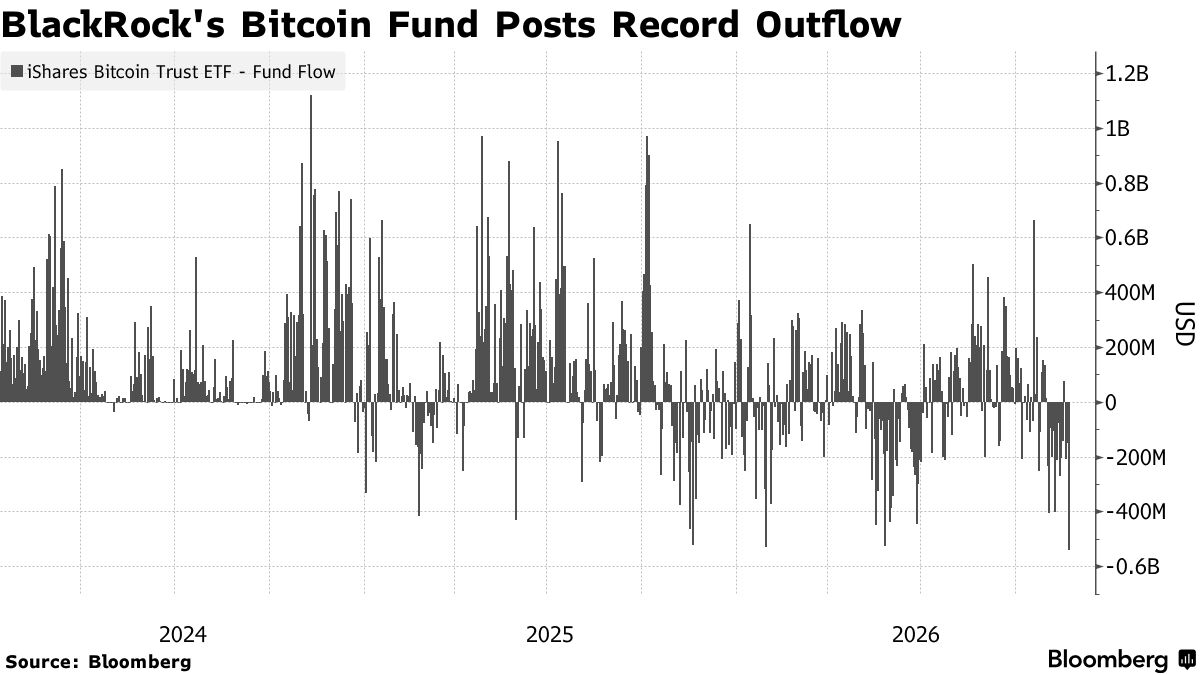
Investors pulled a record $541.1 million from BlackRock Inc.’s spot Bitcoin fund on Thursday. The withdrawal from the iShares Bitcoin Trust accounted for most of the $582 million that left US spot Bitcoin funds during the session. The funds have recorded net outflows in 12 of 14 trading sessions this month.
A stronger dollar and rising expectations of another Federal Reserve rate increase put pressure on markets this week. The pullback reached both trades that had ridden strong price momentum and those that had benefited from bets on lower rates. Bitcoin is down more than 50% from its all-time high set in October 2025.
The last time Bitcoin had a longer losing streak, it fell for eight weeks through May 29, 2022, as the Fed raised rates and the collapse of the TerraUSD stablecoin and its sister token Luna rattled crypto markets.
“With ETF outflows telling the story and a hawkish Fed maintaining pressure on risk assets, institutions are not yet stepping in to buy meaningfully,” said Paul Howard, senior director at market maker Wincent.
On Friday, Bitcoin’s slide triggered the liquidation of roughly $1.5 billion in long crypto bets over 24 hours, with Bitcoin positions accounting for the majority of that sum, according to Coinglass data.
“What made the move so fast was leverage,” said Andrew Yang, research analyst at Kaiko. “As Nasdaq losses deepened again in late-morning New York trading, Bitcoin broke below $60,000, triggering $94.6 million in BTC liquidations on Binance, Bybit and OKX in a single hour.”
Large liquidation events — in which more than $500 million worth of Bitcoin positions are wiped over 24 hours — are becoming a recurring feature in the market, as sharp swings repeatedly flush leveraged traders out of their bets.
Anthropic PBC shares erased much of their first-day jump on Friday, testing investors’ faith after the AI lab delivered the biggest initial public offering in history. The tech-heavy Nasdaq 100 Index dropped 4.3%.
“Digital assets are selling off along with other risk assets due to broader macro concerns around the sustainability of the AI Capex cycle and its impact on earnings,” said Cosmo Jiang, general partner at Pantera Capital.
Bitcoin has been caught in a confluence of pressures in recent weeks. A hack of Binance, the world’s largest crypto exchange, at the end of October rattled digital assets, while sweeping Democratic victories in the US midterm elections the following week fueled concerns about the outlook for AI companies.
Since Oct. 30, the first US trading session after the Binance hack, roughly $4.1 billion has flowed out of spot Bitcoin ETFs.
Bitcoin has continued to behave like a risk asset, often falling alongside tech stocks. Its 40-day correlation with the Nasdaq 100 has climbed to 0.69, according to data compiled by Bloomberg.
“On days the Nasdaq fell 1% or more, Bitcoin fell about three quarters of the time,” crypto market maker DWF Labs said in a report showing the relationship since 2020. “History says Bitcoin is a risk-on asset, not a safe haven.”
Still, Wincent’s Howard said Bitcoin could see an “orderly recovery over the winter months.”
“With the Anthropic IPO now in the rear-view mirror, we could start to see capital rotating back into crypto as Bitcoin tests lower price levels,” he said.
Written by: Sidhartha Shukla, Olga Kharif, and Emma Haidar @Bloomberg
The post “Bitcoin Breaks Below $58,000 With Investors Fleeing Risk Assets” first appeared on Bloomberg