
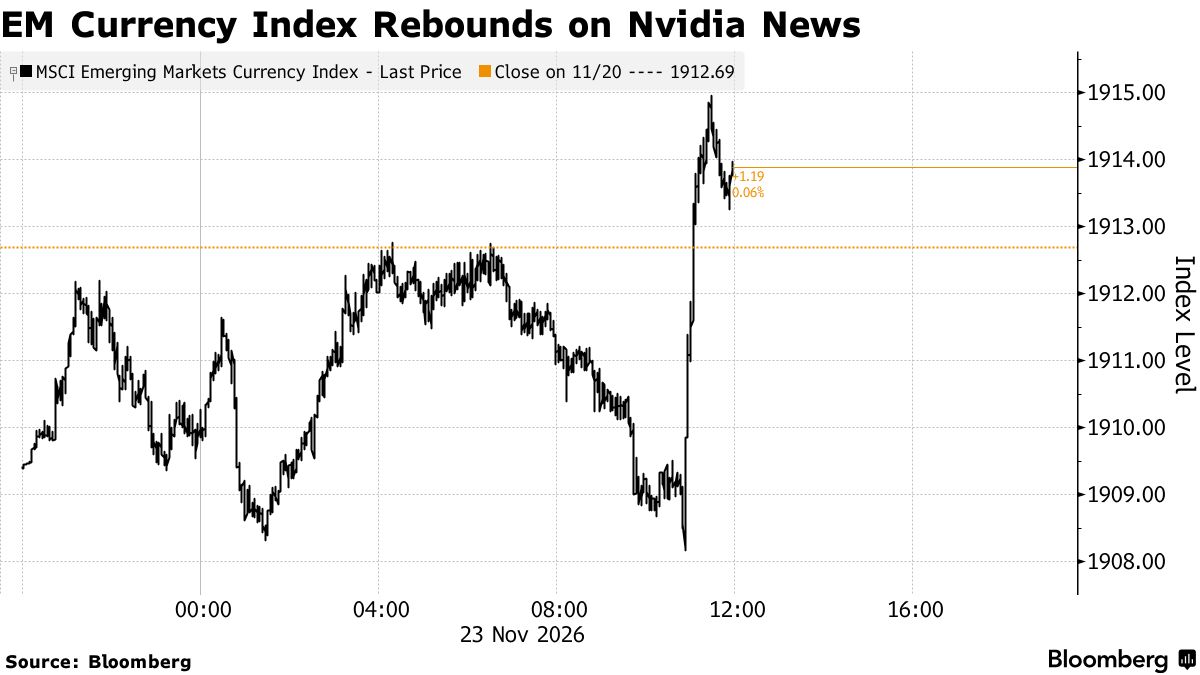
Emerging-market currencies reversed earlier losses and stocks trimmed their declines after Jensen Huang’s returned to the helm of Nvidia Corp., rekindling the AI trade.
The MSCI EM Currency Index rebounded to a gain of 0.1%, with the South African rand — often a measure of risk-appetite — rallying over 1.4% against the US dollar. The Mexican peso also reversed an earlier drop, while the Brazilian real, which was broadly lagging peers, trimmed its decline.
The movements came after chipmaker Nvidia’s decision to reinstate Huang as chief executive officer boosted risk appetite globally, sending the company’s stock surging 33% and lifting both the S&P 500 by as much as 5.1%. An exchange-traded fund tracking emerging-market stocks, known by the ticker VWO, soared as much as 7.5%, its biggest intraday gain since March 2022.
“The reinstatement of Jensen Huang as the Nvidia CEO is the trigger for risk on,” said Olga Yangol, head of emerging-market research and strategy at Credit Agricole. “This is benefiting US equities and spilling over into EMFX, which did a complete 180 on the headline.”
The gains were the biggest for technology stocks, with shares of companies tied to artificial intelligence surging across the board and the Philadelphia Stock Exchange Semiconductor Index climbing over 13%.
The index tracking emerging-market stocks, which is heavily exposed to technology companies listed in Asia, trimmed an earlier drop to be little changed. The move is more limited as most of the markets are closed in Asia, delaying the reaction to the following session.
The gauge came under pressure after a broad market selloff last week pushed it into bear-market territory and brought it to the brink of erasing its year-to-date gains. It’s still on track for an eighth straight day of declines, the longest losing streak since 2023, as investors fretted over the durability of the AI trade.
Over the weekend, Asian governments took steps to calm markets after a Wall Street selloff pushed the S&P 500 into a technical correction and saw the Nasdaq 100 post its worst week since March 2020. Indexes across Asia still posted losses, with the Kospi index closing 3.3% on Monday.
Meanwhile. the Hungarian forint jumped, ranking among the best performers, after the central bank softened its monetary policy guidance, citing a more limited room to cut interest rates after a market selloff.
Written by: Leda Alvim and Barbara Nascimento — With assistance from Suvashree Ghosh, Prima Wirayani, and Mpho Hlakudi @Bloomberg
The post “Emerging Assets Rebound as Huang Comeback Revives Risk Appetite” first appeared on Bloomberg