
German Chancellor Friedrich Merz on Friday implored Germans to either embrace uncomfortable reforms or watch their economy fade.
“Our nation is in the midst of an important, perhaps decisive phase in its modern history,” Merz said in a speech in Saarbruecken marking 35 years since German reunification. “Many things must change if they are to remain as good as they are, or even to improve.”
Merz’s plea reflects Germany’s deep-rooted fear that its once-powerful business model is eroding, with high energy prices, cheap Chinese electric vehicles and spiraling defense costs all battering the country’s industries.
Despite this, the chancellor has struggled to unite his coalition on a solution, as his conservative camp butts heads with its center-left partners.
The remarks were unusual given the setting — an event to celebrate German reunification. German chancellors typically use the anniversary, which this year featured French President Emmanuel Macron, to discuss the still-difficult relationship between the former West Germany and the ex-communist eastern states.
In a similar tone, Macron warned against what he described as “the degeneration of democracy” and urged Europeans to embrace difficult economic, security and technology adjustments.
“Our generation has a choice,” he said. “To choose or allow the extremes, which are false promises in the face of this doubt, or to stand up again and decide to embrace our new era, and make it an era of boldness and determination,” he added, to loud applause from the audience.
Merz nodded at the history, encouraging Germans to come together once again in the present.
“After 35 years of German unity — and in a difficult time for our country — we should regroup and look forward with confidence and energy,” Merz said. “Let us make a joint effort for new unity in our country.”
But he also used the speech to sell some political priorities, including rebuilding Germany’s military.
“We must learn to defend ourselves again,” Merz said, following a series of drone sightings near critical infrastructure sites that have alarmed German authorities. European leaders discussed similar airspace violations during two summits in Copenhagen this week, calling the incidents part of Russia’s hybrid war on western allies.
Merz’s latest pitch for reform, which the chancellery carefully orchestrated, reveals the deepening anxiety in Berlin about the country’s economic weakness and divisive mood.
Germany’s struggling economy has faced repeated setbacks of late, complicating Merz’s promise to reignite growth. After a strong start to 2025, output shrank 0.3% in the second quarter and is only likely to edge up slightly over the year as a whole.
The Bundesbank sees gross domestic product rising slightly between July and September as drags from trade with the US fade. With a US-European Union tariff accord reducing uncertainty, the outlook for Germany’s economy among firms has been improving.
Still, Merz’s coalition is mired in divisions, especially over potential reforms to Germany’s welfare state. The chancellor’s Christian Democratic Union and its sister party, the Christian Social Union, are pushing for revisions, while the Social Democratic Party remains reluctant.
A two-day coalition retreat this week failed to produce any decisions on basic reforms.
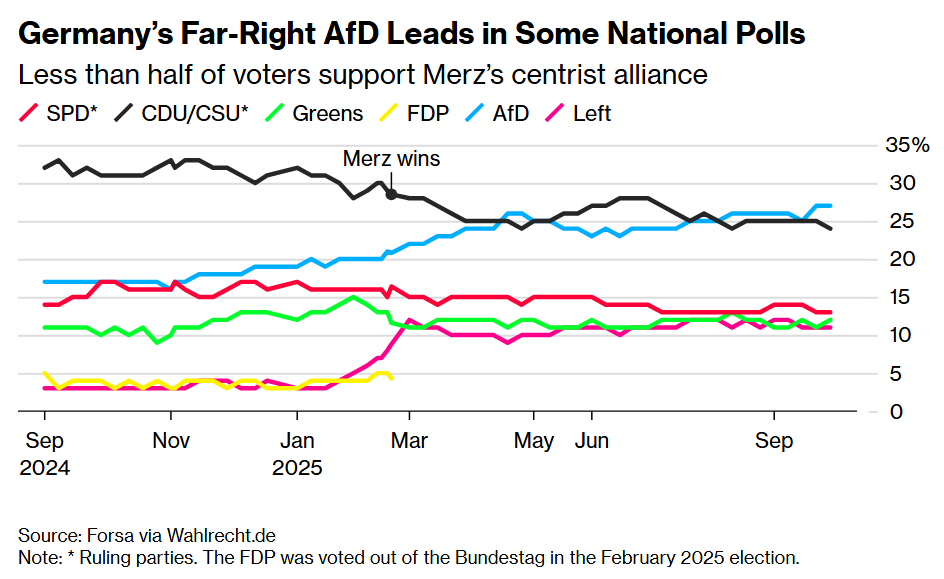
The ruling alliance has also failed to stall the rise of the Alternative for Germany, the far-right party that has successfully tapped into voters’ migration concerns.
A Forsa survey published Tuesday showed the AfD had stretched its lead over Merz’s bloc to three percentage points for the first time, with 27% backing to the CDU/CSU’s 24%.
The SPD trailed in third at 13%, just ahead of the Greens and the Left party.
Additionally, Merz’s personal ratings have been consistently poor, even before the government took office in early May. In the Forsa poll, only 26% of respondents said they were satisfied with his performance as chancellor.
Written by: Arne Delfs, Stephan Kahl, and Samy Adghirni — With assistance from Zoe Schneeweiss @Bloomberg
The post “Merz Urges Germans to Accept Change or Suffer Economic Slide” first appeared on Bloomberg