
A buildup of leveraged hedge fund bets in Treasuries has left investors exposed to abrupt position shifts that could amplify stress across global bond markets, according to Apollo Global Management Inc. Chief Economist Torsten Slok.
Hedge funds now own roughly 8% of the entire $31 trillion US Treasury market, according to Apollo calculations, based on the latest data from the Federal Reserve and Office of Financial Research. That’s up from just 3% five years ago. The buildup has been fueled by heavy borrowing, with combined financing via repurchase agreements and prime brokerages now exceeding $6 trillion, Slok said in a Friday blog post.
“Any forced unwind of these leveraged positions could send shockwaves through global fixed income markets,” he wrote.
Slok’s warning underscores broader concerns about the resilience of the Treasury market. Earlier this week, former Treasury Secretary Henry Paulson said that US authorities need to prepare a back-up plan in order to avert a potential collapse in demand for US government debt tied to long-running worries over the federal debt load — an event that he said would have “vicious” effects.
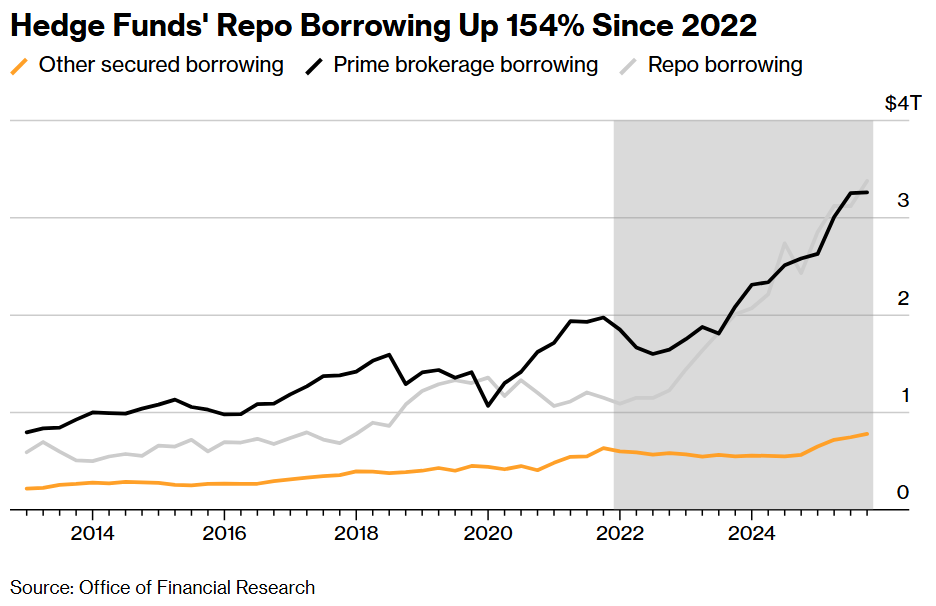
Regulators have for years been raising red flags about the growing role of hedge funds in the US bond market, particularly those engaged in relative-value strategies such as the cash-futures basis trade.
That strategy exploits small price discrepancies between Treasury securities and futures, relying heavily on cheap and stable short-term funding as well as significant leverage.
A sharp rise in funding costs and volatility at the height of the pandemic triggered a rapid unwinding of these positions, exacerbating turmoil in the bond market and ultimately prompting the Fed to step in.
Estimates of the exact size of hedge funds’ exposure to Treasuries vary. In a November speech, Fed Governor Lisa Cook said their holding of Treasury cash securities — including bills, notes and bonds — reached a peak of more than 10% in the first quarter of 2025, up from 4.6% in the first three months of 2021.
Written by: Ye Xie — With assistance from Alex Harris @Bloomberg
The post “Hedge Funds’ Treasury Bets Risk Market Shock, Apollo’s Slok Warns” first appeared on Bloomberg