
A drone strike near the United Arab Emirates’ only nuclear power plant has underscored the fragility of the Iran war ceasefire and vulnerability of such civilian energy infrastructure.
Barakah is the Middle East’s largest nuclear power plant, located around 280 kilometers (174 miles) west of Abu Dhabi and close to the UAE’s border with Saudi Arabia. The aerial assault didn’t cause any casualties or abnormal radiation, but did trigger the plant’s emergency power supply.
The UAE hasn’t named a perpetrator and nobody has claimed responsibility for the strike. However, Anwar Gargash, a senior foreign-policy adviser to President Sheikh Mohamed bin Zayed, alluded to Iranian involvement. The attack, “whether perpetrated by the principal or through one of its proxies,” is a “dangerous escalation,” he said. The UAE has been repeatedly targeted by Iran since the US and Israel launched strikes against the Islamic Republic in late February.
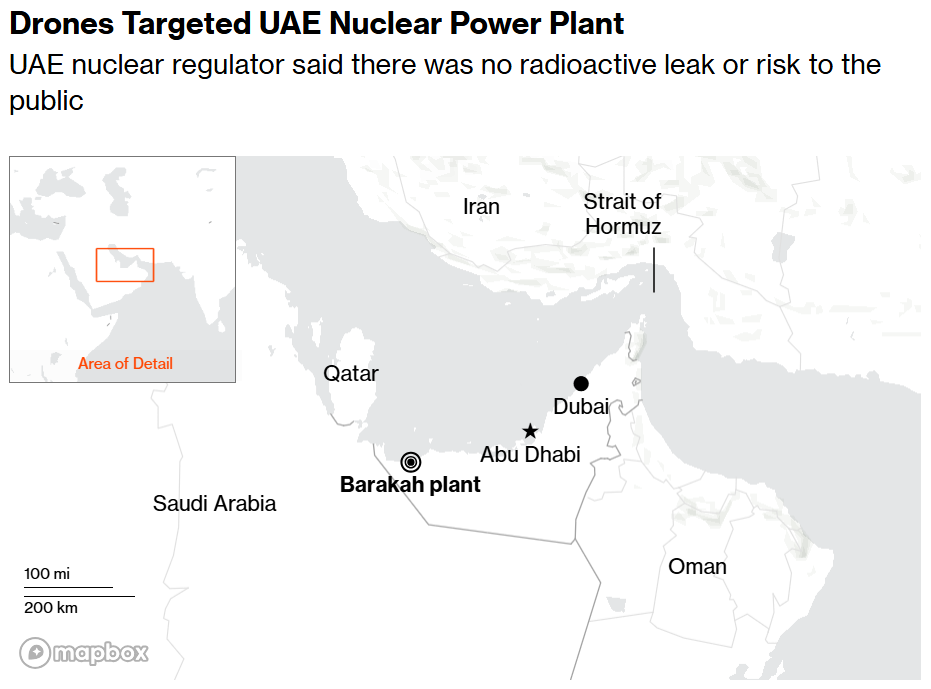
How serious was the drone attack?
The UAE’s nuclear safety regulator said that a drone hit an electrical generator at the Barakah plant on the morning of May 17. The strike caused a fire outside the plant’s inner perimeter, which activated emergency diesel generators to supply electricity to one of four reactors.
Backup power is one of the last lines of defense to maintain nuclear safety. Nuclear plants need a constant supply of electricity to keep cooling and circulation systems running. Most stations have enough diesel to be able to operate for several weeks if offsite power is lost.
Without electricity, the fuel inside a reactor’s core can overheat, potentially resulting in a dangerous release of radiation. That’s what happened in 2011 at Japan’s Fukushima nuclear plant, when a tsunami wiped out the reactors’ backup power generators.
While Barakah’s radiation levels are currently normal, if there’s a safety incident that results in a significant release of radiation, the impact would likely spread beyond the UAE. Radioactive particles could be transported by the wind and deposited in neighboring countries or across the Persian Gulf.
Egypt, Jordan and Saudi Arabia condemned the May 17 strike. The head of the International Atomic Energy Agency, Rafael Grossi, said the attack was “unacceptable” and urged “maximum military restraint” to avoid a nuclear accident.
How significant is the Barakah nuclear power plant?
There are only two active nuclear power plants in the Middle East: Barakah in the UAE and Bushehr in southern Iran. Barakah’s four reactors can generate as much as 5,600 megawatts of electricity in total, whereas the one reactor at Bushehr has a capacity of 1,000 megawatts.
Turkey is building a nuclear plant that’s expected to become operational this year, while Egypt is scheduled to bring a facility online in 2028.
Barakah meets about a quarter of the UAE’s electricity demand. Built by Korea Electric Power Corp. and connected to the grid in 2020, the plant has helped reduce the country’s dependence on fossil fuels for power generation and enabled more of its oil and gas to be exported rather than used domestically. Barakah is considered a success story for nations that are relative newcomers to nuclear power as it was finished within budget and on time — something many projects have struggled to do.
How exposed are nuclear power plants to war?
More than half a dozen nuclear power stations and facilities have come under attack over the last five years. The wave started in 2022 when Russia seized control of Ukraine’s Zaporizhzhia plant, the largest nuclear power station in Europe. While Zaporizhzhia’s six reactors are currently shut down, they still require continuous cooling and have been battling intermittent power failures for the last four years.
Despite appeals by the IAEA — which has placed monitors at Zaporizhzhia to prevent an accident — countries have continued to disregard international rules against assaulting nuclear sites. Attacking nuclear power plants violates the Geneva Conventions — the international treaties that cover conduct during war — and runs contrary to legal resolutions passed by the United Nations Security Council and IAEA board of governors.
Facilities around Iran’s Bushehr plant have been attacked at least four times during the current war. The IAEA warned that such incidents could cause a “severe radiological incident” that would impact the entire Gulf region. The US and Israel have also attacked Iran’s nuclear fuel sites in Isfahan, Fordow and Natanz, resulting in localized contamination.
Other nuclear facilities that have been targeted in recent years include Russia’s Kursk plant. Iran fired missiles in March at the city of Dimona, where Israel’s main nuclear site is located, although no damage to the reactor was reported.
What do attacks on civilian infrastructure mean for the nuclear industry?
Attacks on nuclear installations aren’t just a danger to health and safety, they also risk undermining the emerging nuclear renaissance in Western economies as an alternative to fossil fuels.
The public, and by extension politicians, are highly sensitive to radiation emergencies. An incident in one country tends to dampen enthusiasm for nuclear power around the world. Major accidents at Three Mile Island in the US, Chernobyl in Ukraine and Japan’s Fukushima have had lasting legacies in undercutting consumer confidence in nuclear energy.
The nuclear industry has called for a deescalation of strikes. “Attacks on energy infrastructure are reckless and unacceptable,” lobbyists at the World Nuclear Association wrote in response to the attack in the UAE. “It is vital that protections afforded to civilian infrastructure — especially nuclear power plants — are reaffirmed and respected.”
Written by: Jonathan Tirone @Bloomberg
The post “How Attack on UAE Shows Nuclear Plants’ Vulnerability in War” first appeared on Bloomberg