
New York City Comptroller Mark Levine says the unprecedented control that Elon Musk will have over SpaceX represents a new level of disregard for regular shareholders’ rights.
“I understand that we are in an era of founders wanting more control,” Levine said in an interview. But what Musk is planning with SpaceX “is way beyond what we’ve seen.”
“There’s no precedent for this,” he said.
SpaceX, which is due to go public this week, is drawing a frenzy of interest from investors desperate to participate in what is set to be the biggest initial public offering ever undertaken. But buying into the company requires accepting a governance structure that gives Musk roughly 80% of the voting rights, while also making him chief executive and chief technical officer, as well as chair of the board.
SpaceX’s Mission:
“Our mission is to build the systems and technologies necessary to make life multiplanetary, to understand the true nature of the universe, and to extend the light of consciousness to the stars. To do this, we have formed the most ambitious, vertically integrated innovation engine on (and off) Earth with unmatched capabilities to rapidly manufacture and launch space-based communications that connect the world, to harness the Sun to power a truth-seeking artificial intelligence that advances scientific discovery, and ultimately to build a base on the Moon and cities on other planets.”
Not investing in SpaceX, which is already forcing markets to adjust around it, isn’t easy for a large, index-tracking investor.
Levine, whose job entails overseeing about $300 billion in both actively and passively managed portfolios in New York city’s public pension funds, says it would be “very complicated” to exclude SpaceX.
“We’ve never divested from a single company,” he said. “We’ve done sector-based exclusion only,” so blacklisting SpaceX “would be unprecedented for us and it is not simple.”
Instead, Levine says he plans to push for a more democratic corporate governance process from within.
Musk can’t be allowed to “disempower” shareholders, he said, adding that investment professionals in New York have told him they want him to “keep fighting on this.”
A Bloomberg request for comment from SpaceX, sent by email, went unanswered.
Levine, along with Marcie Frost, chief executive of California Public Employees’ Retirement System, and Thomas DiNapoli, the State of New York Comptroller, last month raised “serious concerns” about the “extreme governance structure” at SpaceX. Their letter, sent to Musk a week before the May 20 IPO filing, received no answer, Levine said.
On Tuesday, the Council of Institutional Investors sent a letter to SpaceX outlining its concerns about shareholder rights and corporate governance. The nonprofit, whose members include some of the biggest US public pension funds, said it’s urging SpaceX to “reconsider” several governance provisions before completing its offering.
SpaceX Voting Profile vs. Mag 7
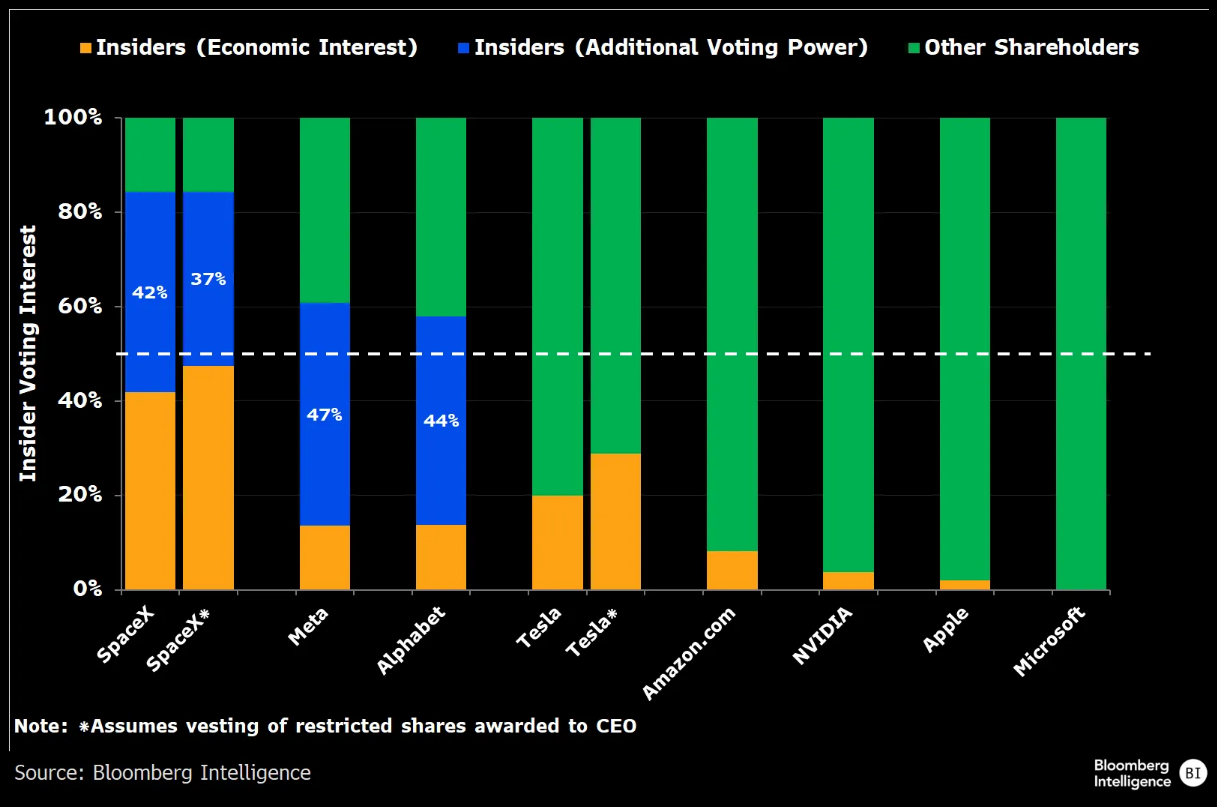
The SpaceX IPO is already oversubscribed, with the offering expected to price on June 11 and begin trading the following day. The $75 billion being sold this week values the company at roughly $1.8 trillion.
For some ESG-focused investors, governance concerns have proved a dealbreaker. AkademikerPension, a Danish pension fund with $25 billion in assets, said at the end of May it won’t be participating in the IPO. Not only is SpaceX “grossly overvalued” but it also has a “catastrophic governance structure,” AkademikerPension Chief Investment Officer Anders Schelde said on May 29. The fund will also exclude SpaceX via passive, index-tracking investments, he said.
In the UK, EdenTree Investment Management told Bloomberg it’s expecting to stay away from the IPO. SpaceX’s intended governance structure would “reduce the protections available to minority investors,” said Hayley Grafton, senior sustainable investment analyst at EdenTree, which manages around $4.3 billion in assets.
“The main question for us is whether we are comfortable allocating clients’ assets to a structure where weak investor protections appear to be the price of admission,” Grafton said. “On the information available today, the answer is, ‘No’.”
Bård Bringedal, CIO for equities at Norway-based Storebrand Asset Management, says the investor “notes that SpaceX’s governance structure raises a number of clear concerns.”
For that reason, the $145 billion asset manager has “no plans to invest in SpaceX in our actively managed strategies,” he said. However, the company “does not meet our exclusion criteria,” meaning Storebrand’s “index-tracking strategies may still gain exposure if the company is included in relevant benchmarks,” Bringedal said.
SpaceX is set to be fast-tracked into the Nasdaq 100 Index, after Nasdaq Inc. changed its rules to accommodate the company. S&P Dow Jones Indices’ index committee, meanwhile, won’t drop its requirement that companies generate positive net income for at least a year before they can join the S&P 500 Index.
Fast-tracking SpaceX into indexes is not “prudent,” Levine said. “The whole idea of having a waiting period is that stocks tend to be volatile in the early days because they’re unproven. I think it would be prudent to take a little bit of time and see where it stabilizes at.”
Nell Minow, co-founder and chair of ValueEdge Advisors LLC, says she’s advising clients asking about this week’s SpaceX IPO “not to buy the stock or the indexes,” because, in her view, the company’s offering “extinguishes shareholder rights entirely.”
Instead, Minnow says she’s “recommending that large institutional investors tell their financial institutions to create new indexes” that exclude SpaceX.
For the most part, however, governance concerns aren’t preventing investors from lining up for a piece of SpaceX. And any ESG advisers telling CIOs to stay away from SpaceX might find they just sent a “career-ending memo,” according to one former UK-based sustainability manager who asked not to be identified by name discussing such a sensitive matter.
The ESG considerations around SpaceX are “highly complex,” says Nick Gaskell, senior sustainability investment manager at Aberdeen Investments. “Taking a balanced view, there is clear value from SpaceX operations,” he said.
SpaceX announced in February that it had acquired Musk’s xAI, which includes the chatbot, Grok, and the social media platform, X. The deal gave SpaceX a valuation of $1 trillion at the time, and xAI a value of $250 billion, Bloomberg News reported at the time.
Grok was recently the target of widespread criticism after it was used to generate sexualized images of people without their consent. In January, California Attorney General Rob Bonta launched an investigation into “the proliferation of non-consensual sexually explicit material produced using Grok.” xAI has since applied some restrictions and blocking mechanisms to prevent users “undressing” real people.
At the same time, the energy and water consumption of the data centers powering artificial intelligence has drawn criticism from climate activists. Musk’s efforts to build data centers in Tennessee and Mississippi, for example, are currently being fought by local communities worried about the ramifications for regional water supply, prices and pollution.
AI is expected to be a major driver behind the rise in global electricity demand toward 2030, the International Energy Agency said last year. However, much of that demand will be filled with low-carbon energy sources, the IEA also noted, adding that the computational capability of AI may actually help expedite efforts to cut planet-warming emissions.
SpaceX recently amended its IPO prospectus to include water scarcity and drought as potential risk factors to its data center projects. And Musk has famously said he plans to put data centers in space, in order to rely on solar power and not place any burden on Earth-based grids. The technology behind that plan, however, remains unproven.
Gaskell of Aberdeen says SpaceX is helping to improve the supply-chain efficiency of the International Space Station, while Starlink plays a role in providing easier internet access in remote areas.
Miranda Beacham, head of responsible investment at Aegon AM, says she would expect SpaceX to provide shareholders with “the usual information” on metrics such as climate and greenhouse gas emissions.
And “we would expect further details on the strategy for sourcing renewable electricity and carbon offsetting strategy,” she said.
However, given the “lack of accountability built into the governance structures of SpaceX,” she said, “the normal avenue of stewardship activities to improve these matters may be of limited use.”
Written by: Olivia Raimonde, Frances Schwartzkopff, and Alastair Marsh @Bloomberg
The post “NYC Pensions Boss Says SpaceX’s Disregard for Shareholders Has ‘No Precedent’” first appeared on Bloomberg