
Even hedge funds are divided about whether to ride the artificial intelligence wave or position for a nasty stock-market correction.
Andreas Halvorsen’s Viking Global Investors, which manages more than $50 billion, is among the cautious few.
He recently told investors his hedge fund reduced its net exposure to below its historical average. Halvorsen has expressed concerns about lofty valuations and high capital expenditures for AI and sees little margin for safety, given fragile US economic growth, hot inflation and a tumultuous geopolitical climate.
Renaissance Technologies’ computer-driven models are also betting that equities will fall after going on a tear over the past 3 1/2 years.
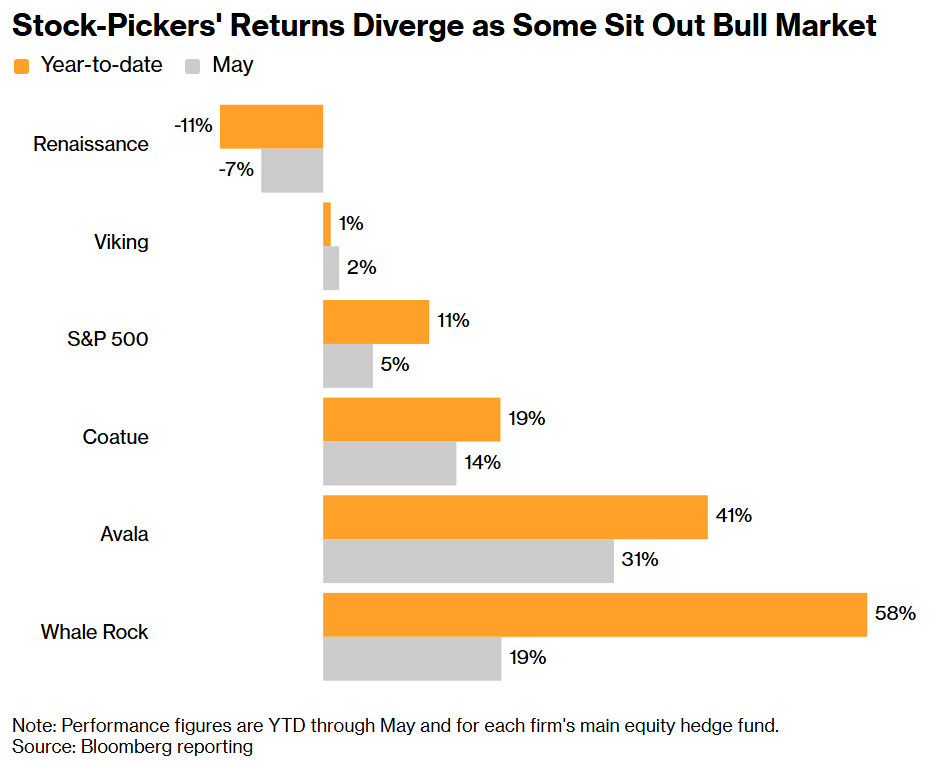
Because of their more bearish bent, the two firms have missed out on a rally that drove robust returns for some of their biggest rivals. Viking gained 1.7% in May, helping it eke out a gain of just 0.8% for the first five months of the year, while Renaissance tumbled 6.6% last month, extending its 2026 decline to 11%, according to people familiar with the matter.
Meanwhile, Philippe Laffont’s $70 billion Coatue Management advanced 19% this year through May, just shy of the 20% return for the tech-heavy Nasdaq 100. Some smaller hedge funds have done even better, with Divya Nettimi’s Avala Global and Alex Sacerdote’s Whale Rock Capital Management posting gains of 41% and 58%, respectively, one of the people said, asking not to be identified discussing confidential information.
Big bets on AI-related stocks are propelling some of their best monthly returns on record. Avala, which also makes some private-market wagers, climbed 31% in May alone, one of the people said.
Representatives for all of the firms declined to comment.
“I was reminded recently of the motto for my military unit: ‘Prepare for tomorrow’s threats today,’” Halvorsen, a former officer in the Royal Norwegian Navy, wrote in a letter to investors in April.
Bouts of volatility over the past week help support that caution. A tech rout on June 5 fueled a 4.8% decline in the Nasdaq 100, its biggest one-day drop in two months. The index swooned again this week, dropping 3.1% over the past two trading days.
Halvorsen previously acknowledged that Viking’s returns have been disappointing.
“It is not lost on us that markets have thus far rewarded ‘AI winners’ handsomely, and that our balanced positioning has been a headwind to performance,” he wrote in an October letter to clients.
Soaring valuations in public and private markets have stoked worries of an AI bubble akin to the dot-com crash early this century, when the Nasdaq 100 plunged 83% from its peak in the span of about 2 1/2 years. Today, just six stocks account for a third of the index’s weighting.
“It’s informative that there is divergence among these incredibly well-versed hedge funds,” said Wendy Li, co-founder and chief investment officer of Ivy Invest, which caters to retail clients with an endowment-style portfolio of fund managers. “It’s evident that even with them there’s no consensus on where markets are headed.”
Coatue is betting that a massive AI super-cycle has just begun and that now is the time to be invested in the technology. Nettimi, whose Avala Global manages $3 billion, is similarly bullish: Technology bets comprised about 46% of her firm’s long US stock wagers as of March 31, regulatory filings show. Amazon.com Inc, Nvidia Corp. and Microsoft Corp. are among its top five equity holdings.
Sacerdote’s Whale Rock also makes large tech bets and was a significant investor in Anthropic PBC’s Series G funding round. He predicts the company will reach 500 million users.
“We are so so early,” he said last week at the Sohn Montreal investment conference. “This is an L curve going straight up.”
The majority of tech-focused stock-pickers are bullish. Over the past 12 months, the cohort had the highest exposure to the Nasdaq Composite Index since 1998 and double the historical average, according to hedge fund research firm PivotalPath. For each percentage point the Nasdaq moves, funds in the PivotalPath Equity Sector TMT Index tend to move about 0.8% in the same direction.
“We have ongoing debates about this ourselves, about how we think about hedge funds in the portfolio,” said Li of Ivy Invest. “Is it a good thing that they are capturing beta? Or are they there to dampen volatility and decrease drawdown risk?”
Regardless on where they land, institutional investors should have done their due diligence.
“At the end of the day, investors know these funds and how they trade,” Li said. “They know what they’re getting into.”
Written by: Hema Parmar @Bloomberg
The post “ Hedge Funds Are Split Over How to Trade This AI-Fueled Market” first appeared on Bloomberg