
Federal Reserve Chairman Kevin Warsh said he is appointing a task force to examine the central bank’s $6.7 trillion balance sheet, a first step in addressing a policy issue he has long criticized.
Warsh said one of the independent task forces he is forming will “review the benefits and risks of the current ample reserves regime and the composition of the balance sheet.” His announcement came at a press conference after the Federal Open Market Committee held rates steady at a range of 3.5% to 3.75% on Wednesday.
The focus on the balance sheet sharpens questions over how aggressively a Warsh-led Fed will act. Warsh has called for dramatically paring back the central bank’s financial footprint, which ballooned under successive rounds of asset purchases amid the global financial crisis and Covid-19 pandemic. At its peak in June 2022, the Fed’s balance sheet had swelled to as much as $8.9 trillion from just $800 billion nearly two decades earlier.
Warsh said the task forces would begin their work in the coming weeks with “most if not all concluding by year-end.” The group charged with reviewing the balance sheet would examine whether “monetary policy is coming from our interest rate tool or our balance sheet tool,” he said.
The timing reinforced expectations on Wall Street that a shift toward a smaller balance sheet would unfold gradually over several years, with policymakers unlikely to focus on the issue until later this year as they address more immediate operational priorities.
“Warsh is trying to make a splash by committing to take a hard look at big questions, which is commendable for a new Fed chair,” said Gennadiy Goldberg, head of US interest rate strategy at TD Securities. “At the end of the day, the Fed still needs to bring inflation under control, which means that they need to sound hawkish in the near-term while they take a fresh look at the big questions.”
Fed officials were split over whether they expect to raise rates this year. Policymakers’ new projections indicated nine officials foresee at least one quarter-point hike this year, with six anticipating at least two. Another nine expected no move or a cut.
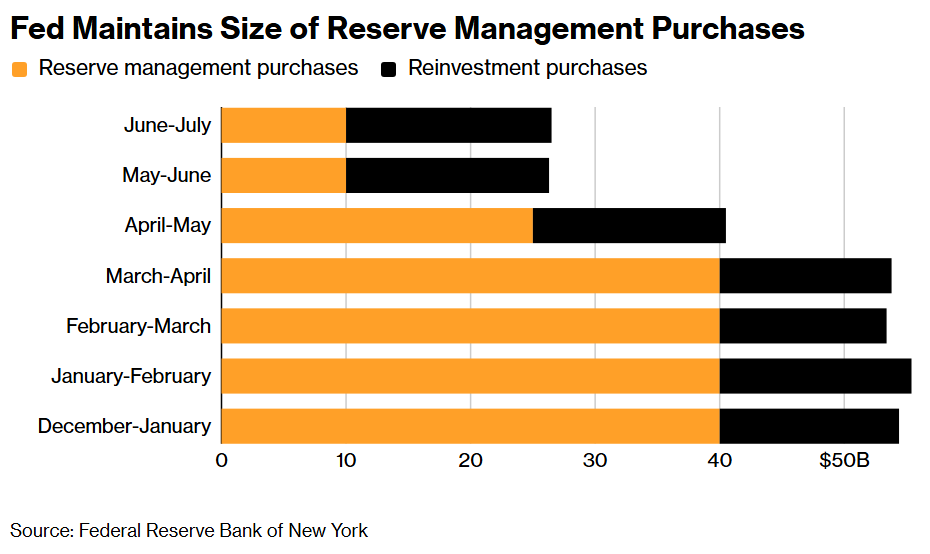
The Fed abruptly stopped shrinking its balance sheet — a process known as quantitative tightening — at the end of 2025 and pivoted to adding reserves back into the financial system by buying Treasuries that mature in less than a year.
In December, the central bank began buying about $40 billion of bills each month in a bid to ease the pressures that were building in short-term rates. Former-Chair Jerome Powell said at the time that the Fed was “front-loading” its purchases to ensure there were enough reserves through the April tax season.
The central bank sharply reduced reserve management purchases to $25 billion in April, which was greater than anticipated as policymakers had conveyed that the decrease could be “somewhat gradual” to account for uncertainty and other factors. It reduced them to $10 billion last month, another sharp pullback that surprised market participants. The amount was unchanged for the June-July cycle.
It has purchased more than $284 billion of T-bills since the buying began on Dec. 12.
Policymakers, however, have already signaled its attitudes toward balance sheet policy. The FOMC on Wednesday adjusted the language of its policy implementation note to reflect that it instructs the Open Market Desk at the New York Fed to increase its purchases of Treasury bills “when appropriate.”
“Introducing conditionality to balance sheet expansion is a first step and it sends a pretty strong signal on how they’re thinking about it,” said Deutsche Bank strategist Steven Zeng.
Written by: Alex Harris @Bloomberg
The post “Warsh Forms Task Force to Review Fed’s $6.7 Trillion Balance Sheet” first appeared on Bloomberg