
Exchange-traded funds are attracting cash at a record-breaking trillion-dollar pace despite persistent inflation, war in the Middle East and bouts of market volatility — a testament to American households’ enduring buy-and-hold conviction.
US-listed ETFs have absorbed about $1 trillion this year, reaching the milestone before June is over. That’s after taking all of 2024 and 10 months last year to do the same.
Flows are now on pace to “easily break” last year’s record haul of $1.5 trillion, which itself had topped the 2024 peak of $1.1 trillion, according to Bloomberg Intelligence. Year to date, the flows were led by Vanguard’s S&P 500 fund (VOO), which has raked in roughly $110 billion already.
ETFs are a popular investment vehicle because they are easier to trade compared to mutual funds, they are relatively low cost, and there’s an ETF for almost everything in market.
“Every year, more investors are appreciating the benefits of the ETF wrapper,” said Roxanna Islam, head of sector and industry research at TMX VettaFi. “And it’s not just for existing strategies, but there’s increasingly newer and innovative strategies that are being placed into the ETF wrapper that are attracting attention.”
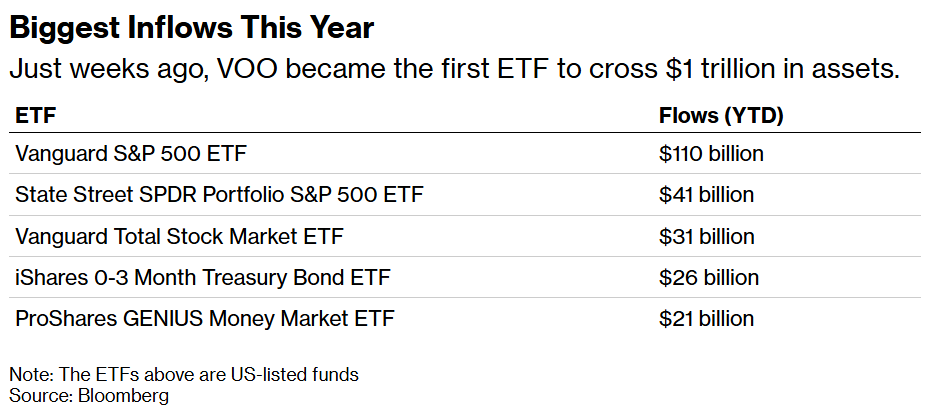
Equity-focused funds constitute the majority of the influx, garnering more than $660 billion year to date. Besides VOO — which just weeks ago became the first ETF to cross $1 trillion in assets — State Street’s SPYM, a cheaper version of its mega SPY fund, has accumulated roughly $41 billion in flows year to date, followed by Vanguard’s total-stock market vehicle (VTI), with $31 billion, according to data compiled by Bloomberg.
Most notably, allocations to US-centered equity ETFs have accelerated recently — even as the war with Iran dragged on, according to BI. It suggests that investors see “American markets as the primary destination for risk capital,” said BI’s Athanasios Psarofagis.
Since last week, however, there have been some outflows from US ETFs, bringing the year-to-date influx to $987 billion. Still, it’s notable that the cohort has brought in this haul, with six months left to the year.
The ETF industry isn’t set to break just one record: it’s also on track to see a record number of new funds. More than 600 products have started trading this year, the fastest pace ever, according to BI.
In this mix, one of the most eye-catching flow-gatherers has been a fund by Roundhill that offers exposure to global memory-chip companies and trades under the ticker DRAM. It became the fastest-growing fund, when measured by flows, gathering more than $15 billion since its April launch. Its success has also spawned a number of copy-cat products.
“I don’t want to say it’s a mania, but it’s the continued momentum of ETFs being a preferred vehicle and an extension of how they’re used to capitalize on areas of the market that maybe weren’t as accessible,” said Christian Magoon, founder and CEO of Amplify ETFs.
Written by: Chloe Cresswell — With assistance from Isabelle Lee @Bloomberg
The post “War, Inflation Can’t Stop ETFs’ Trillion-Dollar Inflow Boom” first appeared on Bloomberg