
The debate over artificial intelligence is keeping IPOs stuck on the launchpad, and with the shadow of Anthropic PBC’s market debut looming larger by the day, billions of dollars of capital and months of preparations are hanging in the balance.
“People are truly paralyzed,” said West Riggs, head of equity capital markets at Truist Financial Corp. “The market has to sort itself out.”
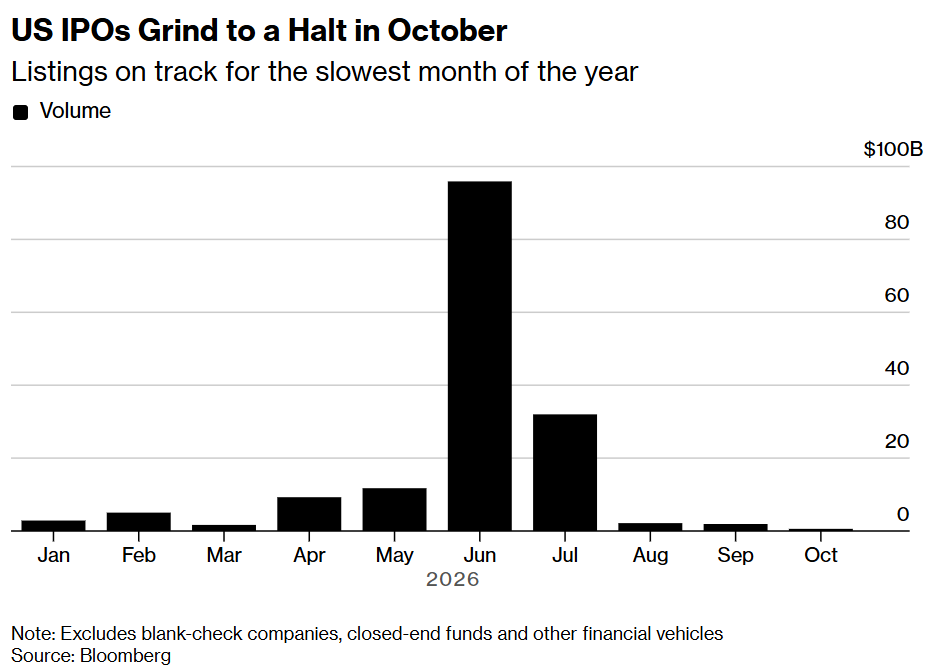
AI infrastructure companies teeing up US listings including London-based Nscale Ltd. and Singapore’s DayOne Data Centers Ltd. continue to pitch investors on their central importance to the sector’s buildout, yet with shares of peers such as CoreWeave Inc. plunging, investors’ appetite for risk-taking has evaporated. That puts October on track for the slowest month of the year by US IPO volume, data compiled by Bloomberg show.
It’s a marked turn away from a roaring pace that saw $162.6 billion raised through the end of September, the data show.
Wall Street is pinning its hopes for a record fee year on Anthropic’s anticipated debut next month, which could raise as much or more than SpaceX’s listing, people familiar with the matter have said. Companies gauging investors’ willingness to back their IPOs are similarly clamoring for the firm behind Claude to deliver a needed win that would clear the decks.
Still, Riggs isn’t alone on Wall Street among those who, outside of Anthropic, are starting to shift their focus to next year.
“It doesn’t feel too encouraging for the rest of 2026,” Riggs said in an interview. “There’s a lot of optimism for 2027, particularly in software, but overall things feel pretty sluggish from an IPO perspective. Even a couple of the non-AI-related things we’re working on seem to be pushed.”
Companies like Nvidia Corp.-backed data center developer Nscale and Switch Inc. are workshopping their IPO pitches, as roughly a dozen companies have yet to advance their IPO plans despite publicly filing documents with US regulators. Signs of market strain emerged when smart-ring maker Oura Inc. and Bamboo Insurance Services Inc. were forced to postpone debuts, as interest rates climbed higher and the Iran war dragged on.
Oura’s offering was beset by concerns including the company’s target market capitalization with several prospective investors pushing back on a potential fully diluted valuation of about $15 billion, Bloomberg News reported last month.
Valuation Gap Returns
A discrepancy in expectations between what management teams and their companies expect to seek in an IPO and potential investors can hold up the process, and even stall deals for years. The return of the so-called valuation gap after a promising first half of 2026 may reflect differing outlooks on where funding costs are likely to go, and whether challenges to the broader sector may be quickly resolved.
For Will Braeutigam, US capital markets transactions leader at Deloitte & Touche, that bid-ask spread has “blown out.”
“There is a stalemate on valuation, and rationalizing that gap is what needs to happen before the broader market can move forward,” he said.
With just $587.7 million raised through US IPOs since the end of September, excluding blank-check firms and other financial vehicles, the fourth quarter is shaping up to be a dud for every company but Anthropic. Given the upcoming US midterm elections and the rapidly approaching holiday slowdown, the IPO market risks being effectively stalled for months.
Braeutigam anticipates that six or fewer companies will raise $500 million or more on US exchanges through the end of the year.
“Most of our clients are focused on Q2,” Braeutigam said.
Written by: Bailey Lipschultz @Bloomberg
The post “‘Paralyzed’ US IPO Market Asks If There’s Life After Anthropic” first appeared on Bloomberg