
It took around 24 hours for Wall Street’s response to the US midterm elections to turn negative. Once it did, it set in motion a chain reaction of selling that moved considerably faster.
The blue wave that swept Congress was initially met with a solid gain in American stocks, with the event risk tied to the vote out of the way and oil prices in retreat, and on expectations the Trump administration would now be reined in. But by Thursday morning, investors were reassessing the wider implications, and the Democrats’ deep skepticism of the data-center expansion on which the artificial intelligence revolution depends.
“It’s a dangerous time,” said Sinisa Sorgic, a 20-year trading veteran and manager at proprietary firm Bright Trading. “I’m nervous. I want to be able to sleep at night.”
What began with selling by retail investors was accelerated by hedge funds and long-only managers, before quantitative firms that ride market volatility compounded the losses. The final result was the tech-heavy Nasdaq 100 Index’s worst drop since March 2020 — and $3.7 trillion of US market value wiped out in a day.
As the market looks set to end the week in more stable fashion with the Nasdaq 100 regaining some of the ground it lost, this is how the initial selloff unfolded.
Retail Moved First
The first half hour of Thursday trading belonged to retail.
After the mid-week rally and with policy uncertainty looming, those investors decided to cash-in gains, creating what Mohit Kumar, strategist at Jefferies LLC in London, said was the largest wave of retail selling since the Covid crash.
“I began working at 7,” said Raphael Monges, a graduate student in engineering at Columbia University and a member of the Columbia Options & Futures Trading Club . “I saw the opening of the market and the Nasdaq going down so fast, then S&P. But the Nasdaq was crazy with all the AI pushing the Nasdaq down. My phone began buzzing. Everyone was looking at the stocks, and everything was red.”
The data bears that out: The net selling of single stocks by retail investors on Thursday ranks behind only two days, both in March 2020 as the Covid pandemic was hitting, according to the analytics firm Vanda Research. JPMorgan Market Intelligence said the group’s selling was more than three standard deviations from the norm.
“The portfolio took a solid hit as yesterday was a sea of red,” said Joel Rieger, a 50-year-old retail trader in California who didn’t made any changes to his portfolio during the post-midterm trading. “This is going to hurt in the near term.”
As so often happens on Wall Street, selling begets selling, and the early downward move accelerated as hedge funds added to the pressure before long-only asset managers did the same. Volumes from that cohort were unusually large as managers began to lock in gains from what has overall been a strong year in equities, Kumar said.
The problem was no major buyers emerged on the other side.
“Institutional investors have stepped back just as retail and systematic are selling aggressively,” Viraj Patel, Vanda’s global macro strategist, wrote in a note. “These are the kind of flow dynamics we rarely see outside periods of genuine market stress.”
At JPMorgan Chase & Co., Ron Adler, global co-head of equity high touch trading, watched it all unfold from the cash desk, where trading volumes were up 50%.
“Part of what we’re seeing is portfolio pain and indiscriminate selling,” he wrote in a note to clients. “The candor of the flows today seems directionally rational. It’s the magnitude that’s raising eyebrows.”
Automatic Offloads
Once the direction of a stock move is set, and if it is large enough, a host of mechanical transactions come into play that can amplify losses.
For instance, options dealers have to continually adjust their exposure based on how the market moves. Sometimes they find themselves selling stocks when they’re falling and buying when they’re rising, a situation dubbed negative gamma. Midway through Thursday’s session, dealer negative gamma was at about $7 billion for every 1% move, according to estimates from Charlie McElligott, managing director of cross-asset strategy at Nomura Securities International Inc.
In other words, for each 1% decline in equities, they would add an additional $7 billion in selling pressure.
McElligott also estimated that volatility-control funds, which buy and sell depending on how much the market swings, needed to offload about $61 billion of stocks based on moves at the time, with $25 billion of selling from Wednesday still being executed. End-of-day adjustments by leveraged exchange-traded funds would mean another $47 billion of stocks on sale, he estimated.
“Conversations with clients are telling-me that they’re feeling further incentivized to take risk down at this point,” McElligott wrote to clients. He said the theme of feedback was “preservation of residual shreds of remaining YTD performance and staying-alive into next yr’s fresh capital and risk.”
As major indexes dropped below key levels, there was further systematic selling. Trend-following quants called commodity trading advisers, or CTAs, sold about $13 billion across S&P 500 and Nasdaq futures, according to Vanda estimates, taking their exposure near the lowest in its data.
All told, there was little chance of an afternoon rebound. The S&P 500 closed near its lows of the day, posting its biggest loss since April last year.
Some hedge funds appear to have seen a big move coming. Short positioning — where the firms wager on declines, rather than gains — were near a five-year high in late October. Net leverage, a measure of how much funds have borrowed to amplify their bets, was at a three-year low.
Even so, Goldman Sachs’s Prime desk estimates fundamental long/short funds lost 1.3% on Thursday, a two-standard-deviation event, with technology-focused funds down more than 4% and now roughly flat for the year. Momentum — an investing style that chases winners and dumps losers — suffered a 3.7 standard deviation loss.
Standing Start
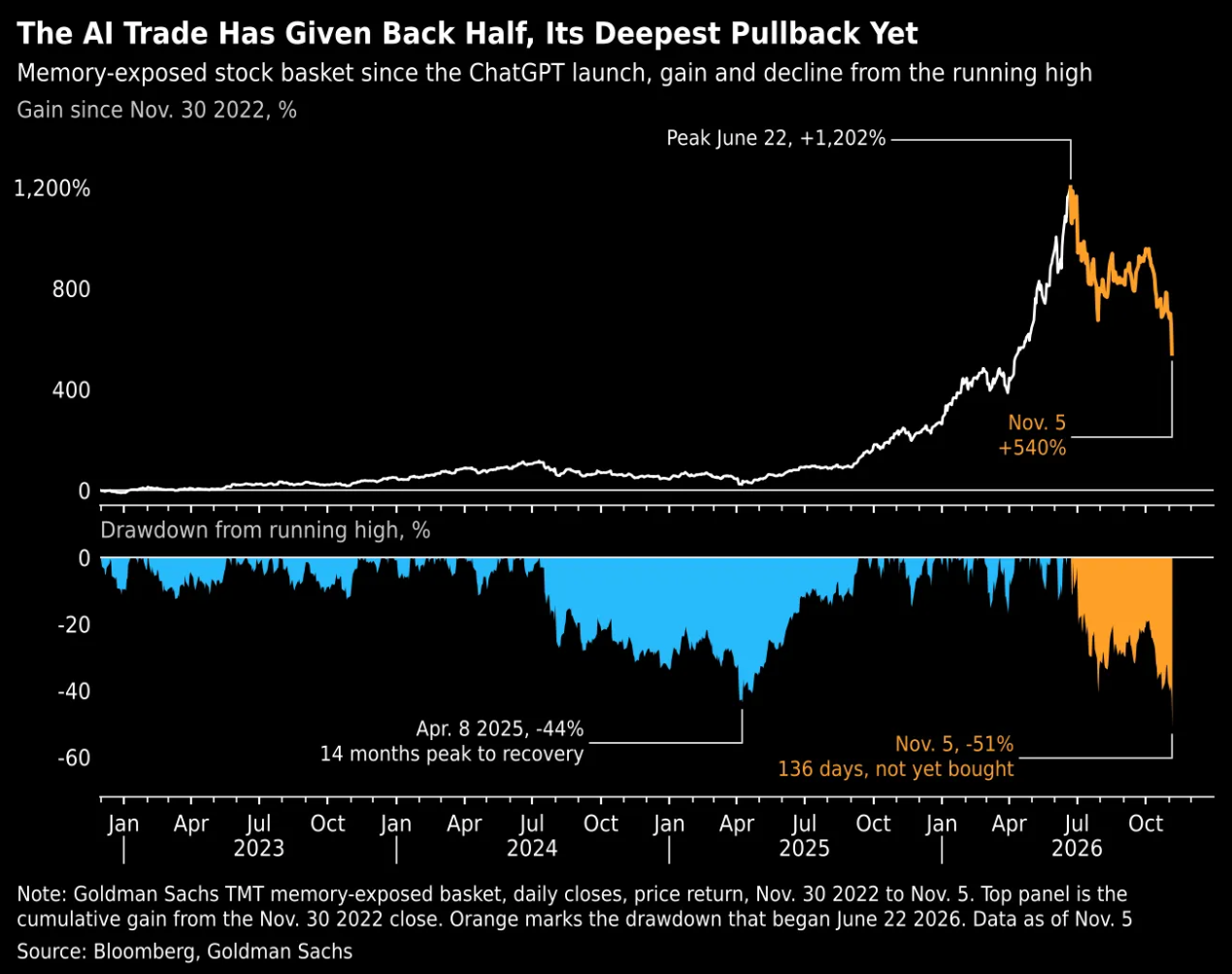
Thursday’s damage across equities was narrow and deep. Memory, optical networking, data-center and AI-semiconductor baskets fell 12% to 15%, five to six standard deviation moves. The S&P 500 without its AI names lost 2.3%.
For about a dozen baskets of AI stocks it was the worst day since the launch of OpenAI’s ChatGPT in November 2022. The hardest-hit baskets, memory and optical networking, have roughly halved from their June peaks, deeper than any pullback they completed in four years. The memory basket’s decline is the first of nine since 2022 not to be bought, 136 days in.
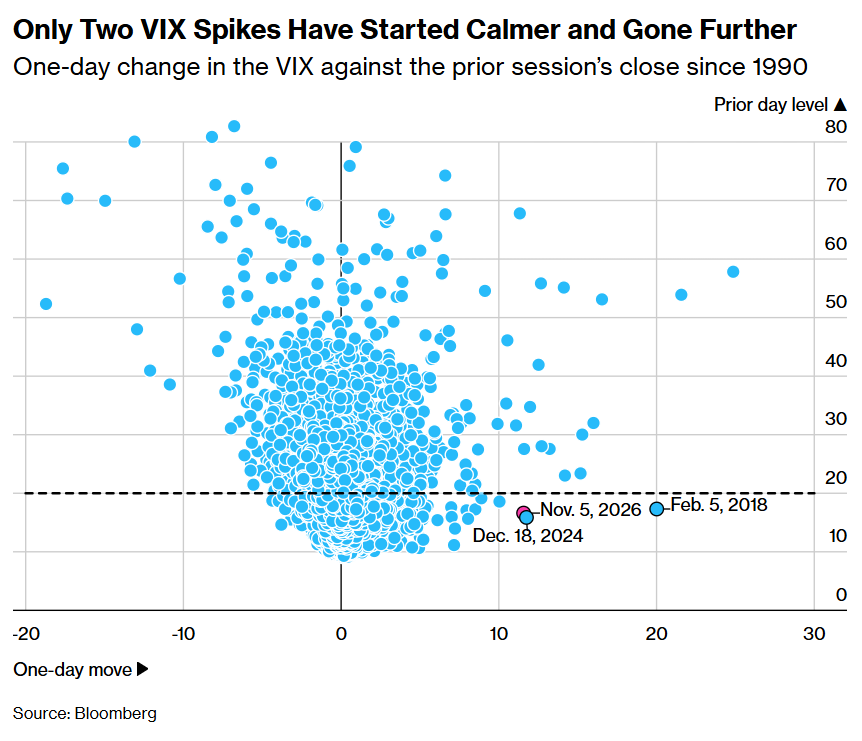
All this seemed more dramatic because it emerged from a standing start. The Cboe VIX Index, a measure of expected equity volatility often dubbed Wall Street’s fear gauge, was at 16.6 points at the start of trading Thursday, below its one-year average. By the close it was near to 28 points.
Since 1980, the S&P 500 has fallen 2% or more the day after gaining 1.5% only 48 times, almost all inside bear markets or crises. Only four came this close to a record; two recovered within 50 sessions, and two came in 1987.
The recovery was starting to show up already on Friday, with chip stocks leading the S&P 500 higher and the Nasdaq 100 climbing as much as 2.6%. Whether those gains will stick, however, remains an open question.
“Yesterday was a bloodbath, said Bright Trading’s Sorgic, who was shorting Taiwan Semiconductor Manufacturing Co. on Thursday but got burned after its US-listed shares rebounded as much as 7.8% on Friday. “It’s too wild to jump back in full force and buy the dip right now.”
Written by: Jan-Patrick Barnert — With assistance from Jess Menton, Zijia Song, Ian Salisbury, and Matthew Griffin @Bloomberg
The post “Anatomy of a Selloff: Sudden Chain Reaction Rattles Wall Street” first appeared on Bloomberg