
Months of unease over Wall Street’s artificial-intelligence boom erupted into a global market convulsion this week, opening a dangerous new chapter for the investment frenzy that has helped power stock prices, corporate spending and economic growth.
The worries have been on display all year: stretched valuations, mounting debt and doubts about the payoff from trillions of dollars in AI spending. But the Democratic sweep of Congress has added a new political threat, raising the prospect of restrictions on the vast data-center buildout underpinning the boom.
The response has been extraordinary even by the standards of a volatile year. Wednesday brought a sharp – and unexpected — rally in US stocks. Thursday saw a $2.3 trillion wipeout in the Nasdaq 100. At the close, 57% of its constituents had fallen at least 20% from their highs, a greater proportion than when the index itself entered a bear market in March 2022. By Friday, chipmakers had rebounded even as strong jobs data reinforced bets on another Federal Reserve interest-rate increase.
The reversals offer a glimpse of how disorderly the next phase of the AI cycle could become — with little help from the usual rescuers. The Fed remains focused on inflation, with traders betting on another interest-rate increase in December. Weakened by the midterm election, President Donald Trump faces new constraints on fiscal support and may have less incentive to shore up a stock market whose recent losses he has already blamed on the Democrats.
“There are going to be losers, and not everybody who’s investing all of this money in capex is going to be a winner,” said Joe Gubler, a portfolio manager at Causeway Capital Management, which oversees about $76 billion.
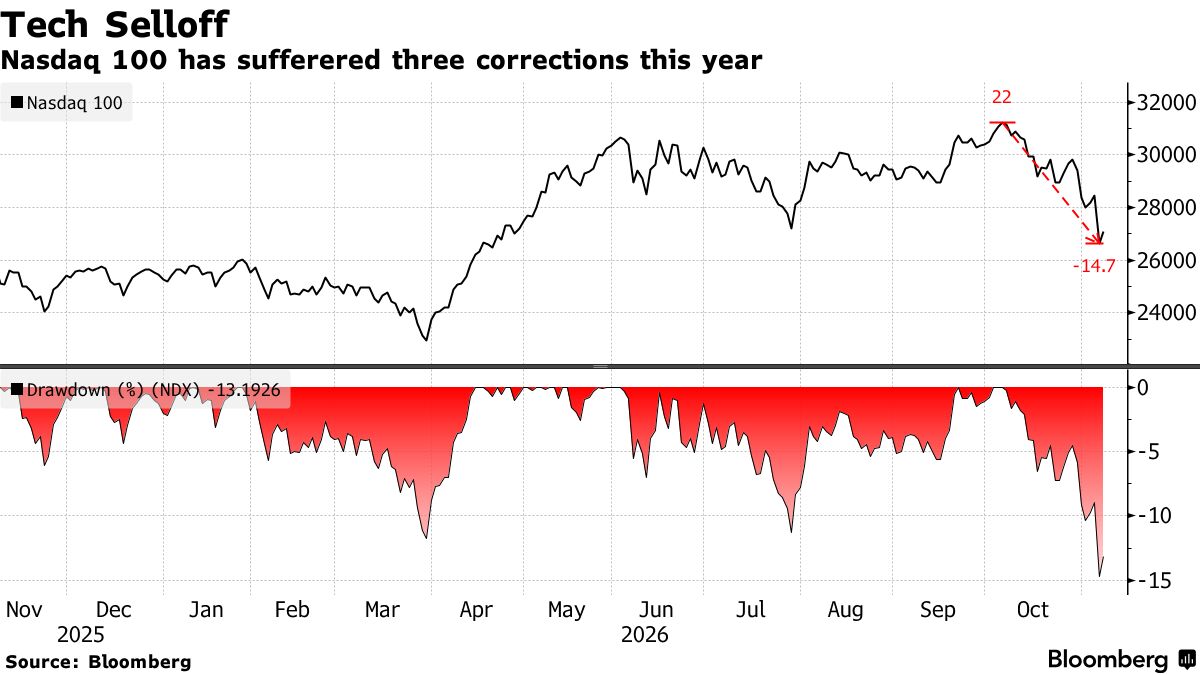
Even retail traders, normally eager to buy market dips, joined the selling at a pace rarely seen since the pandemic. Wall Street’s investment machinery made matters worse. Hedge funds, leveraged investors and automated strategies added to the pressure, making it harder to tell how much of the rout reflected genuine doubts about AI and how much was driven by forced selling.
By Thursday’s close, the US stock market had lost $5.7 trillion in value since its Oct. 6 peak, according to an index tracking total equity market capitalization.
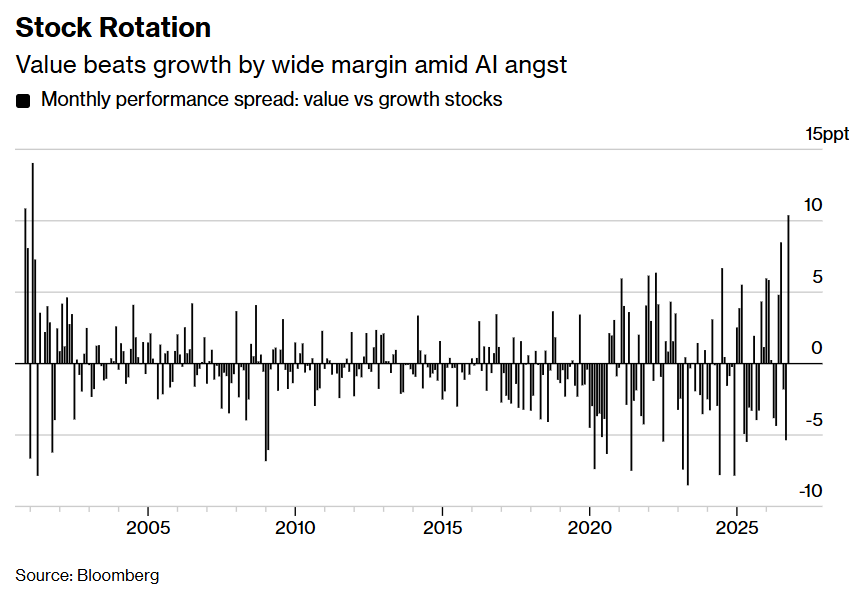
Finding new market leaders is another challenge. Investors had begun rotating toward cheaper, less glamorous sectors like utilities and consumer staples well before the election. But Thursday’s rout exposed the limits of that escape, with the new favorites failing to withstand the collapse in Big Tech.
There is a powerful counterweight: Oil prices have plunged on hopes that the Iran war will wind down. That offers relief from inflationary pressures that have squeezed consumers and businesses throughout Trump’s tariff-heavy presidency, though those benefits would take time to emerge.
The rotation was already gathering force before the election. Growth stocks trailed value shares by 10 percentage points in October, their biggest monthly gap since 2001, just a month after their strongest showing in more than a year.
The whiplash is a cross-asset story. Equities swung from outperforming Treasuries by five percentage points to their worst relative showing since early 2025 over the last two months. A popular momentum strategy also surrendered almost all its September gains in October.
Andrew Lapthorne, Societe Generale’s head of quantitative research, traces much of the turmoil to crowded positions built around AI and oil. As those trades reversed, investors were forced to sell technology shares they had favored and buy back defensive stocks they had bet against, driving even sharper swings.
“You’ve got a mixed combination of people being heavily positioned in one set of assets, and then having to rapidly cover if you’re long-short,” he said. “It could be people with risk budgets where it only takes a few things to then start having some kind of margin call unwind.”
Morgan Stanley data show hedge funds have reduced gross leverage from its June peak by the most in more than a decade. Its quantitative strategists reckon the liquidation may be nearing exhaustion, though they anticipate another market low following a brief rebound.
Lapthorne sees little evidence that the selling reflects a sudden turn toward economic pessimism. And not every investor has been caught out.
Jeff Muhlenkamp exited almost all his fund’s AI holdings before the rout. His $275 million portfolio was roughly flat for November and ahead of the S&P 500 for the year.
“We sold what was expensive and popular, and bought what was cheap and forgotten,” he said. “When momentum changes, we benefit.”
The economy may be holding up, and the forced selling may soon end. But investors want proof their AI investments will pay off — just as the shift in Washington throws up obstacles to building the infrastructure needed to make them work.
“The aggressive speed of the AI spend, you have to assume that will be at a more deliberate pace,” said Rick Rieder, CIO of global fixed income at BlackRock Inc. on Bloomberg Television. “That changed this week and you have to factor that into your calculus.”
Written by: Justina Lee and Lu Wang — With assistance from Vildana Hajric, Dani Burger, and Isabelle Lee @Bloomberg
The post “Wall Street Grapples With $5.7 Trillion Rout as AI Bets Unwind” first appeared on Bloomberg