
The way this AI-driven rout is spreading across stocks reveals some worrying similarities to market patterns leading up to the dotcom crash.
Back in 2000, the tech-heavy Nasdaq Composite Index peaked on March 10. It then fell more than a third by mid-April, before rebounding 35% by mid-June as investors bought the dip and rotated into shares of profitable big tech firms, an analysis by London-based economic research firm TS Lombard showed.
Six months into the tech benchmark’s correction, the S&P 500 was still trading at an all-time high.
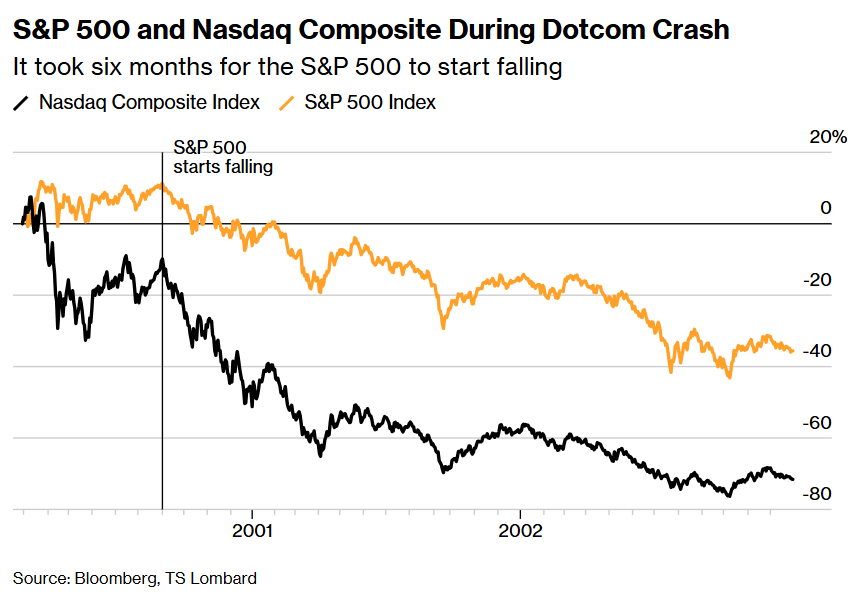
Then, the damage started to worsen. Tighter funding for weaker tech businesses, widening credit spreads and falling earnings estimates began to weigh on the profitable companies that counted this segment as customers.
The Nasdaq fell more than 40% in three months back then. Healthy looking order books had masked the turn that was coming.
“Bottlenecks are not a reason to be bullish – they can precede a sizeable glut,” according to Dario Perkins, a macro strategist at TS Lombard.
Something similar appears to be happening.
For weeks, the selloff has been concentrated in tech. The Nasdaq has corrected after sliding from an early October record high amid concerns about overspending in AI and after a Democratic sweep of Congress. The S&P 500 initially fared better and outperformed, but now, the pain is visible more widely. The S&P 500 is set for its worst week since April 2025.
“There are some troubling parallels with the summer of 2000, right before the crash,” Perkins said.
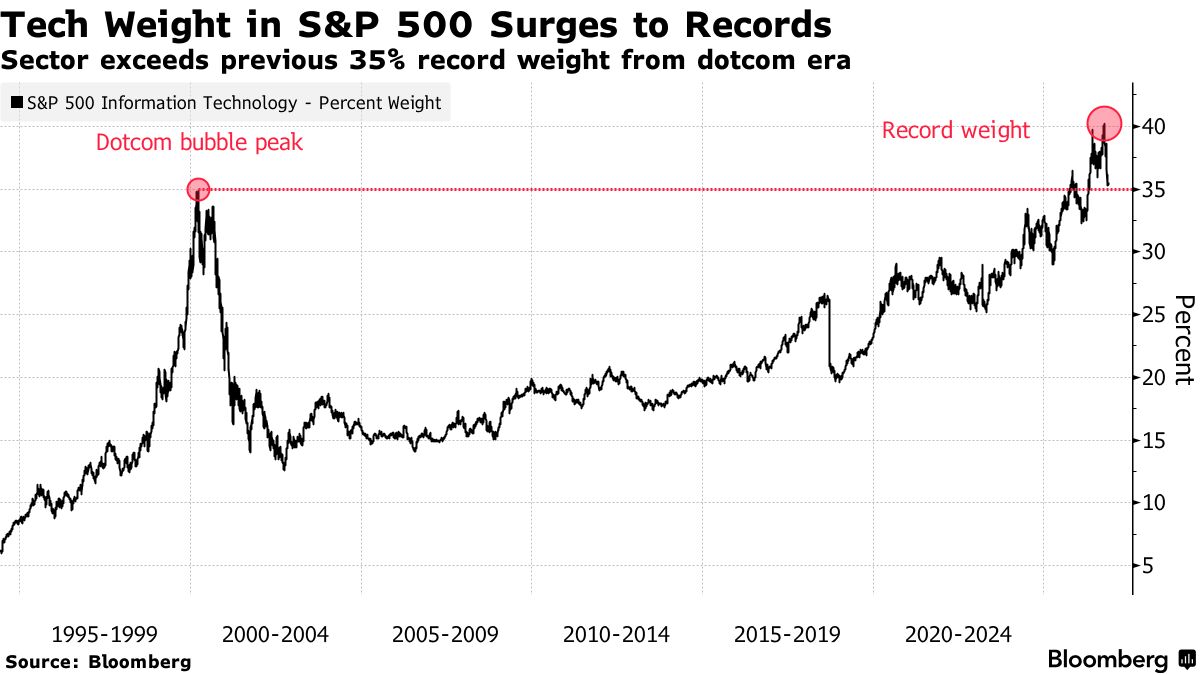
The risks tech poses to the broader market in 2026 are amplified by the sector’s increased presence in key indexes. The information technology weighting in the S&P 500 exceeded 40% of the benchmark last month, compared with a peak of 35% in 2000.
And that doesn’t even account for megacaps like Meta Platforms Inc. and Alphabet Inc., classified as members of the communication services sector. Adjusting for the broader technology cohort, the weighting culminated at more than 46% last month.
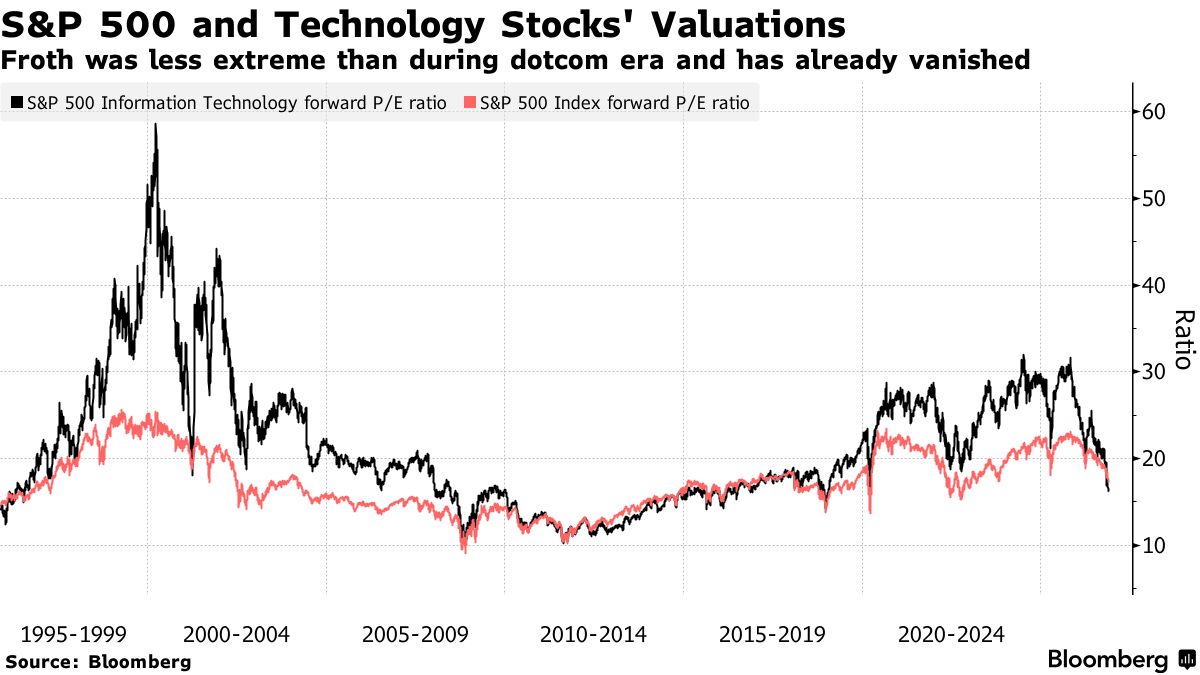
One contrast between today and 26 years ago lies in valuations. Many internet companies in 2000 had no profits at all, while investors were also paying extraordinary multiples for those that did. The information-technology sector traded at about 60 times 12-month forward earnings near the peak.
Now, most leading tech companies are producing stellar earnings, and so the premiums in their share prices are less extreme. The froth that built up in tech valuations during the dotcom boom took years to disappear. This time around, it looks to have been wiped out already.
Investors are grappling with sharp moves and deep losses this week, but there are solid reasons to believe the AI boom still has further to run. The hyperscalers are yet to downgrade their strong capex plans and compute demand remains impressive. Earnings growth is strong and the economy is in good shape.
An important point to keep in mind, for Perkins and his colleagues at TS Lombard, is how this pattern has played out in the past: a market correction followed by a prompt rebound ahead of the ultimate crash.
The firm’s own arguments for why AI’s expansion can keep going are “eerily similar” to those made as the dotcom bubble burst in 2000. “At a minimum, that calls for some humility,” Perkins said.
Written by: Ruhell Amin and Michael Msika @Bloomberg
The post “Stock Rout’s Spread Beyond Tech Carries Warning From Dotcom-Era” first appeared on Bloomberg