
South Korea reiterated its commitment to stabilize equity markets, but the measures failed to soothe investor sentiment, with the benchmark Kospi ending lower Monday following last week’s selloff.
“We have made clear the government’s commitment to stabilizing the market,” Finance Minister Lee Hyoung Il told reporters on Monday. “We expect this to help improve investor sentiment.”
Authorities announced plans Sunday to prepare a stock-market stabilization fund for potential deployment, alongside measures to ease restrictions on corporate share buybacks and intensify surveillance of illegal short selling. Lee said any decision to activate the fund would depend on market conditions.
Lee’s remarks Monday offered little additional clarity beyond Sunday’s announcement, with no indication of when the fund might be activated or how much money could be mobilized. That partly weighed on the market, with the Kospi index falling as much as 5.8% on Monday, extending Friday’s 5.2% tumble.
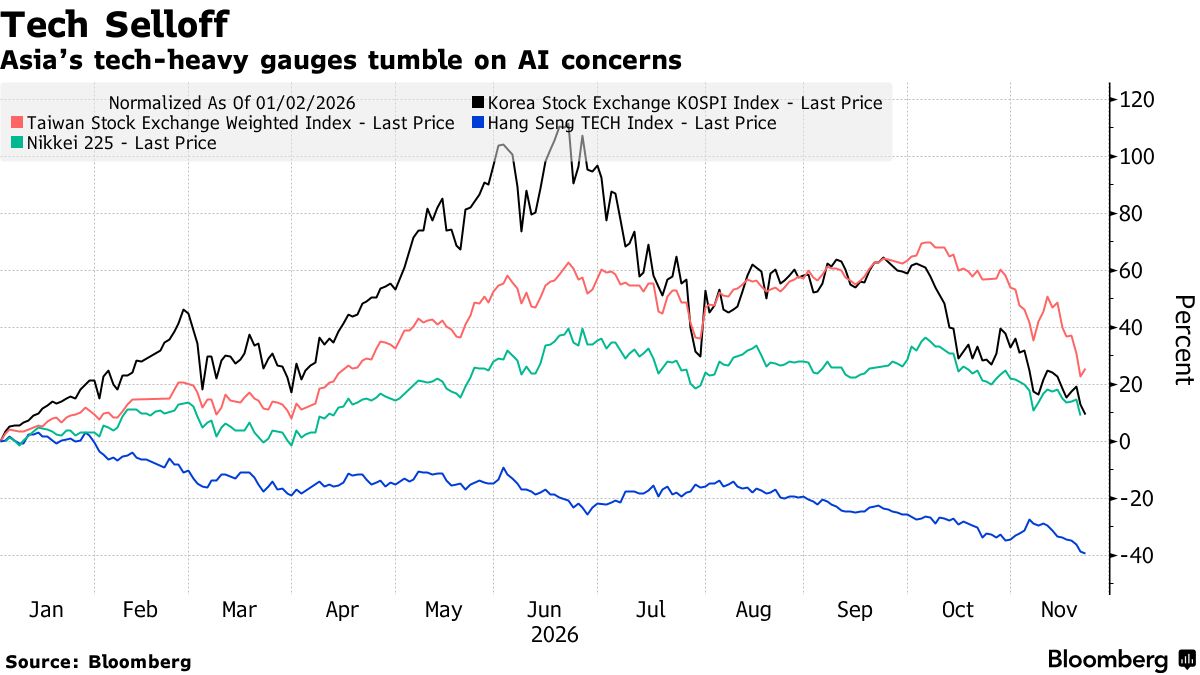
The caution contrasts with Taiwan, where a stabilization fund has already entered the market to buy shares and regulators have tightened restrictions on short selling. That helped Taiwan’s benchmark equity index to rise as much as 1.7% on Monday. China, meanwhile, has moved to lower margin requirements for stock purchases financed with borrowed money.
“After the announcement, investors appeared to conclude there was nothing substantial and resumed selling,” said Jeong-Woo Park, an economist at Nomura Holdings Inc. “Under the government risk management framework, it’s difficult for the government to step in because the stock-market retreat isn’t being driven by fundamentals or a liquidity crunch in financial markets.”
The Kospi closed down 2.3% Monday, its weakest level since January.
The South Korean stabilization fund, financed by banks and other financial institutions, was last deployed during the 2008 global financial crisis. Authorities have previously announced plans to revive the mechanism during bouts of market turmoil, including a roughly 10.76 trillion won ($7.2 billion) fund in 2020 as the Covid pandemic roiled markets.
The history highlights the distinction between preparing the fund and actually deploying capital. Previous announcements have signaled the government’s willingness to support markets without necessarily resulting in purchases of shares.
Seoul’s Finance Minister Lee added that South Korea already enforces short-selling rules similar to the tighter curbs introduced in Taiwan.
“Rather than further easing regulations, we plan to focus more on cracking down on illegal short selling and strengthening surveillance of unfair trading practices by operating a special monitoring unit for about three months,” he said.
South Korean and Taiwan stocks were among the biggest beneficiaries of the AI-driven chip boom. Last week’s global selloff was triggered by investor concern over the sustainability of massive artificial intelligence infrastructure spending and the outlook for semiconductor demand.
Chip Outlook
But Lee sought to reassure investors about the outlook for the chip sector, saying AI-driven investment in data centers was likely to keep expanding despite concerns over financing and regulatory risks. South Korea’s two major chipmakers have already secured substantial orders through long-term supply contracts, while their inventories continue to decline rapidly, he said.
The latest data showed Korea’s exports continued to power ahead in early November, with annual shipments topping $1 trillion for the first time as the global AI boom continued to stoke demand for chips.
The minister also said economic growth in the high-3% range was increasingly likely this year and that a 4% expansion was mathematically possible. The outlook underscores how heavily South Korea’s economy now relies on the same AI boom unsettling global markets.
Lee acknowledged that South Korea’s heavy reliance on semiconductors could amplify external shocks and widen disparities among industries. The government plans to prioritize reducing economic polarization and supporting employment, particularly among younger workers, as it prepares its economic policy agenda for next year.
Citigroup Inc. economist Jin-Wook Kim said the potential reactivation of South Korea’s roughly 10 trillion won stabilization fund could help calm volatility through its signaling effect.
He also estimated that the National Pension Service would have room to buy 17 trillion won of domestic equities if the Kospi drops to 4,500 — assuming the fund maintains its year-end local equity allocation target.
Written by: Heesu Lee — With assistance from Jaehyun Eom, Shinhye Kang, and Seyoon Kim @Bloomberg
The post “S. Korea’s Market Measures Fall Short of Stemming Stock Selloff” first appeared on Bloomberg